

Commentary
Dmitri Trenin
{
  "authors": [
    "Dmitri Trenin"
  ],
  "type": "commentary",
  "centerAffiliationAll": "",
  "centers": [
    "Carnegie Endowment for International Peace",
    "Carnegie Russia Eurasia Center"
  ],
  "collections": [],
  "englishNewsletterAll": "",
  "nonEnglishNewsletterAll": "",
  "primaryCenter": "Carnegie Russia Eurasia Center",
  "programAffiliation": "",
  "programs": [],
  "projects": [
    "Eurasia in Transition"
  ],
  "regions": [
    "North America",
    "United States",
    "South Asia",
    "Afghanistan",
    "Central Asia",
    "Russia"
  ],
  "topics": [
    "Security",
    "Foreign Policy"
  ]
}
Source: Getty
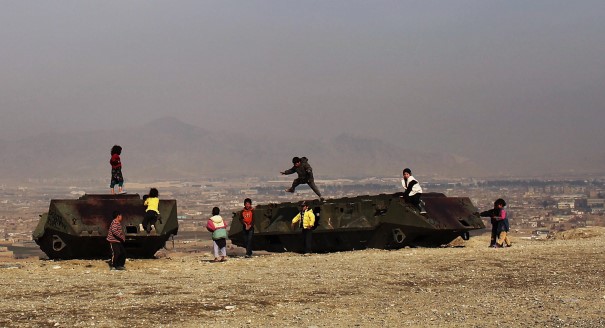
In the run-up to 2014, when the U.S./NATO combat forces due to leave Afghanistan, fears multiply that a major extremist threat is rising again for the neighborhood and beyond. Russia is right to focus on the southern flank as far as its most pressing security needs are concerned.
Twelve years ago this month, the United States, joined by Britain and supported by Russia, with overwhelming support from the entire international community, hit hard Al Qaeda in Afghanistan and dislodged the Taliban regime in Kabul. The U.S. intervention in Afghanistan saved Russia, Alexei Arbatov said last week. In the mid- and late 1990s, many in Russia feared the Taliban would push north, across Central Asia and all the way to the Volga. These fears were most probably exaggerated. The Taliban was then, and has remained, an essentially Afghan phenomenon. However, it harbored not only Al Qaeda, but a number of other extremists: Chechens, Uzbeks, Tajiks, and others. In 1999 and again in 2000, Afghanistan was the base for extremist groups' raids deep into Kyrgyzstan and Uzbekistan, which the local government forces were hard put to defend against.
In 2001, the United States for the first time established military presence in Central Asia. Many in the Russian politico-military leadership expressed concern. Not President Putin, who was then thinking in terms of a genuine anti-terrorist coalition. Twelve year later, the United States is finally heading back. With the U.S./NATO combat forces due to leave Afghanistan in 2014, Kyrgyzstan decided to terminate the U.S. lease of the Manas air base. Last week, the U.S. military began to redeploy from Manas to a Romanian air base near Constanta. Russia is about to claim another notable geopolitical achievement: soon, it will again be the only outside power with military forces in Central Asia.
Americans, however, seem to create problems for others both when they insert themselves into a region, and when they extricate themselves from it. In the run-up to 2014, when Kabul, rather than the U.S. and its allies, will be fully responsible for security in Afghanistan, fears multiply that a major extremist threat is rising again for the neighborhood and beyond, including Central Asia and even parts of Russia. These fears are largely misplaced. True, "Post-American" Afghanistan will hardly be at peace with itself, and its neighbors will feel it. However, it will be the neighbors—Pakistan and India, in the first place—who will probably vie for influence in Afghanistan, not the Afghans who will seek to subvert neighboring governments. Central Asia may be beset by a number of problems as it looks to political transition in its two biggest countries, Uzbekistan and Kazakhstan, but Afghanistan is not the source of most of them.
Russia is right to focus on the southern flank as far as its most pressing security needs are concerned. It is also right not to panic as U.S. forces leave Afghanistan. It needs to develop an adequate understanding of current Afghan realities, including the importance of the Pushtun factor and the nature and role of the Taliban. It needs to cooperate with Afghanistan's neighbors, but stay away from their competition. It absolutely needs to avoid any military involvement of its own in Afghanistan, and engage economically only when this makes sense in economic terms. It must focus squarely on drugs trafficking into Russia and on drugs production, but carry out this anti-drugs offensive from Russia's border south, gradually drug-cleansing Central Asia and building a drugs firewall, moving it farther and farther away from the Russian territory. America's imminent departure makes a strong case for Russia's leadership on anti-drugs measures in Central Asia.
Former Director, Carnegie Moscow Center
Trenin was director of the Carnegie Moscow Center from 2008 to early 2022.
Recent Work
Dmitri Trenin
Dmitri Trenin
Carnegie India does not take institutional positions on public policy issues; the views represented herein are those of the author(s) and do not necessarily reflect the views of Carnegie, its staff, or its trustees.

This piece argues that the present Indian strategy, based on opportunistic diversification and utilization of limited strategic reserves, remains inadequate when confronting supply disruptions. It evaluates India’s options in the short, medium, and long terms.

Vrinda Sahai

India and the United States are close to concluding a Reciprocal Defense Procurement Agreement (RDPA) that will allow firms from the two countries to sell to each other’s defense establishments more easily. While this may not remedy the specific grievances both sides may have regarding larger bilateral issues, an RDPA could restore some momentum, following the trade deal announcement.

Konark Bhandari

On the last day of the India AI Impact Summit, India signed Pax Silica, a U.S.-led declaration seemingly focused on semiconductors. While India’s accession to the same was not entirely unforeseen, becoming a signatory nation this quickly was not on the cards either.
Konark Bhandari

This piece examines India’s response to U.S. sanctions and tariffs, specifically assessing the immediate market consequences, such as alterations in import costs, and the broader strategic implications for India’s energy security and foreign policy orientation.
Vrinda Sahai
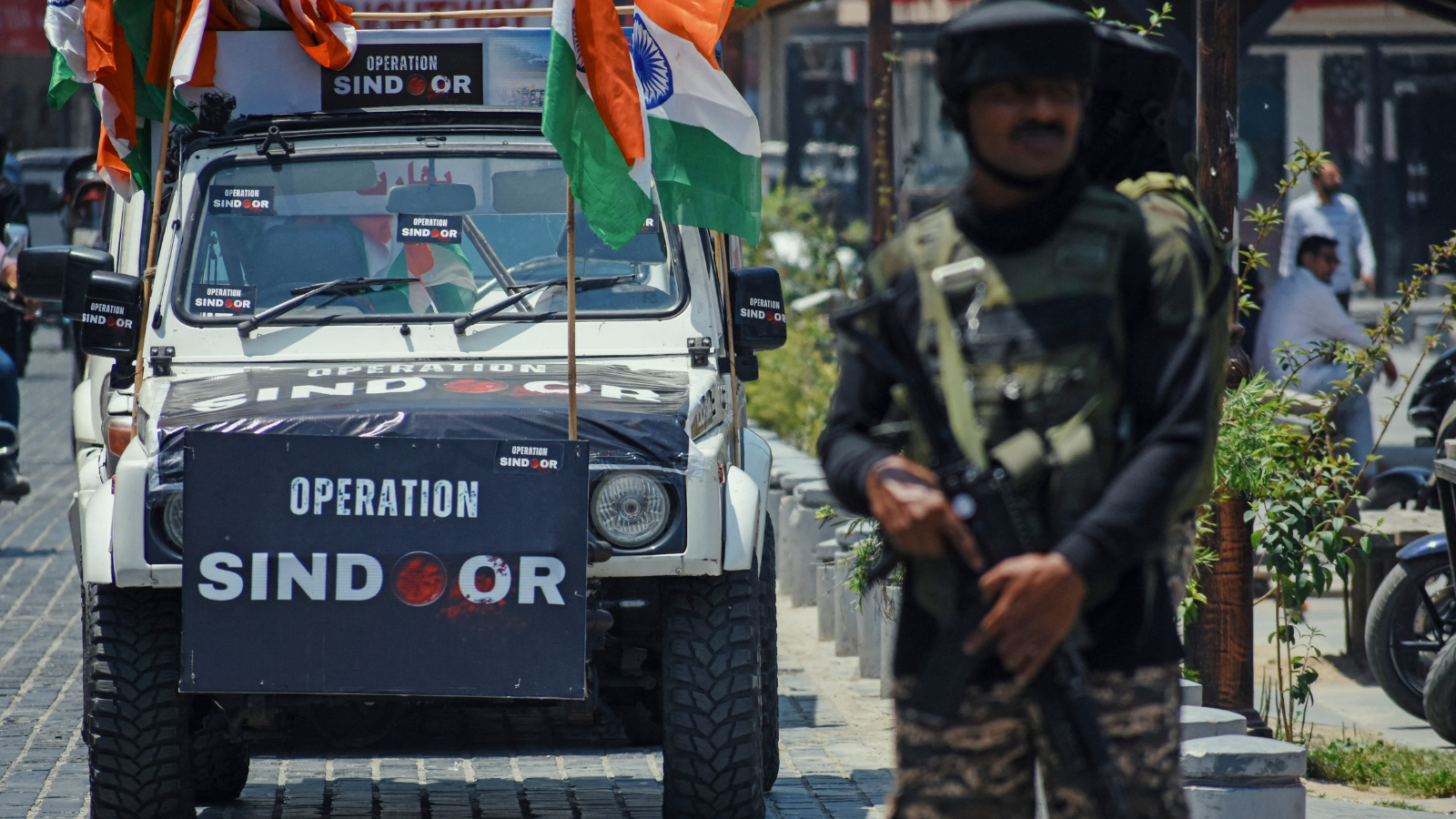
The India-Pakistan conflict that played out between May 6 and May 10, 2025, offers several military lessons. This article presents key takeaways from Operation Sindoor and breaks down how India’s preparations shaped the outcome and what more is needed to strengthen future readiness.

Dinakar Peri