

Research
- +10
Rosa Balfour, Frances Z. Brown, Yasmine Farouk, …
{
  "authors": [
    "Moisés Naím"
  ],
  "type": "legacyinthemedia",
  "centerAffiliationAll": "",
  "centers": [
    "Carnegie Endowment for International Peace"
  ],
  "collections": [],
  "englishNewsletterAll": "",
  "nonEnglishNewsletterAll": "",
  "primaryCenter": "Carnegie Endowment for International Peace",
  "programAffiliation": "",
  "programs": [],
  "projects": [],
  "regions": [
    "North America",
    "United States",
    "Western Europe",
    "France",
    "Germany"
  ],
  "topics": [
    "Political Reform",
    "Security",
    "Foreign Policy"
  ]
}
Source: Getty
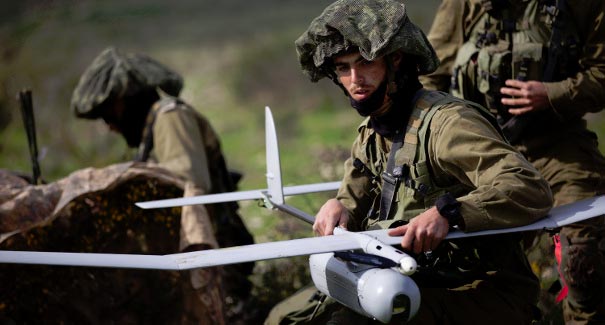
The two most disruptive military technologies widely used in the 21st century are improvised explosive devices, and drones. A combination of these two technologies could have improvised explosives falling from the sky onto densely populated cities.
Source: Atlantic
Recently Angela Merkel has found herself in two complex situations. The first, as we all know, has stirred a bitter global debate about American spying. The second, though largely ignored, deserves at least as much attention because it may have even larger implications for international security. It’s about a prank using a drone.
Let’s start with the first: The chancellor is furious with Barack Obama. She called to berate him for U.S. snooping. “We need to have trust in our allies, and this trust must now be established once again,” she said a few days later.
Merkel is not the only head of government who is upset at the U.S. Dilma Rousseff, her Brazilian counterpart, abruptly cancelled a state visit to Washington when it became public that the United States was spying on her. President Francois Hollande of France is also indignant, as is Italian Prime Minister Enrico Letta. Upon learning that the U.S. and U.K. intelligence services had been monitoring Italy’s telecommunication networks, Letta said, "It is inconceivable and unacceptable that there should be acts of espionage of this type."Really? Inconceivable and unacceptable? Unacceptable perhaps, but surely not inconceivable. It’s rather normal, in fact. Governments that have spy agencies use them. Is Barack Obama more at fault than his Russian, Chinese or, for that matter, French counterparts? What is the likelihood that any world leader and, increasingly, private organizations, with the technological means to tap into the telephone or email communications of other powerful players will refrain from doing so? Nil.
The difference now is that the knowledge that these practices are routine has become public. Before, governments could conveniently pretend that they did not know. Now as a result of the actions of WikiLeaks and Edward Snowden, obfuscation and hypocrisy have become harder and riskier to use in international relations. This is the thesis of “The End of Hypocrisy,” a fascinating article by Henry Farrell and Martha Finnemore in the current issue of Foreign Affairs.
All governments maintain public stances that they reject in private. Moreover, they’re all privy to dark secrets about their allies that would be embarrassing for them to publicly acknowledge. Were Merkel, Rousseff and all the other incensed leaders really shocked to learn that spies… well, spy? Of course not. They just can’t feign ignorance any longer.
The second complex situation in which the German chancellor was involved took place on September 15th, in Dresden. On this sunny Sunday, Chancellor Merkel was participating in an outdoor campaign rally. She was accompanied at the podium by other dignitaries, including her Defense Minister, Thomas de Maizière. Everything was going smoothly until a perceptible buzz was followed by the appearance of a small remote-controlled drone. Coming from nowhere, this flying device was directed at the platform and crashed only a few feet from the chancellor and her colleagues. In the pictures and videos of the event, Angela Merkel’s bewildered smile is caught alongside the defense minister’s icy glare.
What happened? The Pirate Party immediately claimed responsibility. One of its leaders explained that “the goal of this effort was to make Chancellor Merkel and Defense Minister de Maizière realize what its like to be subjected to drone observation.” The remote operator of the flying device, a 23-year-old man who is a member of the Pirate Party, was quickly arrested in a hideout close by. He explained that he just wanted to take close-up pictures with the camera he had installed on the mini-drone.
The implications are as obvious as they are terrifying. What would have happened if that drone, instead of being equipped with a camera, was armed with an explosive device? Now that do-it-yourself kits for drones of all shapes, sizes, and prices are proliferating, how can we keep them from the hands of would-be assassins, the mentally ill or terrorists? And if they become popular as weapons, what’s to keep them from wreaking havoc in sporting arenas or public squares?
The two most disruptive military technologies widely used in the 21st century are improvised explosive devices (IED’s), and drones. Combine these two technologies, and we might see IEDs not bursting along dirt roads in remote countries, but falling from the sky onto densely populated cities.
Merkel and the other heads of government whose phones have been tapped are forced to make a big fuss about the violation of their private communications by their allies. That’s ok. But let’s hope that the chancellor and her colleagues will devote as much attention to the new threat that made its debut in Dresden last September as they are to denouncing American espionage.

Distinguished Fellow
Moisés Naím is a distinguished fellow at the Carnegie Endowment for International Peace, a best-selling author, and an internationally syndicated columnist.
Recent Work



Rosa Balfour, Frances Z. Brown, Yasmine Farouk, …
Moisés Naím
Carnegie India does not take institutional positions on public policy issues; the views represented herein are those of the author(s) and do not necessarily reflect the views of Carnegie, its staff, or its trustees.

In any defense establishment, change is an ongoing process. However, despite the best of intentions, existing bureaucracies, bound by habit and years of socialization, have their limits in implementing transformative change.

Anit Mukherjee

How is AI reshaping space security, creating governance challenges, and where does international diplomacy stand today?


Tejas Bharadwaj, Almudena Azcárate Ortega

After the chill in ties between 2020 and 2024 that brought India–China relations to their lowest point in several decades, the two countries have engaged each other afresh. This paper argues that there are predominantly four imperatives guiding India’s approach to China, and they exist in an order of priority.

Saheb Singh Chadha

This piece argues that India’s central challenge is not managing a single flashpoint but resolving the underlying tension between expansion and institutional coherency of the BRICS grouping.

Vrinda Sahai

A partnership between India, a country of subcontinental size, and Africa, a continent of fifty-four countries, may seem asymmetric until one notes that both are home to nearly the same number of people—1.4 billion. This essay spells out the existing challenges to the partnership, its optimal potential, and the possible pathways to realize it over the next quarter-century.

Rajiv Bhatia