

Paper
Yezid Sayigh
{
  "authors": [
    "Yezid Sayigh"
  ],
  "type": "other",
  "centerAffiliationAll": "dc",
  "centers": [
    "Carnegie Endowment for International Peace",
    "Malcolm H. Kerr Carnegie Middle East Center"
  ],
  "collections": [
    "Arab Awakening"
  ],
  "englishNewsletterAll": "menaTransitions",
  "nonEnglishNewsletterAll": "",
  "primaryCenter": "Malcolm H. Kerr Carnegie Middle East Center",
  "programAffiliation": "MEP",
  "programs": [
    "Middle East"
  ],
  "projects": [],
  "regions": [
    "Levant",
    "Syria",
    "Middle East"
  ],
  "topics": [
    "Political Reform",
    "Security"
  ]
}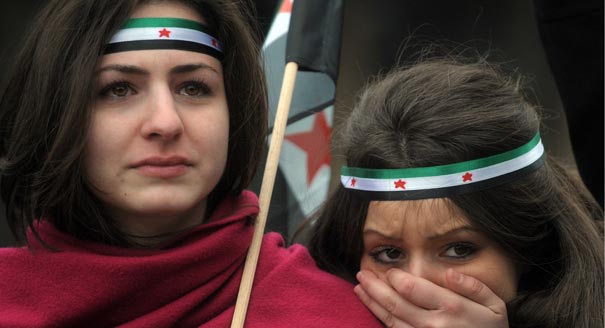
Source: Getty
The nature of the Syrian revolution is particularly complex. A deeper social reading on Syria is required to further understand the violence in Syria and the importance of its timing during the Arab uprisings.
Source: London School of Economics and Political Science
“The nature of what’s going on in Syria—the Syrian revolution—is so particularly complex,” said Carnegie’s Yezid Sayigh during a public lecture at the London School of Economics and Political Science. Sayigh reflected upon the notion of “revolution” as a framework to “understand the nature and the strengths and weaknesses of the protagonists – both the regime and its various foes.”
Noting parallels with other historical experiences, such as the beginning of Palestinian activism, Sayigh explained the importance of social dynamics in Syria: “the sort of discourse we get and the sort of reporting we get on which a lot of policy is built is about good and bad…tyrannical regime versus democratic opposition, moderates versus radical Islamists.” Sayigh noted that it’s not necessarily wrong, but that “this kind of reporting, it doesn’t really tell us what is going on in Syria and certainly not enough to understand where things are going, and why they’ve gone where they are, and why we keep seeming to be surprised about where things have gone.”
Sayigh emphasized the importance of a social reading on Syria, explaining that “had there not been an Arab Spring...the Syrian revolution—the uprising—probably wouldn’t have started just in that time, in that way.” Additionally, by looking at violence of the armed struggle, including “who wields violence, how it’s wielded, what for, with what discourse, that, I think, tells us more about the nature of the Syrian revolution.”
This conference was recorded and hosted by the London School of Economics and Political Science.

Senior Fellow, Malcolm H. Kerr Carnegie Middle East Center
Yezid Sayigh is a senior fellow at the Malcolm H. Kerr Carnegie Middle East Center in Beirut, where he leads the program on Civil-Military Relations in Arab States (CMRAS). His work focuses on the comparative political and economic roles of Arab armed forces, the impact of war on states and societies, the politics of postconflict reconstruction and security sector transformation in Arab transitions, and authoritarian resurgence.
Recent Work
Yezid Sayigh
Yezid Sayigh
Carnegie India does not take institutional positions on public policy issues; the views represented herein are those of the author(s) and do not necessarily reflect the views of Carnegie, its staff, or its trustees.

After the chill in ties between 2020 and 2024 that brought India–China relations to their lowest point in several decades, the two countries have engaged each other afresh. This paper argues that there are predominantly four imperatives guiding India’s approach to China, and they exist in an order of priority.

Saheb Singh Chadha

This piece argues that the present Indian strategy, based on opportunistic diversification and utilization of limited strategic reserves, remains inadequate when confronting supply disruptions. It evaluates India’s options in the short, medium, and long terms.

Vrinda Sahai

This piece examines India’s response to U.S. sanctions and tariffs, specifically assessing the immediate market consequences, such as alterations in import costs, and the broader strategic implications for India’s energy security and foreign policy orientation.
Vrinda Sahai
The India-Pakistan conflict that played out between May 6 and May 10, 2025, offers several military lessons. This article presents key takeaways from Operation Sindoor and breaks down how India’s preparations shaped the outcome and what more is needed to strengthen future readiness.

Dinakar Peri
This book offers a comprehensive analysis of India's evolving relationship with sovereignty in a complex global order. Moving beyond conventional narratives, it examines how the sovereignty principle shapes India's behavior across four critical domains—from traditional military power to contemporary data governance.

Rudra Chaudhuri, Nabarun Roy