

Paper
James M. Acton, Ankit Panda
{
  "authors": [
    "James M. Acton"
  ],
  "type": "legacyinthemedia",
  "centerAffiliationAll": "dc",
  "centers": [
    "Carnegie Endowment for International Peace"
  ],
  "collections": [
    "U.S. Nuclear Policy"
  ],
  "englishNewsletterAll": "ctw",
  "nonEnglishNewsletterAll": "",
  "primaryCenter": "Carnegie Endowment for International Peace",
  "programAffiliation": "NPP",
  "programs": [
    "Nuclear Policy"
  ],
  "projects": [],
  "regions": [
    "North America",
    "United States",
    "East Asia",
    "China",
    "Russia"
  ],
  "topics": [
    "Security",
    "Military",
    "Nuclear Policy",
    "Arms Control"
  ]
}
Source: Getty
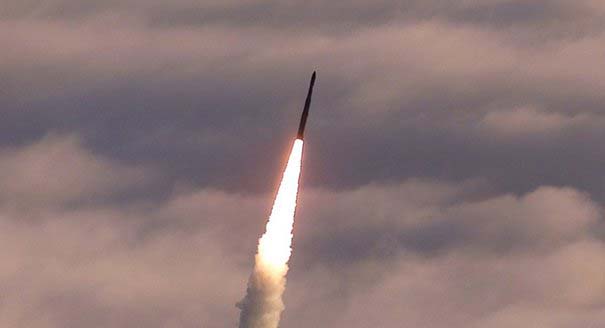
The U.S. military has been working on a weapon that could strike remote targets quickly, a development that risks triggering a new arms race with foreign adversaries.
Source: NPR
ARUN RATH, HOST:
From a car without a driver to a weapon without emission. There's a good chance you've never heard of the Boost Glide Missile. But since the Bush Administration, the U.S. military has been developing this new type of weapon that can strike a remote target very quickly. What that target would be is not clear. James Acton is a senior associate at the Carnegie Endowment Fund for International Peace in Washington. And he's worried that while this weapon is quietly being perfected, the U.S. is in danger of triggering a new arms race with foreign adversaries. To understand, we had to get an explanation of how this weapon actually works.
JAMES ACTON: So the weapon itself is a glider. It's a little bit like a hang glider, except for it goes 10, 15, 20 times the speed of sound. And if you want to get something going that fast, you have to launch it by a rocket. And so the idea of developing what was initially termed as Global Weapons that could reach anywhere in the world within one hour was kind of thought up in the first few years of the Bush Administration.RATH: Can you talk about the reaction from other countries to the U.S. development of this technology?
ACTON: Yeah, well, it's been received with great concern, particularly in Russia and China. The U.S., it doesn't have a clear doctrine for the use of these weapons. But nonetheless, both Russia and China have reached the conclusion that it's about targeting their nuclear forces. And in spite of the fact that they're concerned about this weapon, both Russia and China have their own development programs in process. But interestingly, in January of this year, China tested it's first Boost Glide Weapon, which the Pentagon has called the WU-14.
RATH: Is this the start of a full-on arms race?
ACTON: I'm worried that it could be the start of an arms race. This could start off being a very slow moving arms race. None of these weapons need to be deployed this year or even next year. The timelines we're talking about here are probably of the order of a decade or two. However, I think there's good reasons to suppose that it's going to be hard to stop the development of these weapons. So I do worry that we could be here at the start of a conventional arms race.
RATH: You'd mentioned earlier that there's not really a clear doctrine. And you quoted one of your pieces, Brian Green who was the then the deputy assistant secretary of defense for strategic capabilities. He said in 2007, we prefer, actually, in our shop, not to talk about specific scenarios. Why?
ACTON: Well, this is my big criticism of the way that Boost Glide development is being done in the U.S. If you develop a weapon in regard to specific scenarios, you can ask questions about whether there are other alternative means of dealing with that scenario. The Bush administration, by contrast, it said that it's very hard to know what threats are out there. So rather than do what has traditionally been done in the U.S., which is develop weapons to meet specific threats, the Bush administration advocated capabilities that would be useful, it argued, in a whole range of different scenarios.
RATH: The fact that the research and development is ongoing - does that indicate to you that President Obama has adopted that point of view?
ACTON: I don't know whether President Obama personally has adopted that point of view, but I think that the current administration hasn't really had a serious think about whether that program is useful. I think before a decision to actually acquire these weapons is taken, there needs to be a holistic look at whether this is the right system to do the job or not. I don't know the answer to question, but I think that look needs to be taken before a decision to acquire weapons is made.
RATH: James Acton is a senior associate at the Carnegie Endowment for International Peace in Washington. James, thanks very much.
ACTON: Thanks for having me.

Jessica T. Mathews Chair, Co-director, Nuclear Policy Program
Acton holds the Jessica T. Mathews Chair and is co-director of the Nuclear Policy Program at the Carnegie Endowment for International Peace.
Recent Work

James M. Acton, Ankit Panda
James M. Acton
Carnegie India does not take institutional positions on public policy issues; the views represented herein are those of the author(s) and do not necessarily reflect the views of Carnegie, its staff, or its trustees.

In any defense establishment, change is an ongoing process. However, despite the best of intentions, existing bureaucracies, bound by habit and years of socialization, have their limits in implementing transformative change.

Anit Mukherjee

How is AI reshaping space security, creating governance challenges, and where does international diplomacy stand today?


Tejas Bharadwaj, Almudena Azcárate Ortega

After the chill in ties between 2020 and 2024 that brought India–China relations to their lowest point in several decades, the two countries have engaged each other afresh. This paper argues that there are predominantly four imperatives guiding India’s approach to China, and they exist in an order of priority.

Saheb Singh Chadha

This piece argues that India’s central challenge is not managing a single flashpoint but resolving the underlying tension between expansion and institutional coherency of the BRICS grouping.

Vrinda Sahai

The U.S.–India semiconductor cooperation story is well-stocked with top-level strategic intent. What remains unresolved, however, are some underlying challenges that will determine whether the cooperation actually functions. Three such friction points stand out.

Shruti Mittal