

Commentary
Alexey Malashenko
{
  "authors": [
    "Alexey Malashenko"
  ],
  "type": "commentary",
  "centerAffiliationAll": "",
  "centers": [
    "Carnegie Endowment for International Peace",
    "Carnegie Russia Eurasia Center"
  ],
  "collections": [],
  "englishNewsletterAll": "",
  "nonEnglishNewsletterAll": "",
  "primaryCenter": "Carnegie Russia Eurasia Center",
  "programAffiliation": "",
  "programs": [],
  "projects": [],
  "regions": [
    "Caucasus",
    "Russia",
    "Georgia",
    "Eastern Europe",
    "Ukraine"
  ],
  "topics": [
    "Political Reform",
    "Foreign Policy"
  ]
}
Source: Getty
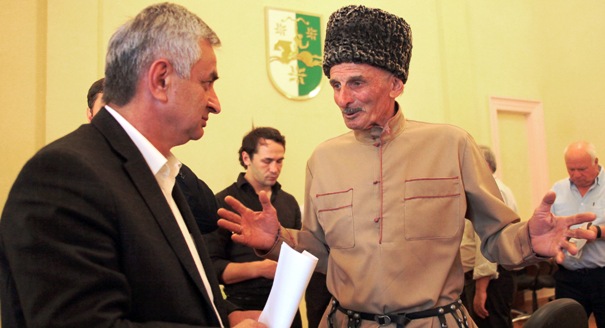
The coup d’état in Abkhazia attracted virtually no media attention in Russia, and even less attention was paid to the parliamentary election in South Ossetia. It seems that after almost six years of Abkhazian and South Ossetian “independence,” these territories stopped being Russia’s headache, only to be replaced by Crimea.
With the Ukrainian events appearing on front pages following Russia’s annexation of Crimea, the May-June coup d’état in Abkhazia attracted virtually no media attention. Even less attention was paid to the June 8 parliamentary election in South Ossetia. All the differences between these two occurrences notwithstanding, they share a common connection to Russia’s political life.
While Crimea became part of Russia just two months ago, Abkhazia and South Ossetia—their quasi-independence aside—effectively joined Russia in 2008. The Kremlin takes pride in the fact that it was able to acquire as many as three new territories in a short period of time. At the same time, the Russian establishment is starting to come to a realization that controlling these territories comes with a hefty political price tag. The monetary losses are no less tangible, especially given Russia’s current troubled economic state.
As for the political costs, it is obvious that the international community will not legally recognize Crimea as part of Russia in the near or even distant future. The same fate will befall Abkhazia and South Ossetia. However, Russia’s control over these territories is already unofficially recognized, and no one, including Ukraine and Georgia, is intending to restore them to their former status.
Interestingly enough, both Russia and the international media often refer to the Sukhumi events as a coup d’état, which means that the Abkhazian statehood is already etched in collective consciousness. By the way, the majority of the republic’s citizens share the same view (only 30 percent of them would like Abkhazia to be part of Russia). Perhaps, these sentiments are fueled by the Caucasus natives’ pride, but Abkhazians may also fear that their land will become a haven for Russian businessmen and corrupt officials.
The Abkhazian events caught Moscow by surprise. 10,000 people came to Sukhumi’s main square on May 27 (the republic’s population totals 240,000, only 50 percent of them ethnic Abkhazians). The opposition leaders did not consult Moscow before starting their protests, which certainly points to their autonomy. Of course, neither side questions Abkhazia’s alliance with Russia, so references to the Kiev Maidan made by some analysts are inappropriate and even foolish. Moreover, the opposition demanded an even closer cooperation with Russia. The acting President Valeri Bganba speaks of Abkhazia’s participation in the Customs Union and the Eurasian Economic Union. But again, there were no calls for the republic to join the Russian Federation.
That is where the situations in Abkhazia and South Ossetia differ. The talk of joining Russia figured prominently in the South Ossetian parliamentary election. In most cases, it was presented in the guise of “Alanian reunification,” that is unifying South Ossetia, which is home to 30 to 50,000 people, with the Russian republic of North Ossetia (Alania). The local surrogate of the United Russia, the United Ossetia Party, which won the election with 43 percent of the vote, was especially active in making these calls. Such overtures could actually be heard as early as 2008, right after South Ossetia declared its independence. But Moscow was not interested in it then or now. It is quite happy with the current state of affairs and does not want to invite more international censure.
Also, the internal situation in Abkhazia and South Ossetia poses no threat to Russia on a regional or any other level. The Kremlin’s man on Abkhazia, Vladislav Surkov, who flew to Sukhumi during the protests, was not tasked with restoring order there but was simply assessing the situation. In the end, the locals decided what they needed to do by themselves. The Ossetian also decided on their own who to vote for in their multi-party election.
One may conclude that after almost six years of Abkhazian and South Ossetian “independence,” these territories stopped being Russia’s headache, only to be replaced by Crimea with its 2.7 million population, nonexistent economy and 250,000-strong Crimean Tatar minority.
Meanwhile, Abkhazia and South Ossetia may revel in their participation in the Alternative World Cup. Two more fragments of the former USSR, Transnistria and Nagorny Karabakh, are also competing in the tournament alongside Zanzibar, Quebec, Lapland, Kurdistan and other unrecognized states.
Former Scholar in Residence, Religion, Society, and Security Program
Malashenko is a former chair of the Carnegie Moscow Center’s Religion, Society, and Security Program.
Recent Work
Alexey Malashenko
Alexey Malashenko
Carnegie India does not take institutional positions on public policy issues; the views represented herein are those of the author(s) and do not necessarily reflect the views of Carnegie, its staff, or its trustees.

After the chill in ties between 2020 and 2024 that brought India–China relations to their lowest point in several decades, the two countries have engaged each other afresh. This paper argues that there are predominantly four imperatives guiding India’s approach to China, and they exist in an order of priority.

Saheb Singh Chadha

This piece argues that India’s central challenge is not managing a single flashpoint but resolving the underlying tension between expansion and institutional coherency of the BRICS grouping.

Vrinda Sahai

A partnership between India, a country of subcontinental size, and Africa, a continent of fifty-four countries, may seem asymmetric until one notes that both are home to nearly the same number of people—1.4 billion. This essay spells out the existing challenges to the partnership, its optimal potential, and the possible pathways to realize it over the next quarter-century.

Rajiv Bhatia

The India–EU Free Trade Agreement (FTA) is shaping up to be one of the most consequential trade negotiations, both economically and strategically. But, what’s in the agreement, what’s missing, and what will determine its success in the years ahead
Vrinda Sahai, Nicolas Köhler-Suzuki
Trump 2.0 has unsettled India’s external environment—but has not overturned its foreign policy strategy, which continues to rely on diversification, hedging, and calibrated partnerships across a fractured order.



Milan Vaishnav, ed., Sameer Lalwani, Tanvi Madan, …