

In The Media
Lina Khatib
{
  "authors": [
    "Lina Khatib"
  ],
  "type": "legacyinthemedia",
  "centerAffiliationAll": "dc",
  "centers": [
    "Carnegie Endowment for International Peace",
    "Malcolm H. Kerr Carnegie Middle East Center"
  ],
  "collections": [],
  "englishNewsletterAll": "menaTransitions",
  "nonEnglishNewsletterAll": "",
  "primaryCenter": "Malcolm H. Kerr Carnegie Middle East Center",
  "programAffiliation": "MEP",
  "programs": [
    "Middle East"
  ],
  "projects": [],
  "regions": [
    "Gulf",
    "Levant",
    "Iraq",
    "Middle East"
  ],
  "topics": [
    "Political Reform",
    "Security",
    "Foreign Policy"
  ]
}
Source: Getty
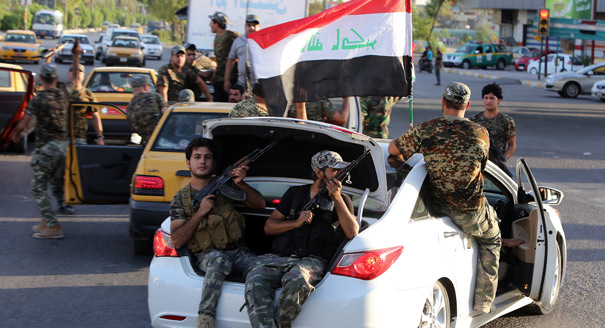
The Islamic State of Iraq and Syria, who have laid siege to large parts of Iraq, contains all the necessary ingredients to become a global terrorist group.
Source: National Public Radio
LINDA WERTHEIMER, HOST:
This is MORNING EDITION from NPR News. I'm Linda Wertheimer.
RENEE MONTAGNE, HOST:
And I'm Renee Montagne. We're aiming to bring you up to speed this week on the players in this new crisis in Iraq. This morning we look at the group at the center of it all - ISIS - the Islamic State of Iraq and Syria. That's the extremist militant group that seized large parts of Iraq in the past week. ISIS grew out of a Sunni Islamist group called al-Qaida in Iraq, which a decade ago gained notoriety for its horrific attacks on Iraqi civilians. ISIS eventually split with al-Qaida in Iraq and gained strength next door in Syria. On the line from Beirut we're joined by Lina Khatib, director of the Carnegie Middle East Center. Welcome to the program.LINA KHATIB: Thank you.
MONTAGNE: The name - the Islamic State of Iraq and Syria, ISIS - suggests that they see themselves, not as simply a movement, but actually as a state - a country.
KHATIB: Yes. ISIS is very much a group that is behaving as a state in Syria - not necessarily in Iraq -although they have this kind of ambition. They have set up their own state-like institutions such as a court, a police system, schools. They have also appropriated existing state institutions in Syria. And every time they take over a new area, they present it to their followers as evidence that they are indeed working on establishing and expanding states.
MONTAGNE: Even to the point where they have sort of a governing document.
KHATIB: Yes. ISIS has a governing document based on Sharia law and their own vision for establishing an Islamic state in the region. Obviously, they impose extra-conservative extremist rules in their governing document. And they impose taxation on the population in areas under their control. So all of these measures are helping them establish long-term roots in these areas.
MONTAGNE: They ultimately aim to be a state with designs on being also a global terrorist group.
KHATIB: Right now, the ambitions of ISIS are very much regional. But because ISIS involves a number of Jihadist fighters who come from outside the Middle East - including Jihadists from the United States and from European countries - all the ingredients for it to become this kind of new global terrorist group are there. And in fact, the governing documents for ISIS present it as, in a way, the more authentic and more legitimate al-Qaida. So they are even more extreme than al-Qaida.
MONTAGNE: And where do they get their funding? You mentioned taxation and we've heard of that. But they appear to be quite flush with money.
KHATIB: Yes, absolutely. ISIS in Iraq, as well as ISIS in Syria, are now financially independent. They have taken hold of a number of oil wells and oil fields in those countries. And they are selling the oil from those wells to the Syrian regime and to other actors. And what happened recently in Iraq is that they also raided the central bank and took over $400 million of money that they transported to Syria.
MONTAGNE: And that central bank in Mosul?
KHATIB: Yes. So ISIS has all of these, kind of, local sources of funding as well as some foreign funders who are individuals mainly from the Gulf region, who believe in the ISIS ideology. So they are, unfortunately, financially quite comfortable.
MONTAGNE: Well then - just finally - what do you think, knowing what you know about ISIS, can it prevail when it reaches mixed or Shiite areas? And of course, in particular - everyone's wondering - will it actually try to take Baghdad?
KHATIB: It would be very difficult for ISIS to take Baghdad. One reason why ISIS managed to take over Mosul is because in that area, it has a relatively significant number of local supporters from the Sunni population that were resentful about Maliki. The Iraqi army does not put up much of a fight in Mosul because a lot of the members of the Army who were there were Sunnis who felt they really had nothing to do defend because they did not feel they belonged to the Iraqi state. The Army in Baghdad is more tightly linked to the government itself. And also, physically, only a few hundred ISIS fighters actually took over Mosul. It would be difficult for them to replicate this on a larger scale in Baghdad.
MONTAGNE: Lina Khatib is the director of the Carnegie Middle East Center. Thank you very much for joining us.
KHATIB: Thank you.
This interview was originally broadcasted on National Public Radio.
Former Director, Middle East Center
Khatib was director of the Carnegie Middle East Center in Beirut. Previously, she was the co-founding head of the Program on Arab Reform and Democracy at Stanford University’s Center on Democracy, Development, and the Rule of Law.
Recent Work
Lina Khatib
Lina Khatib
Carnegie India does not take institutional positions on public policy issues; the views represented herein are those of the author(s) and do not necessarily reflect the views of Carnegie, its staff, or its trustees.

In any defense establishment, change is an ongoing process. However, despite the best of intentions, existing bureaucracies, bound by habit and years of socialization, have their limits in implementing transformative change.

Anit Mukherjee

After the chill in ties between 2020 and 2024 that brought India–China relations to their lowest point in several decades, the two countries have engaged each other afresh. This paper argues that there are predominantly four imperatives guiding India’s approach to China, and they exist in an order of priority.

Saheb Singh Chadha

This piece argues that India’s central challenge is not managing a single flashpoint but resolving the underlying tension between expansion and institutional coherency of the BRICS grouping.

Vrinda Sahai

A partnership between India, a country of subcontinental size, and Africa, a continent of fifty-four countries, may seem asymmetric until one notes that both are home to nearly the same number of people—1.4 billion. This essay spells out the existing challenges to the partnership, its optimal potential, and the possible pathways to realize it over the next quarter-century.

Rajiv Bhatia

The India–EU Free Trade Agreement (FTA) is shaping up to be one of the most consequential trade negotiations, both economically and strategically. But, what’s in the agreement, what’s missing, and what will determine its success in the years ahead
Vrinda Sahai, Nicolas Köhler-Suzuki