

Article
Amr Adly, Hamza Meddeb
{
  "authors": [
    "Amr Adly"
  ],
  "type": "legacyinthemedia",
  "centerAffiliationAll": "dc",
  "centers": [
    "Carnegie Endowment for International Peace",
    "Malcolm H. Kerr Carnegie Middle East Center"
  ],
  "collections": [],
  "englishNewsletterAll": "menaTransitions",
  "nonEnglishNewsletterAll": "",
  "primaryCenter": "Carnegie Endowment for International Peace",
  "programAffiliation": "MEP",
  "programs": [
    "Middle East"
  ],
  "projects": [],
  "regions": [
    "Egypt",
    "Levant",
    "Palestine",
    "Middle East",
    "North Africa"
  ],
  "topics": [
    "Political Reform",
    "Security",
    "Economy",
    "Democracy"
  ]
}
Source: Getty
Egypt’s harsh stand toward Hamas in the latest conflict in Gaza is not merely due to the severe deterioration in relations since the overthrow of the Morsi government. The cash-strapped Sisi government shares long-held concerns in Cairo that it, instead of Israel, risks becoming responsible for relieving the stifling siege.
Source: Al Hayat
Egypt’s official stand on the conflict in Gaza was met with much criticism among supporters of the Palestinian cause in general and Hamas in particular. The Egyptian government was even accused of complicity in perpetuating the siege of Gaza and engaging in mediation for the sole purpose of weakening, not to say rooting out, Hamas, as a wing of the Muslim Brotherhood. Against the backdrop of this covert struggle with Egypt, the Islamic Resistance Movement (Hamas) turned down an Egyptian ceasefire initiative and instead attempted to lure Qatar and Turkey into playing a negotiating role of some sort. As a countermeasure, the Egyptian government held tight to its proposed initiative, while stepping up its anti-Hamas rhetoric in the media.
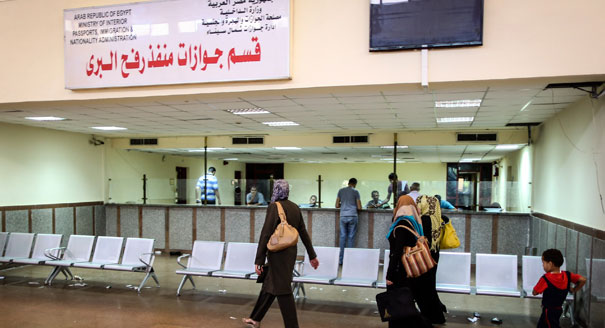
This recent position on Hamas and Gaza is not the outcome of the domestic crisis that has plagued Egypt since the overthrow of the Muslim Brotherhood regime. Despite mounting tension with Hamas - against the backdrop of frequent terrorist attacks in north Sinai and unprecedented destruction of the network of tunnels between Sinai and Gaza, which serve as the Gaza Strip’s economic lifeline – Egypt’s categorical refusal to turn Rafah into a corridor for the movement of goods as well as passenger traffic, and to play a direct economic role in the supply of goods to besieged Gazans has been a fixture of its policy since Israel’s unilateral withdrawal from Gaza in 2005 and Hamas’ takeover of the Strip in 2007. Successive Egyptian governments have stated their fear that Israel’s withdrawal from Gaza and its implementation of air, sea and ground blockade of the Strip were only meant to saddle Egypt with the burden of managing Gaza and guaranteeing its subsistence, as part of Israeli attempts to liquidate the Palestinian cause. This concern, which dates back to the Hosni Mubarak era, was largely caused by Cairo realizing its economic, security and institutional limitations in tightening its grip on areas located away from the Nile Valley, including north Sinai. It was also driven by the belief that placing Gaza under direct or indirect Egyptian control would lead to a spillover of the Palestinian-Israeli conflict into Egypt, even if partially.Notwithstanding this unwavering official Egyptian position, which continued to consider Gaza as an occupied territory and to put the burden of subsistence on Israel’s shoulders, and which kept the Rafah border crossing open to Palestinian passenger traffic only amid tightening security and administrative restrictions, the Mubarak regime was tolerant with the many-branched tunnel network between Sinai and Gaza. These tunnels were used to smuggle basic goods to Gazans and different arms supplies to Hamas and other Palestinian factions. This informal underground economy, worth millions of dollars a year, bred a web of intertwined interests among traders and smugglers on both sides of the border. Deterioration of the security situation in north Sinai, particularly after January 2011 and in the past two years, sounded, however, the death knell of this policy of tolerance towards tunnels leading to Gaza. The Egyptian army thus kicked off a strategy of systematically targeting tunnels with the aim of destroying them and stopping informal movement between Gaza and north Sinai. This policy proceeded at a quickening pace after the overthrow of Morsi, as terrorist groups believed to receive funds and weapons from Gaza stepped up their attacks on Egyptian armed forces.
As Palestinian factions and the Ramallah-based Palestinian Authority demanded a lift of the siege as a precondition for a ceasefire agreement with Israel, Egyptian authorities upheld their position that any siege-lifting arrangement should exclude Rafah and that the burden of subsistence should fall on Israel alone, as the occupying force, without any direct Egyptian involvement. After the Egyptian initiative was turned down almost a month ago, the Egyptian government gave the cold shoulder to--and almost completely neglected--Palestinian demands. Egypt’s interests do not lie in a perpetuation of the blockade. Egypt has traditionally sought to shift responsibility for Gaza to Israel. By playing the role of a trustworthy mediator in Israel’s eyes to ease the siege and by attempting to revive a 2005 agreement on border crossings, Egypt would have the chance to buttress its position that the Palestinian Authority should regain its role in Gaza as the main party to the border crossing agreement, and that the solution to the stifling siege should be reached, through Israel, not Egypt, after the closure of tunnels between Sinai and Gaza.
This article was originally published in Arabic by Al-Hayat.

Former Nonresident Scholar, Middle East Center
Adly was a nonresident scholar at the Carnegie Middle East Center, where his research centers on political economy, development studies, and economic sociology of the Middle East, with a focus on Egypt.
Recent Work

Amr Adly, Hamza Meddeb

Robert Springborg, Ishac Diwan, Amr Adly, …
Carnegie India does not take institutional positions on public policy issues; the views represented herein are those of the author(s) and do not necessarily reflect the views of Carnegie, its staff, or its trustees.

After the chill in ties between 2020 and 2024 that brought India–China relations to their lowest point in several decades, the two countries have engaged each other afresh. This paper argues that there are predominantly four imperatives guiding India’s approach to China, and they exist in an order of priority.

Saheb Singh Chadha

A partnership between India, a country of subcontinental size, and Africa, a continent of fifty-four countries, may seem asymmetric until one notes that both are home to nearly the same number of people—1.4 billion. This essay spells out the existing challenges to the partnership, its optimal potential, and the possible pathways to realize it over the next quarter-century.

Rajiv Bhatia

On March 10, 2026, India’s Union Cabinet approved amendments to Press Note 3, a regulation that mandated government approval on all foreign direct investment (FDI) from countries sharing a land border with India. This amendment raises questions primarily about whether its stated benefits will materialize and if the risks have been adequately weighed. This piece will address the same.

Konark Bhandari

This piece argues that the present Indian strategy, based on opportunistic diversification and utilization of limited strategic reserves, remains inadequate when confronting supply disruptions. It evaluates India’s options in the short, medium, and long terms.

Vrinda Sahai

This piece examines India’s response to U.S. sanctions and tariffs, specifically assessing the immediate market consequences, such as alterations in import costs, and the broader strategic implications for India’s energy security and foreign policy orientation.
Vrinda Sahai