

Article
C. Raja Mohan, Darshana M. Baruah
{
  "authors": [
    "C. Raja Mohan"
  ],
  "type": "legacyinthemedia",
  "centerAffiliationAll": "dc",
  "centers": [
    "Carnegie Endowment for International Peace",
    "Carnegie India"
  ],
  "collections": [],
  "englishNewsletterAll": "ctw",
  "nonEnglishNewsletterAll": "",
  "primaryCenter": "Carnegie India",
  "programAffiliation": "SAP",
  "programs": [
    "South Asia"
  ],
  "projects": [],
  "regions": [
    "India",
    "Southeast Asia",
    "South Asia",
    "Indonesia"
  ],
  "topics": [
    "Foreign Policy"
  ]
}
Source: Getty
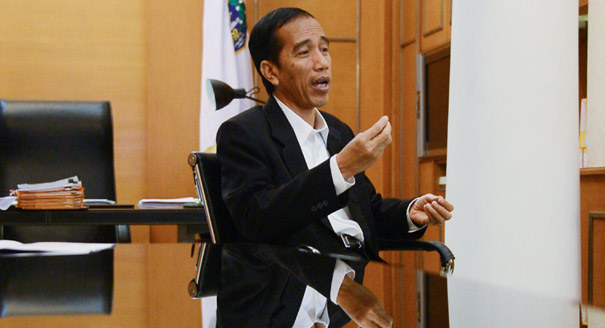
There are good reasons why Indian Prime Minister Narendra Modi should start paying serious attention to the new Indonesian president, Joko Widodo.
Source: Indian Express
India is probably too preoccupied with itself to notice that a new leader, Joko Widodo, has taken charge of Indonesia this week. It is a pity that there was no Indian political figure present when Widodo was sworn in on Monday.
There are good reasons why Prime Minister Narendra Modi should start paying serious attention to the new Indonesian president. For Widodo, popularly known as Jokowi, has much in common with Modi. They both are outsiders to the traditional political elite and made their way up on their own steam. If Modi grew up selling tea, Jokowi was raised in one of Jakarta’s slums. Beyond the personal, Modi must put Jakarta at the heart of India’s strategic imagination. After all, there is no major country in the world that shares so much history and culture with India, not to mention the “Indo” in its name.
Indonesia is the world’s biggest Islamic nation, a democracy and anchors Southeast Asia’s regional institutions. Rapid economic growth in recent years has made the Indonesian economy the ninth largest in PPP terms.After the expansive political cooperation in the 1950s, India and Indonesia drifted apart from the 1960s. Although there has been greater engagement between the two countries in recent years, neither figures prominently on the other’s mental map. Modi and Jokowi can and should change that. When they meet on the margins of the East Asia Summit in Myanmar and the G-20 meeting in Australia next month, Modi and Jokowi will have an opportunity to inject some strategic content into the bilateral relationship.
Political elites in India and Indonesia often recollect that Nehru and Sukarno took the initiative to convene the Asia-Africa conference at Bandung in 1955 and helped found the non-aligned movement. It is but rarely, though, that either country thinks of the other as a neighbour.
India views Indonesia through the prism of Southeast Asia. Indonesia, too, sees India as belonging to another region, South Asia. But geography reminds us that India and Indonesia share a maritime boundary. This shared frontier is likely to acquire greater weight as Jokowi promises to make Indonesia a major maritime power. Although Indonesia is an archipelagic nation, comprising nearly 13,500 islands, maritime strategy has not been at the top of Jakarta’s agenda.
In his inaugural speech, Jokowi has promised to change all that. “We have for too long turned our backs on the ocean, the straits and the bay. This is the time for us to restore it so we will prosper like our ancestors,” he said. Quoting the Indonesian navy’s motto, “Jalasveva Jayamahe (in the seas, we shall be victorious)”, Jokowi proclaimed his determination to build strong maritime capabilities, both civilian and military. Jokowi’s speech is entirely in tune with his campaign promise to make Indonesia a “global maritime nexus”.
Indonesia’s new maritime consciousness has been shaped by a number of factors. The growing economic integration between East and West Asia and the strategic significance of the sea lines of communication between the two regions have made Jakarta an enthusiastic proponent of the “Indo-Pacific” as a new geopolitical construct.
It is not difficult to see why. All the straits linking the Indian and Pacific Oceans travel along or across Indonesian waters. This geographic awareness has been reinforced by China’s muscular assertion of its territorial claims, which cover almost all the waters of the South China Sea that is bordered on the south by Indonesia. Parts of Indonesia’s exclusive economic zone in the South China Sea overlap with Beijing’s claims. As China’s capacity to patrol and control the waters of the South China Sea has grown, so has the frequency of incidents between Chinese maritime authorities and Indonesian fishermen.
Determined to affirm Indonesia’s sovereignty, Jokowi plans to raise Indonesia’s defence spending to 1.5 per cent of GDP; if implemented, it will mark a 70 per cent increase over the current levels. As it seeks to quickly modernise its navy, secure its waters and emerge as a regional maritime power, Indonesia is looking for partners. The United States, which had an arms embargo against Jakarta for many years, and Japan are all set to boost Indonesia’s naval capabilities.
But New Delhi is yet to get its defence engagement with Jakarta in shape. Through the decade-long UPA rule, Delhi and Jakarta had been talking about expanding bilateral defence cooperation. But progress had been rather slow thanks to A.K. Antony’s dysfunctional defence policies. Modi and his defence minister, Arun Jaitley, can do a lot better if they emulate Nehru, who sought to build expansive defence cooperation with Indonesia in the 1950s.
This article was originally published in the Indian Express.
Former Nonresident Senior Fellow, Carnegie India
A leading analyst of India’s foreign policy, Mohan is also an expert on South Asian security, great-power relations in Asia, and arms control.
Recent Work

C. Raja Mohan, Darshana M. Baruah


Alexander Gabuev, Paul Haenle, C. Raja Mohan, …
Carnegie India does not take institutional positions on public policy issues; the views represented herein are those of the author(s) and do not necessarily reflect the views of Carnegie, its staff, or its trustees.

In any defense establishment, change is an ongoing process. However, despite the best of intentions, existing bureaucracies, bound by habit and years of socialization, have their limits in implementing transformative change.

Anit Mukherjee

As AI grows more sophisticated, as the supply chains that power it become more contested, and as access to frontier models becomes geopolitically charged, India must begin to ask a different set of questions. Not what applications it can build on someone else’s infrastructure but what the world needs.

Konark Bhandari

The Indian Ocean Region hosts one of the densest concentrations of subsea cables in the world. Yet, despite accounting for a significant share of global internet traffic, India’s participation remains limited.

Charukeshi Bhatt

How is AI reshaping space security, creating governance challenges, and where does international diplomacy stand today?


Tejas Bharadwaj, Almudena Azcárate Ortega

After the chill in ties between 2020 and 2024 that brought India–China relations to their lowest point in several decades, the two countries have engaged each other afresh. This paper argues that there are predominantly four imperatives guiding India’s approach to China, and they exist in an order of priority.

Saheb Singh Chadha