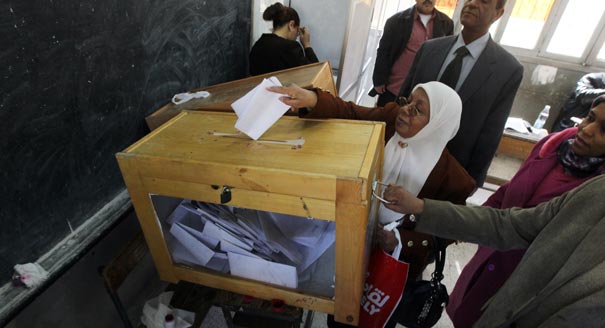
After the removal of restrictive measures against political parties, the period following the January 2011 revolution witnessed the creation of more than 80 parties across the political spectrum. Parliamentary elections, held between November 2011 and January 2012, resulted in an overwhelming victory for Islamists, with the Muslim Brotherhood’s Freedom and Justice Party gaining 47 percent of seats in the People’s Assembly and the Salafi Nour Party winning 24 percent. Liberal and secular parties all together took slightly less than 30% percent of People’s Assembly seats. Islamist parties also won nearly 90 percent of contested seats in the Shura Council (upper house), resulting in an Islamist majority in both houses.
In June 2012 the Supreme Constitutional Court—composed primarily of Mubarak-era judges—dissolved the People’s Assembly just two days prior to presidential elections.
Click here for a list of the significant political parties that participated in the 2012 parliamentary elections
Carnegie Analysis
Op-Ed
The democratic spirit that seems to have struck deep roots in Egyptian society may still ensure that when everything that could go wrong does go wrong, the country can still recover.
Event
The outcome of the presidential elections will have a major impact on the future of Egypt, affecting the power of the Islamist parties, the position of the military, and its economic future.
Article
The result of the first round of Egypt’s presidential election seems poised to be the prelude to a direct confrontation between the old regime and the Muslim Brotherhood.
Article
Islamist parties seem to be evolving rapidly as they learn to navigate through the difficult politics and the uncertain democratic processes of their countries.
Event
Amr Hamzawy, one of Egypt’s best known liberal members of parliament and one of the founding members of the Carnegie Middle East program, returned to Carnegie to discuss the transition in Egypt and the nature of the political process.
Conference
April 5, 2012
Islamist parties will have a dominant impact on the outcome of Arab transitions, but there is little understanding in Washington of what that will mean for governing.
Op-Ed
The Egyptian Muslim Brotherhood’s decision to abandon its pledge not to run a presidential candidate is a strong indication of the Brotherhood’s conversion to a fully political logic.
Article
One year after the Egyptian military forced President Mubarak from office, Egypt is caught in a vicious circle that risks derailing its move toward democracy, leading to more uncertainty and violence.
Op-Ed
With scant governing experience, Egypt’s Muslim Brotherhood must face the challenges and pressures of power in a complicated political transition.
TV/Radio Broadcast
Nearly a year after the overthrow of President Hosni Mubarak, Egypt is still engaged in fundamental political debates over the future of its political system.
Paper
Egypt’s Muslim Brotherhood stands on the brink of an impressive electoral victory, but it is not clear how much its past decisions and behavior will guide its future actions.
Article
Challenging Egypt’s Supreme Council of the Armed Forces requires sustained unity of purpose and determination among civilian leaders and political parties and movements, and a favorable external environment, neither of which is assured at present.
Article
The responses of the military and secular parties could determine whether Egypt is headed toward a government dominated by Islamists or a less threatening alliance of the Muslim Brotherhood’s Freedom and Justice Party and secular parties
Event
Egypt is undergoing its most difficult moment since the uprisings began; the military has lost popularity and there is no agreement among political forces about what the next step should be.
Op-Ed
Early polling in Egypt suggests that Islamist movements are receiving the bulk of the vote, but both the country and the Muslim Brotherhood might be better served by an outcome like Tunisia’s, where Islamists have political strength but must still reach out to others to get anything done.
Q&A
The most challenging part of the change to civilian government in Egypt lies ahead—the country’s road to democracy is far from guaranteed.
Article
While it is now clear who the participants in Egypt’s political game are, it will be several more months before it is possible to know whether the emerging balance of power will allow a democratic transformation.
Event
The ongoing revolutionary changes in Egypt have brought new Islamist actors to prominence and posed sharp questions about the constitution, the official religious establishment, and the electoral process.
Op-Ed
The transitional governments in both Egypt and Tunisia must negotiate with their respective political parties and protesters to forge an understanding of what must be done in the next few months and what will have to wait until after elections.
Article
Political forces in Egypt today face a dilemma: either proceed ahead expeditiously to elections in order to end the post-revolutionary rule of the military or slow down the electoral timetable and prioritize the writing of a new constitution.
TV/Radio Broadcast
Islamist parties in Egypt and Tunisia are emerging as powerful political players in each country’s transition. Upcoming elections in both countries and the performance of Islamist parties once they are in office will determine their future role in formal politics.
Op-Ed
The Muslim Brotherhood’s tight control over the Freedom and Justice Party could produce tension between those seeking large numbers of votes for the party and others who wish to focus on fulfilling the Brotherhood’s mission.
Testimony
As Egypt transitions to democracy, the once-outlawed Muslim Brotherhood is looking to play a more active role in the nation’s political life.
Participating Political Parties
Nationalist Parties
Liberal and Leftist Parties
Islamist Parties
Youth and Protest Movements
Islamist Movements
Nationalist Parties
We Are Egypt Party (founded 2014)
Egyptian National Movement (founded 2012)
National Democratic Party (founded 1976)
Liberal and Leftist Parties
Wafd Party (founded 1919)
Egyptian Social Democratic Party (founded 2011)
Free Egyptians Party (founded 2011)
Egyptian Popular Current (founded 2012)
Constitution Party (Dustour) (founded 2012)
Congress Party (founded 2012)
Egyptian Communist Party (founded 1975)
Egypt Freedom Party (founded 2011)
Egyptian Socialist Party (founded 2011)
Ghad Party (Tomorrow) (founded 2004)
Karama Party (founded 1996)
Socialist Popular Alliance Party (founded 2011)
Reform and Development Party (founded 2009)
Tagammu Party (founded 1976)
Islamist Parties
Freedom and Justice Party (founded 2011)
Nour Party (founded 2011)
Strong Egypt Party (founded 2012)
Asala Party (founded 2011)
Building and Development Party (founded 2011)
Egyptian Current (founded 2011)
Watan Party (founded 2013)
Wasat Party (founded 1996)
Youth and Protest Movements
Tamarod (founded 2013)
April 6 Youth Movement (founded 2008)
National Coalition to Support Legitimacy (founded 2013)
National Salvation Front (founded 2012)
Ahrar (founded 2013)
Kifaya (founded 2004)
Maspero Youth Union (founded 2011)
National Association for Change (founded 2010)
No To Military Trials (founded 2011)
Students Against the Coup (founded 2013)
Islamist Movements
Muslim Brotherhood (founded 1928)