

Commentary
Yezid Sayigh
{
  "authors": [
    "Yezid Sayigh"
  ],
  "type": "legacyinthemedia",
  "centerAffiliationAll": "dc",
  "centers": [
    "Carnegie Endowment for International Peace",
    "Malcolm H. Kerr Carnegie Middle East Center"
  ],
  "collections": [],
  "englishNewsletterAll": "menaTransitions",
  "nonEnglishNewsletterAll": "",
  "primaryCenter": "Malcolm H. Kerr Carnegie Middle East Center",
  "programAffiliation": "MEP",
  "programs": [
    "Middle East"
  ],
  "projects": [],
  "regions": [
    "Egypt",
    "Maghreb",
    "Libya",
    "North Africa"
  ],
  "topics": [
    "Political Reform",
    "Security",
    "Foreign Policy"
  ]
}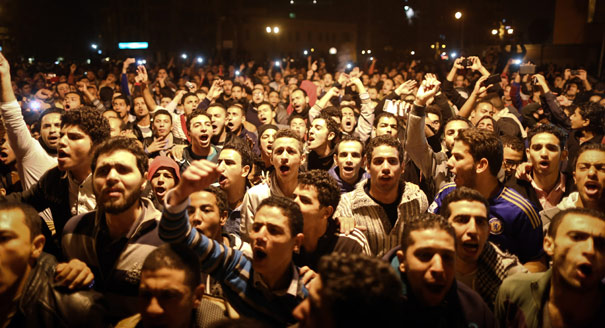
Source: Getty
Egypt’s current foreign policy activism is more show than substance. The temptation to expand this approach by intervening in Libya will only reveal Egypt’s vulnerabilities and deepen them further.
Source: Al-Hayat
Much is being made of signs of a reinvigorated Egyptian foreign policy. Egyptian President Abdel-Fattah al-Sisi’s trips to Moscow in 2014 and Russian President Vladimir Putin’s return visit to Cairo in February 2015, during which Russia committed to build a nuclear power plant in Egypt, were followed by deals to purchase Russian and French arms signed in September 2014 and February 2015. These have been portrayed by Egyptian commentators and others as demonstrating Egypt’s independence in relations with the United States.
More significantly, Sisi’s call on February 22 for a unified Arab intervention force in Libya, has greatly heightened expectations that Egypt will assume an activist regional profile. His subsequent meetings with Saudi Arabia’s King Salman bin Abdulaziz Al Saud and Jordan’s King Abdullah II increase the prospects of coordinated diplomatic, and possibly military, action on Libya. This moreover followed the Egyptian attempt to propose military intervention to the United Nations Security Council in mid-February 18, which was abandoned in the face of Western reluctance.
Egypt seems poised to play a prominent role beyond its own borders, but the hope of some that it will resume the sort of regional leadership that it formerly exercised under Presidents Gamal Abdul-Nasser or even Anwar Sadat are misplaced. The challenge to Egyptian national security are real, but its current foreign policy activism is more show than substance, geared at least in part to deflecting the attention of external and domestic audiences from the growing social, economic, and security travails on its home front. The temptation to expand this approach by intervening in Libya is powerful, but will only reveal Egypt’s vulnerabilities and deepen them further.Having conducted limited air strikes on alleged ISIS targets in Libya in mid-February, Egypt is now gearing up diplomatically to for a possible expansion of military operations. Other Arab states may contribute, but this is likely to be mostly token—the main burden will certainly fall on the Egyptian Armed Forces. However, intervention on any scale will probably become far more protracted and costly than its planners anticipate. Egypt lacks the political capital and economic means for this, even with assistance from its likely partners.
In particular, Egypt cannot risk getting embroiled in what will almost inevitably be a complex and expanding operation in Libya when it already has such a hard time resolving its own home-grown insurgency in Sinai and faces a spreading challenge of militancy and political violence in other parts of the country. Its counter-insurgency in Sinai has so far relied excessively on harsh measures and brute force, despite periodic promises to invest in social and economic development for Sinai’s inhabitants, repeated recently by Sisi.
Dragging Egypt into a second counter-insurgency campaign beyond its own borders is precisely what ISIS’s Libyan followers seek, to drain and exhaust it. Furthermore, most Libyan militias—including Islamist ones—are heavily focused on local agendas and struggles. A military intervention in the border region would place the Egyptian army in confrontation with groups do not pose a real or imminent cross-border threat, and therefore be counter-productive for Egypt.
A genuine attempt to uproot ISIS would require military operations against the group’s burgeoning presence in areas extending as far as Sirte, which in turn means that Egyptian forces would have to advance from eastern to central Libya. This would bring Egyptian troops into conflict with the western-based Libya Dawn camp—often labelled simplistically as “Islamist”—and it would invariably throw the country into deeper civil war. But even if Egypt were to be successful in defeating Dawn, disarming and demobilizing local militias and enforcing the peace would demand far greater resources than Egypt commands and bog it down for years.
The hard reality is that Egypt lacks the economic foundations for a leading regional role, let alone intervention in Libya. Egyptian officials and commentators clearly resent portrayals of Turkey as the more significant regional power, but asserting Egypt’s pre-eminence requires turning it first into an economic powerhouse. This, in turn, would require deep structural changes in the Egyptian economy that none of the key elite players or state institutions that now rule the country are willing to envisage.
Behind the posturing, it is likely that Sisi has no intention of involving Egyptian ground forces in Libya. But Egypt may still be drawn in. This would reveal its weaknesses, not newfound strength or resolve. Public comments by Egyptian officials calling for a collective effort by the international community to save Libya suggest commendable awareness of the limits of Egyptian ability, but are unlikely to be met with action, especially by key Western powers. And Egypt’s principal Gulf allies will not bankroll a military mission in Libya indefinitely on top of helping to subsidize the Egyptian budget and hard currency reserves, even if they support intervention.
Under such conditions loose talk by some Egyptian commentators of acting in Yemen against the Houthis is pure fantasy. Striving for a political solution of the Syrian conflict or stabilization in Gaza would be more convincing ways of demonstrating Egypt’s influence and capability as a regional power to be reckoned with. But although the hosting of a Syrian opposition conference in Cairo in late January was welcome and useful, Egypt is not developing a sustained diplomatic effort on the scale that is really needed. And far from enabling constructive approaches to Gaza, Egyptian policy is actively pushing the beleaguered territory to the point of breakdown.
If Egypt is unable or unwilling to invest greater diplomatic resources in Syria and Gaza, then it is foolish to expect better results from a far more costly venture into the complex environment of Libya’s conflict. The notion that Egypt is about to reclaim the regional leadership role it once played reflects the wishful thinking of other Arabs who hope, against all evidence, that it will save them from their own problems and failings, and of Egyptians who, for very different reasons, seek to gain leverage and strategic rent from the U.S., European Union, and Gulf Cooperation Council.
Egypt has not been a regional leader since the 1973 war, or done anything dramatic in foreign policy since 1978. This may be good for Egypt, but the reversion to foreign policy activism that rests on such fragile political, economic, and security conditions is dangerous. It means that Sisi and the Egyptian leadership are not confronting squarely what needs to be fixed at home.
This article was originally published in Arabic by Al-Hayat.

Senior Fellow, Malcolm H. Kerr Carnegie Middle East Center
Yezid Sayigh is a senior fellow at the Malcolm H. Kerr Carnegie Middle East Center in Beirut, where he leads the program on Civil-Military Relations in Arab States (CMRAS). His work focuses on the comparative political and economic roles of Arab armed forces, the impact of war on states and societies, the politics of postconflict reconstruction and security sector transformation in Arab transitions, and authoritarian resurgence.
Recent Work
Yezid Sayigh
Yezid Sayigh
Carnegie India does not take institutional positions on public policy issues; the views represented herein are those of the author(s) and do not necessarily reflect the views of Carnegie, its staff, or its trustees.

A partnership between India, a country of subcontinental size, and Africa, a continent of fifty-four countries, may seem asymmetric until one notes that both are home to nearly the same number of people—1.4 billion. This essay spells out the existing challenges to the partnership, its optimal potential, and the possible pathways to realize it over the next quarter-century.

Rajiv Bhatia

The India–EU Free Trade Agreement (FTA) is shaping up to be one of the most consequential trade negotiations, both economically and strategically. But, what’s in the agreement, what’s missing, and what will determine its success in the years ahead

Vrinda Sahai, Nicolas Köhler-Suzuki

This piece argues that the present Indian strategy, based on opportunistic diversification and utilization of limited strategic reserves, remains inadequate when confronting supply disruptions. It evaluates India’s options in the short, medium, and long terms.
Vrinda Sahai
Trump 2.0 has unsettled India’s external environment—but has not overturned its foreign policy strategy, which continues to rely on diversification, hedging, and calibrated partnerships across a fractured order.



Milan Vaishnav, ed., Sameer Lalwani, Tanvi Madan, …

This piece examines India’s response to U.S. sanctions and tariffs, specifically assessing the immediate market consequences, such as alterations in import costs, and the broader strategic implications for India’s energy security and foreign policy orientation.
Vrinda Sahai