

Commentary
Sarah Chayes
{
  "authors": [
    "Sarah Chayes"
  ],
  "type": "other",
  "centerAffiliationAll": "dc",
  "centers": [
    "Carnegie Endowment for International Peace"
  ],
  "collections": [
    "Anti-Corruption"
  ],
  "englishNewsletterAll": "democracy",
  "nonEnglishNewsletterAll": "",
  "primaryCenter": "Carnegie Endowment for International Peace",
  "programAffiliation": "DCG",
  "programs": [
    "Democracy, Conflict, and Governance"
  ],
  "projects": [],
  "regions": [
    "North America",
    "Middle East",
    "North Africa",
    "Southern, Eastern, and Western Africa",
    "South Asia",
    "Southeast Asia",
    "Russia",
    "Eastern Europe"
  ],
  "topics": [
    "Political Reform",
    "Democracy"
  ]
}
Source: Getty
Practically all the really hot security events today can partially be explained as extreme reactions to acute public corruption against which people had no recourse.
Source: Wall Street Journal
Sarah Chayes learned about the corruption the hard way, working in Kandahar, Afghanistan, then later in hotspots across the globe, including Nigeria, Uzbekistan, Tunisia and Egypt. Ms. Chayes analyzed those countries’ corruption systems and laid out her observations in her book, “Thieves of State.” The book also argues that corruption contributes to global instability and drives people to extremism. She discussed the emotional effects of corruption, its effects on global security and lessons for companies in an interview with Risk & Compliance Journal. The conversation has been edited for clarity.
Sarah Chayes: The part of corruption that Americans tend to underestimate is the personal humiliation that accompanies it. “Thieves of State” starts with the story of my co-op member being hit up for bribes a bunch of times as he goes up the road, and at one point, he gets smacked in the face. This is a proud Afghan man.
I watched the people around me becoming more permeable to the Taliban message because of how they were treated by the Afghan government. I kind of watched the corruption happen in front of me: People would come to me beside themselves with indignation, not just that their money was being stolen but also that their dignity was being taken.
Then I moved up to Kabul in an advisory role, and that’s how I learned about the structured nature of corruption. In Kabul I turned the kaleidoscope, and its shape reforms: What if this isn’t a government failing because it allowed corruption to exist? What if it’s a criminal organization that’s succeeding? I began thinking of the Kabul government as a criminal enterprise, and suddenly three or four anomalies I discovered were explained.
If you understand it that way, there are lots of implications for government policy and private practices.
Practically all the really hot security events today can partially be explained as extreme reactions to acute public corruption against which people had no recourse. That’s something I’d want the private sector to think about. Think of that in terms of corporate social responsibility; it gives a new dimension to that idea.
SC: I think they can learn that this isn’t just the cost of doing business. This isn’t just part of the culture in these countries. I hear that from Westerners, but in all the countries where I’ve done research…I’ve never heard anyone say, “You’re making too big a deal out of this.” I’ve never seen anyone who suffers it saying that it’s part of their culture. People do participate, however; it’s how they survive.
It’s important for business leaders not to be fooled by the titles of the government officials they may be interacting with. This is, in effect, a criminal network, and they should think carefully about getting involved in it.
What they should take away from the book is: Do a pretty hard-headed analysis, not just a typical risk analysis, to understand such dynamics as: What elements of state function have been captured in a country, as well as what economic sectors and what the key enablers are for the kleptocrats.
SC: They should think about operating there at all.
One of the things U.S. companies are worried about regarding corruption, is our law—the FCPA [Foreign Corrupt Practices Act]. I currently think FCPA enforcement is too unstrategic. What I would recommend the government do…is focus on a certain number of countries where the security risk is greatest, and focus on getting enforcement to hit the bribe-takers. Most anti-corruption enforcement is against bribe-payers, and the assumption is that companies offer money on silver platters.
It’s good to get that out of U.S. corporate culture, but a lot of times it’s the other way around: Bribes are being extorted. What I would like to see is FCPA enforcement much better targeted at countries and nodes in their kleptocratic networks.
SC: Frankly, I did this as an ordinary person. I didn’t have any specialized equipment help me do that. It would be important to make the investment to send somebody out to learn these things, sort of like hiring a journalist. They would talk to civil society organizations, who would have a lot of information. In a lot of these countries the social networks are strong; you go from one person to the next, to the next.
I found that doing this research in countries that were foreign to me was easier than expected because of what I learned in Afghanistan. I knew what to ask.
Some of the questions are in the book. Where are the revenue streams? How does corruption work here? People are really willing to talk about it in countries that have problems.
Due diligence firms look at it from a legalistic perspective; I would want to know the reality of the political economic dynamics. You can hire a firm and get their off-the-shelf product.
If you have talented people yourself, I bet it would be cheaper to send them out instead — or you may need to do some sort of combination of the two.
SC: Business can really add to the knowledge pool on the problem by collecting and passing on information about corrupt officials. By means of collective action they can help change the incentive structure operating on corrupt leaders. This isn’t just a moral choice; in the long run, by reducing the complexity of the environment, such actions reduce costs.
This piece was originally published in the Wall Street Journal.
Former Senior Fellow, Democracy, Conflict, and Governance Program
Sarah Chayes is internationally recognized for her innovative thinking on corruption and its implications. Her work explores how severe corruption can help prompt such crises as terrorism, revolutions and their violent aftermaths, and environmental degradation.
Recent Work
Sarah Chayes
Carnegie India does not take institutional positions on public policy issues; the views represented herein are those of the author(s) and do not necessarily reflect the views of Carnegie, its staff, or its trustees.

This piece argues that India’s central challenge is not managing a single flashpoint but resolving the underlying tension between expansion and institutional coherency of the BRICS grouping.

Vrinda Sahai

A partnership between India, a country of subcontinental size, and Africa, a continent of fifty-four countries, may seem asymmetric until one notes that both are home to nearly the same number of people—1.4 billion. This essay spells out the existing challenges to the partnership, its optimal potential, and the possible pathways to realize it over the next quarter-century.

Rajiv Bhatia
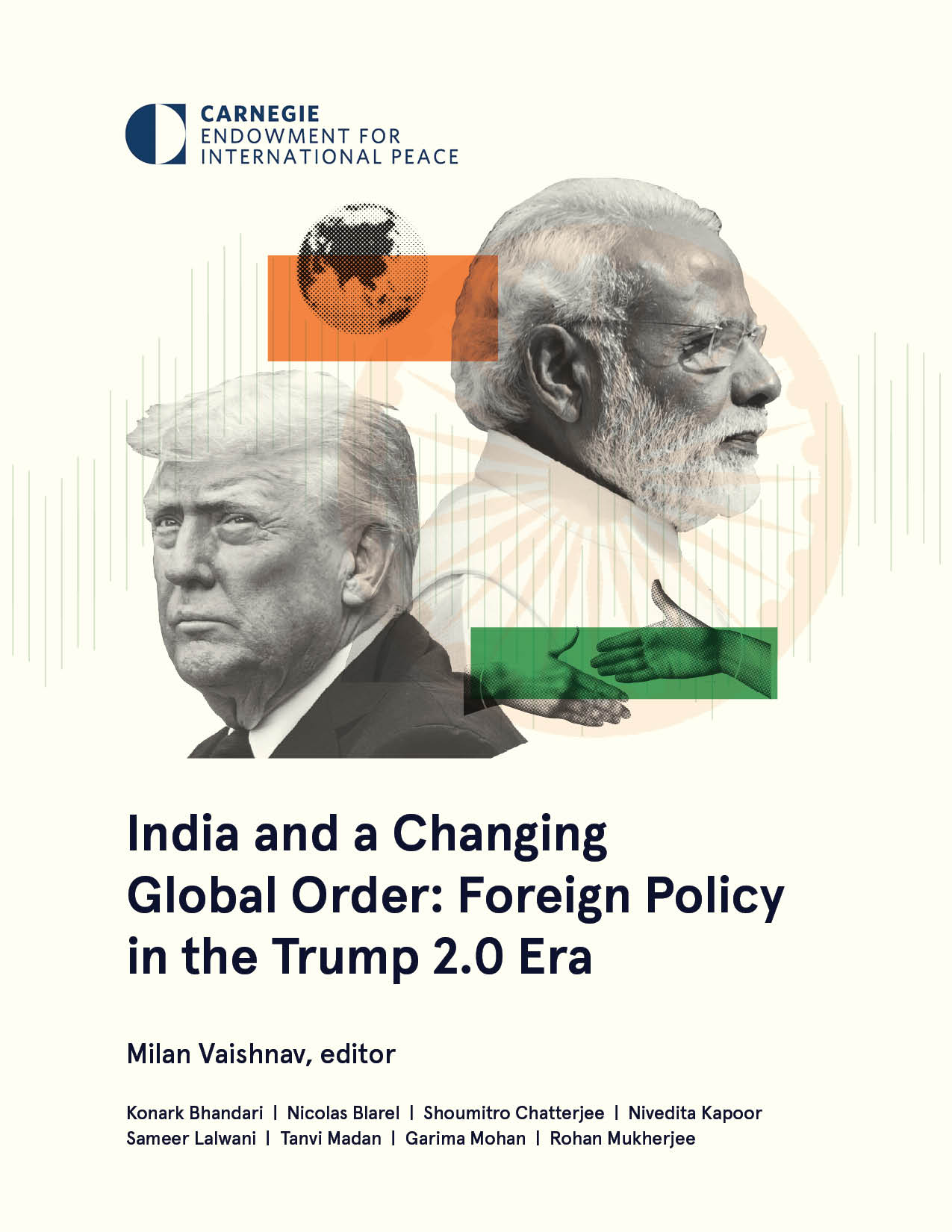
Trump 2.0 has unsettled India’s external environment—but has not overturned its foreign policy strategy, which continues to rely on diversification, hedging, and calibrated partnerships across a fractured order.

Milan Vaishnav, ed., Sameer Lalwani, Tanvi Madan, …

This commentary explores the likely actions of the Trump administration and driving forces on issues of deregulation, the United States’ leadership in AI, national security, and global engagements on AI safety.
Shatakratu Sahu, Amlan Mohanty

An Israeli response to Iran’s October 1 attack is imminent. The key question is of its intensity and potential fallout, both within Iran, in terms of nuclear security policy changes, and across the broader region. The coming days are likely to reshape West Asia irreversibly.
Gaddam Dharmendra