

Article
- +1
Toby Dalton, Mark Hibbs, Nicole Grajewski, …
{
  "authors": [
    "Mark Hibbs"
  ],
  "type": "legacyinthemedia",
  "centerAffiliationAll": "dc",
  "centers": [
    "Carnegie Endowment for International Peace",
    "Malcolm H. Kerr Carnegie Middle East Center"
  ],
  "collections": [
    "Iranian Proliferation",
    "U.S. Nuclear Policy"
  ],
  "englishNewsletterAll": "ctw",
  "nonEnglishNewsletterAll": "",
  "primaryCenter": "Carnegie Endowment for International Peace",
  "programAffiliation": "NPP",
  "programs": [
    "Nuclear Policy"
  ],
  "projects": [],
  "regions": [
    "North America",
    "United States",
    "Middle East",
    "Iran"
  ],
  "topics": [
    "Political Reform",
    "Nuclear Policy",
    "Arms Control"
  ]
}
Source: Getty
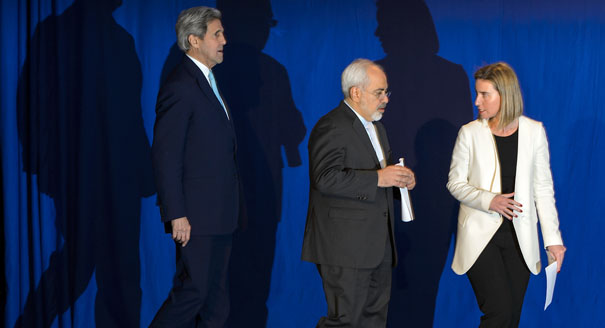
Most of the details of the framework agreement with Iran were voiced by Western negotiators and leaders, or expressed in a U.S. “fact sheet” that may or may not precisely represent Iranian understandings.
Source: Bulletin of the Atomic Scientists
The six powers and Iran invested too much capital into this negotiation to permit either side to simply walk away absent a hard and fast deal on March 31. The result on April 2 was therefore a very promising announcement but no document containing fine print that all parties are committed to implement. Western negotiators hope that what they made public on April 2 will build political momentum toward a final agreement that includes iron-clad and specific obligations, deadlines, schedules, enforcement provisions, timetables, and legal authorities. They also probably hope that if they don’t get there in three months, the momentum they generated through the end of last week will carry them a little further beyond the June 30 deadline. How much further will depend on diplomacy’s critics in Iran and the United States when the time comes.
On April 2, more substance was made known by negotiators than most observers had anticipated. Most of the details, however, were voiced by Western negotiators and leaders, or expressed in a US “fact sheet” that may or may not precisely represent Iranian understandings. If Iran is on board with all of the US State Department’s bullet points, then a final agreement based on these may indeed go far to limit the threat posed by Iran’s latent nuclear-capable status for a decade or more: Most of Iran’s enriched uranium would be withdrawn from Iran; Iran’s route to significant amounts of weapon-grade plutonium would be effectively blocked; the powers would have their thumbs over Iran’s procurement activities; and the IAEA would have explicit authority to reach deep into Iran’s nuclear program.Shortly after Iran and the powers concluded the Joint Plan of Action in November 2013, Iran challenged the US “fact sheet” on that preliminary accord as having misrepresented Iran’s understandings, so caution should prevail about whether Iran’s April 2 positions match those of Western powers. The US statement from April 2 says, for example, that Iran will do “limited research and development” with advanced centrifuges. Iranian Foreign Minister Mohammad Javad Zarif said on April 2 that Iran would continue with the development of its advanced centrifuge models but he did not qualify that statement.
A number of US assertions require precise clarification that must be spelled out at the latest in a final comprehensive agreement. These include Secretary Kerry’s remark that the final deal with Iran will not sunset. Was he referring only to Iranian commitments (already made in the Joint Plan of Action) to implement modified Code 3.1 in its International Atomic Energy Agency (IAEA) safeguards subsidiary arrangements and its Additional Protocol? If so, these provisions have long been understood by all states agreeing to them as permanent obligations. Or did Kerry mean instead that Iran had agreed, in perpetuity, to IAEA comprehensive safeguards and to a commitment never to engage in specific nuclear weapons-related activities, including activities that the IAEA suspects Iran carried out over two decades? The above-cited Iranian version of events suggests that Iran will implement the Additional Protocol “temporarily and voluntarily” until some unspecified future time when Iran would ratify it. The US statement says that Iran will be “required” to grant the IAEA access to “suspicious sites.” But which ones? Will the IAEA have access to facilities or locations operated by Iran’s military? These are details, but in the final agreement the details will matter considerably.
Creative efforts by both sides to finesse the issue of the term of a final agreement—with some obligations running out in 10 years, others in a decade or 15 years later—underscore the tacit assumption or aspiration of Western negotiators that successful implementation of a comprehensive nuclear agreement with Iran, including sanctions-lifting, will over time encourage Iran’s leadership to indefinitely extend most or all the commitments Iran would make to restrain its nuclear behavior. This—and not what’s in the final deal’s footnotes—is the most portentous question mark looming over the entire negotiation.
This article was originally published in the Bulletin of the Atomic Scientists.

Nonresident Senior Fellow, Nuclear Policy Program
Hibbs is a Germany-based nonresident senior fellow in Carnegie’s Nuclear Policy Program. His areas of expertise are nuclear verification and safeguards, multilateral nuclear trade policy, international nuclear cooperation, and nonproliferation arrangements.
Recent Work


Toby Dalton, Mark Hibbs, Nicole Grajewski, …
Mark Hibbs
Carnegie India does not take institutional positions on public policy issues; the views represented herein are those of the author(s) and do not necessarily reflect the views of Carnegie, its staff, or its trustees.

How is AI reshaping space security, creating governance challenges, and where does international diplomacy stand today?


Tejas Bharadwaj, Almudena Azcárate Ortega

The U.S.–India semiconductor cooperation story is well-stocked with top-level strategic intent. What remains unresolved, however, are some underlying challenges that will determine whether the cooperation actually functions. Three such friction points stand out.

Shruti Mittal
India and the United States are close to concluding a Reciprocal Defense Procurement Agreement (RDPA) that will allow firms from the two countries to sell to each other’s defense establishments more easily. While this may not remedy the specific grievances both sides may have regarding larger bilateral issues, an RDPA could restore some momentum, following the trade deal announcement.

Konark Bhandari

On the last day of the India AI Impact Summit, India signed Pax Silica, a U.S.-led declaration seemingly focused on semiconductors. While India’s accession to the same was not entirely unforeseen, becoming a signatory nation this quickly was not on the cards either.
Konark Bhandari

This piece examines India’s response to U.S. sanctions and tariffs, specifically assessing the immediate market consequences, such as alterations in import costs, and the broader strategic implications for India’s energy security and foreign policy orientation.

Vrinda Sahai