

• Research
  • About
  • Experts
Carnegie India logoCarnegie lettermark logo
{
  "authors": [
    "Renad Mansour",
    "David Mack",
    "Jean-Marc Rickli"
  ],
  "type": "legacyinthemedia",
  "centerAffiliationAll": "dc",
  "centers": [
    "Carnegie Endowment for International Peace",
    "Malcolm H. Kerr Carnegie Middle East Center"
  ],
  "collections": [],
  "englishNewsletterAll": "menaTransitions",
  "nonEnglishNewsletterAll": "",
  "primaryCenter": "Malcolm H. Kerr Carnegie Middle East Center",
  "programAffiliation": "MEP",
  "programs": [
    "Middle East"
  ],
  "projects": [],
  "regions": [
    "Gulf",
    "Levant",
    "Syria",
    "Iraq",
    "North America",
    "United States",
    "Middle East",
    "Western Europe"
  ],
  "topics": [
    "Political Reform",
    "Security",
    "Foreign Policy"
  ]
}

Source: Getty

In The Media
Malcolm H. Kerr Carnegie Middle East Center

Has the Strategy Against ISIL Failed?

A meeting in Paris is held to debate how best to cope with the self-proclaimed Islamic State's successes.

Link Copied
By Renad Mansour, David Mack, Jean-Marc Rickli
Published on Jun 2, 2015

Source: Al Jazeera Inside Story

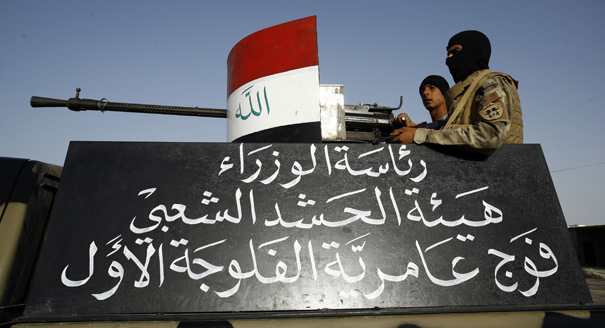
From the start, the US-led coalition that is fighting ISIL acknowledged that the battle would be long. Now, foreign ministers from several countries have met in Paris to figure out why their strategy against ISIL is not working in the face of the radical group's territorial gains in Iraq and Syria.
 
Before the Paris meeting, the US and Iraq blamed each other for the failure. The US defense secretary said the Iraqi army lacks the will to fight ISIL, while the Iraqi prime minister said his country does not get enough international support.
 
So, what will it take to defeat ISIL? 

This interview was originally broadcast on Al Jazeera Inside Story.

About the Authors

Renad Mansour

Former El-Erian Fellow, Middle East Center

Mansour was an El-Erian fellow at the Carnegie Middle East Center, where his research focuses on Iraq, Iran, and Kurdish affairs.

David Mack

Jean-Marc Rickli

Authors

Renad Mansour
Former El-Erian Fellow, Middle East Center
Renad Mansour
David Mack
Jean-Marc Rickli
Political ReformSecurityForeign PolicyGulfLevantSyriaIraqNorth AmericaUnited StatesMiddle EastWestern Europe

Carnegie India does not take institutional positions on public policy issues; the views represented herein are those of the author(s) and do not necessarily reflect the views of Carnegie, its staff, or its trustees.

More Work from Carnegie India

  • Article
    What Could a Reciprocal Defense Procurement Agreement Do for U.S.-India Ties?

    India and the United States are close to concluding a Reciprocal Defense Procurement Agreement (RDPA) that will allow firms from the two countries to sell to each other’s defense establishments more easily. While this may not remedy the specific grievances both sides may have regarding larger bilateral issues, an RDPA could restore some momentum, following the trade deal announcement.

      Konark Bhandari

  • Commentary
    India Signs the Pax Silica—A Counter to Pax Sinica?

    On the last day of the India AI Impact Summit, India signed Pax Silica, a U.S.-led declaration seemingly focused on semiconductors. While India’s accession to the same was not entirely unforeseen, becoming a signatory nation this quickly was not on the cards either.

      Konark Bhandari

  • Commentary
    The Impact of U.S. Sanctions and Tariffs on India’s Russian Oil Imports

    This piece examines India’s response to U.S. sanctions and tariffs, specifically assessing the immediate market consequences, such as alterations in import costs, and the broader strategic implications for India’s energy security and foreign policy orientation.

      Vrinda Sahai

  • Article
    Military Lessons from Operation Sindoor

    The India-Pakistan conflict that played out between May 6 and May 10, 2025, offers several military lessons. This article presents key takeaways from Operation Sindoor and breaks down how India’s preparations shaped the outcome and what more is needed to strengthen future readiness.

      Dinakar Peri

  • Book
    India and the Sovereignty Principle: The Disaggregation Imperative

    This book offers a comprehensive analysis of India's evolving relationship with sovereignty in a complex global order. Moving beyond conventional narratives, it examines how the sovereignty principle shapes India's behavior across four critical domains—from traditional military power to contemporary data governance.

      Rudra Chaudhuri, Nabarun Roy

Get more news and analysis from
Carnegie India
Carnegie India logo, white
Unit C-4, 5, 6, EdenparkShaheed Jeet Singh MargNew Delhi – 110016, IndiaPhone: 011-40078687
  • Research
  • About
  • Experts
  • Projects
  • Events
  • Contact
  • Careers
  • Privacy
  • For Media
Get more news and analysis from
Carnegie India
© 2026 Carnegie Endowment for International Peace. All rights reserved.






