

Paper
Christopher S. Chivvis, Rohan Mukherjee, Milan Vaishnav
{
  "authors": [
    "Milan Vaishnav"
  ],
  "type": "other",
  "centerAffiliationAll": "dc",
  "centers": [
    "Carnegie Endowment for International Peace"
  ],
  "collections": [],
  "englishNewsletterAll": "ctw",
  "nonEnglishNewsletterAll": "",
  "primaryCenter": "Carnegie Endowment for International Peace",
  "programAffiliation": "SAP",
  "programs": [
    "South Asia"
  ],
  "projects": [],
  "regions": [
    "South Asia",
    "India"
  ],
  "topics": [
    "Political Reform",
    "Civil Society"
  ]
}
Source: Getty
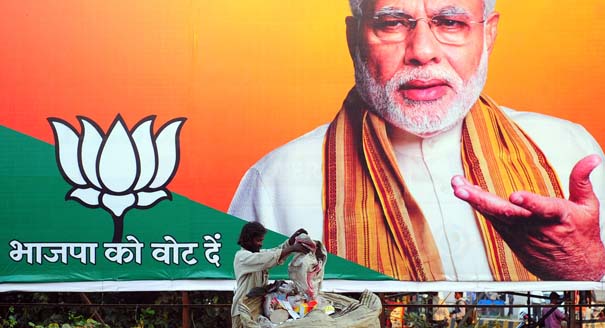
There are three clear lessons that can be drawn from India’s 2014 election.
Source: IDFC
Milan Vaishnav spoke about the 2014 Indian elections at the IDFC Institute in New Delhi. The talk brings together a few of Dr. Vaishnav's current research projects to address whether the recent election was truly a "game changer." He began by laying out the facts of the election, including that it was the largest election in human history and that it is the first time a party other than the Indian National Congress has won such a resounding mandate in India. He noted, optimistically, that while the election was polarized along religious lines, Narendra Modi won in large part due to his successful record as Chief Minister of Gujarat, suggesting that the Indian electorate is rewarding competent governance in a way it has not in the past. In other areas, though, such as the presence of political dynasties in the legislature and the electoral success of criminals, this election was an example of continuity rather than change.Vaishnav pointed to three key takeaways from this election. First, the BJP has supplanted the Congress as the dominant pole around which Indian politics revolves. Second, though identity politics are still important, they are not sufficient to win; politicians must combine identity-based appeals with strong records on economic and governance issues if they are to succeed. Third, though voters may be shifting their preferences and regional parties are proliferating, the nature of the candidates themselves has not changed much.

Director and Senior Fellow, South Asia Program
Milan Vaishnav is a senior fellow and director of the South Asia Program and the host of the Grand Tamasha podcast at the Carnegie Endowment for International Peace. His primary research focus is the political economy of India, and he examines issues such as corruption and governance, state capacity, federalism, and electoral behavior. He also conducts research on the Indian diaspora.
Recent Work

Christopher S. Chivvis, Rohan Mukherjee, Milan Vaishnav



Sophia Besch, Eric Ciaramella, Steve Feldstein, …
Carnegie India does not take institutional positions on public policy issues; the views represented herein are those of the author(s) and do not necessarily reflect the views of Carnegie, its staff, or its trustees.

In any defense establishment, change is an ongoing process. However, despite the best of intentions, existing bureaucracies, bound by habit and years of socialization, have their limits in implementing transformative change.

Anit Mukherjee

As AI grows more sophisticated, as the supply chains that power it become more contested, and as access to frontier models becomes geopolitically charged, India must begin to ask a different set of questions. Not what applications it can build on someone else’s infrastructure but what the world needs.

Konark Bhandari

The Indian Ocean Region hosts one of the densest concentrations of subsea cables in the world. Yet, despite accounting for a significant share of global internet traffic, India’s participation remains limited.

Charukeshi Bhatt

How is AI reshaping space security, creating governance challenges, and where does international diplomacy stand today?


Tejas Bharadwaj, Almudena Azcárate Ortega

After the chill in ties between 2020 and 2024 that brought India–China relations to their lowest point in several decades, the two countries have engaged each other afresh. This paper argues that there are predominantly four imperatives guiding India’s approach to China, and they exist in an order of priority.

Saheb Singh Chadha