

Commentary
Marc Pierini
{
  "authors": [
    "Marc Pierini"
  ],
  "type": "legacyinthemedia",
  "centerAffiliationAll": "dc",
  "centers": [
    "Carnegie Endowment for International Peace",
    "Carnegie Europe",
    "Malcolm H. Kerr Carnegie Middle East Center"
  ],
  "collections": [
    "Turkey’s Transformation"
  ],
  "englishNewsletterAll": "ctw",
  "nonEnglishNewsletterAll": "",
  "primaryCenter": "Carnegie Europe",
  "programAffiliation": "EP",
  "programs": [
    "Europe"
  ],
  "projects": [],
  "regions": [
    "Middle East",
    "Europe",
    "Türkiye",
    "Gulf",
    "Levant",
    "Iraq",
    "Syria",
    "Iran"
  ],
  "topics": [
    "Political Reform",
    "Security"
  ]
}
Source: Getty
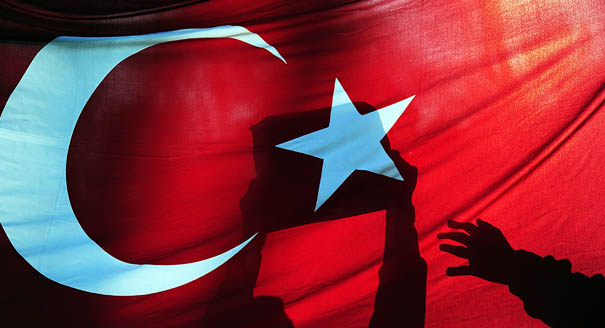
After military operations against the self-styled Islamic State in Syria and Kurdish separatists in Northern Iraq, Turkey’s strategy seems to be at a turning point.
Source: Australian Broadcasting Corporation
Turkey has called a special meeting of NATO ambassadors to discuss military operations against the self-styled Islamic State and Kurdish separatists, known as the PKK.
Turkey has been a reluctant ally in the campaign against the Islamic State, allowing the use of Turkish military bases for anti–Islamic State coalition air strikes but refusing to provide any military support of its own. But last week's bombing of a cultural center in Turkey by a man with suspected links to the Islamic State appears to have been a turning point.On July 24, Turkey launched its own wave of air strikes against the Islamic State in Syria. And, in a move that could vastly complicate the fight, Ankara also renewed its attacks against Kurdish militants in Northern Iraq, ending a shaky two-year ceasefire with the PKK, the Kurdistan People’s Party. In a parallel operation, antiterrorism police arrested almost 600 people accused of supporting the Islamic State or the PKK.
Kurdish forces have played a key role in the battle against the Islamic State, proving to be a far more effective fighting force than the Iraqi army, but Turkey has long been anxious about the consequences of arming the Kurds against the Islamic State.
On RN Breakfast, Marc Pierini discussed Turkey’s strategy with Fran Kelly.
This broadcast was originally aired on the Australian Broadcast Corporation’s RN Breakfast.

Senior Fellow, Carnegie Europe
Marc Pierini is a senior fellow at Carnegie Europe, where his research focuses on developments in the Middle East and Turkey from a European perspective.
Recent Work
Marc Pierini
Marc Pierini
Carnegie India does not take institutional positions on public policy issues; the views represented herein are those of the author(s) and do not necessarily reflect the views of Carnegie, its staff, or its trustees.

In any defense establishment, change is an ongoing process. However, despite the best of intentions, existing bureaucracies, bound by habit and years of socialization, have their limits in implementing transformative change.

Anit Mukherjee

After the chill in ties between 2020 and 2024 that brought India–China relations to their lowest point in several decades, the two countries have engaged each other afresh. This paper argues that there are predominantly four imperatives guiding India’s approach to China, and they exist in an order of priority.

Saheb Singh Chadha

The ASML MoU with Tata Electronics is an indicator of how far the Indian semiconductor ecosystem has come. This ecosystem has been years in the making and represents real commercial logic.

Konark Bhandari

The India–EU Free Trade Agreement (FTA) is shaping up to be one of the most consequential trade negotiations, both economically and strategically. But, what’s in the agreement, what’s missing, and what will determine its success in the years ahead

Vrinda Sahai, Nicolas Köhler-Suzuki

This piece argues that the present Indian strategy, based on opportunistic diversification and utilization of limited strategic reserves, remains inadequate when confronting supply disruptions. It evaluates India’s options in the short, medium, and long terms.
Vrinda Sahai