

Research
- +6
Yasmine Farouk, Nathan J. Brown, Maysaa Shuja Al-Deen, …
{
  "authors": [
    "Michele Dunne"
  ],
  "type": "legacyinthemedia",
  "centerAffiliationAll": "dc",
  "centers": [
    "Carnegie Endowment for International Peace",
    "Malcolm H. Kerr Carnegie Middle East Center"
  ],
  "collections": [],
  "englishNewsletterAll": "menaTransitions",
  "nonEnglishNewsletterAll": "",
  "primaryCenter": "Carnegie Endowment for International Peace",
  "programAffiliation": "MEP",
  "programs": [
    "Middle East"
  ],
  "projects": [],
  "regions": [
    "North America",
    "United States",
    "Middle East",
    "North Africa",
    "Egypt"
  ],
  "topics": [
    "Political Reform",
    "Security",
    "Military"
  ]
}
Source: Getty
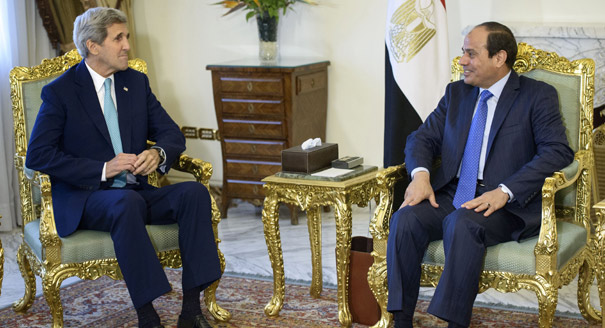
The killing of several Mexican tourists has raised questions about the military aid Egypt receives from the United States.
Source: PBS News Hour
GWEN IFILL: The U.S. sends hundreds of billions of dollars worth of military aid to allies around the world. On Sunday, the army of one of those allies, Egypt, killed 12 tourists. Most of the dead were Mexican citizens.
They were in Egypt’s Western Desert. It’s an area famous for its rock formations and oases. It’s also increasingly a base for insurgents launching attacks against the army.
Jeffrey Brown has more.
JEFFREY BROWN: The Egyptian government says that an Apache helicopter crew mistook the tourists for a group of Islamic militants. An investigation is ongoing.
Egypt is one of the largest recipients of U.S. military aid in the world, receiving $1.3 billion annually. And even before Sunday’s incident, there’s been friction between Washington and Cairo over how the Egyptian military uses American hardware.
I’m joined now by Michele Dunne, senior associate at the Carnegie Endowment for International Peace.
Welcome back to you.
MICHELE DUNNE, Director, Canegie Endowment for International Peace: Thank you.
BROWN: First, what more do we know about this incident on Sunday?
DUNNE: Well, what we know is, there was a group of tourists — they had an Egyptian police escort and apparently had the proper permits — that were touring this — near an oasis in the Western Desert, and that the convoy was attacked, obviously by mistake, by an Egyptian military helicopter.
Twelve people were killed. Seven of those seemed to have been Mexican tourists. There were others who were injured, including one person who is a dual Mexican-U.S. citizen.
BROWN: Now, the helicopter and these other weapons are part of military aid from the U.S. to Egypt, right? This aid had been put on hold for a while during all the turmoil in Egypt. Is it back up to where it was?
DUNNE: Yes. The United States resumed all military aid to Egypt earlier this year, after having suspended after the military coup in 2013.
Now, Egypt is fighting a serious insurgency. So, the United States didn’t want to abandon a longtime ally. The United States has a very deep investment in Egypt and particularly the military, to which it has given more than $35 billion of assistance.
BROWN: The larger context here is this attempt by President Al-Sisi to crush this insurgency. How is — where does that stand?
DUNNE: Well, it’s not going well.
There was a military coup in Egypt a couple of years ago that suspended an attempt at a democratic transition. And since then, terrorists, who already existed in Egypt, have really escalated an insurgency. It started out in the Sinai, and that’s still the main base of it, but it has been spreading to other parts of the country, notably the Western Desert, the areas near Libya, which is where this incident that just took place happened. And it happened in the context of an Egyptian army fight with some militants in that area.
BROWN: This incident got a lot of attention, but it’s just one of many, I gather. There’s a lot going on in the Sinai, for example, right?
DUNNE: Absolutely.
There have been very significant insurgent operations against the Egyptian military in the Sinai. And, frankly, the Egyptian military’s operations just — just aren’t working. They don’t have a holistic strategy against the insurgency. They just seem to have sort of ad hoc operations, and there are reports of very large human rights violations, collective punishment and so forth, going on.
So, at the same time that the Egyptian military is fighting the insurgency, in a way, it’s also fueling it by carrying out these abuses that seem to be channeling more and more people toward the militant groups.
BROWN: Well, and then to circle back where we started, the tension here is because, in this country, and part is because of the use of American hardware. Now, does the U.S. have it — sell these with strings attached? Or does it have any sway or influence in how these — how all this military hardware is used?
DUNNE: The U.S. administration is trying to exert a bit more influence, both about over what Egypt buys with its military aid from the U.S. government and also how it is used.
But the Egyptian military in general has not wanted a lot of advice or training. In general, it wants a lot of hardware and very minimal training. But the United States recently — for example, Secretary of State Kerry was just in Egypt in early August for a strategic dialogue. And he was pressing the issue, including in his public remarks, about the possible connections between human rights abuses and radicalization in the country and the need for more effective counterterrorism methods, as well as a better political and economic atmosphere and rights atmosphere in the country.
BROWN: All right, I think we will leave it there.
And one correction before we go. I think we said seven Mexican citizens — tourists were killed. I think the number is up to eight now.
So, Michele Dunne, thank you so much.
DUNNE: Thank you, Jeff.

Former Nonresident Scholar, Middle East Program
Michele Dunne was a nonresident scholar in Carnegie’s Middle East Program, where her research focuses on political and economic change in Arab countries, particularly Egypt, as well as U.S. policy in the Middle East.
Recent Work



Yasmine Farouk, Nathan J. Brown, Maysaa Shuja Al-Deen, …
Robert Springborg, Emile Hokayem, Becca Wasser, …
Carnegie India does not take institutional positions on public policy issues; the views represented herein are those of the author(s) and do not necessarily reflect the views of Carnegie, its staff, or its trustees.

How is AI reshaping space security, creating governance challenges, and where does international diplomacy stand today?


Tejas Bharadwaj, Almudena Azcárate Ortega

After the chill in ties between 2020 and 2024 that brought India–China relations to their lowest point in several decades, the two countries have engaged each other afresh. This paper argues that there are predominantly four imperatives guiding India’s approach to China, and they exist in an order of priority.

Saheb Singh Chadha

A partnership between India, a country of subcontinental size, and Africa, a continent of fifty-four countries, may seem asymmetric until one notes that both are home to nearly the same number of people—1.4 billion. This essay spells out the existing challenges to the partnership, its optimal potential, and the possible pathways to realize it over the next quarter-century.

Rajiv Bhatia

The U.S.–India semiconductor cooperation story is well-stocked with top-level strategic intent. What remains unresolved, however, are some underlying challenges that will determine whether the cooperation actually functions. Three such friction points stand out.

Shruti Mittal
The induction of INS Aridhaman, which features several technological enhancements, now gives India the third nuclear ballistic missile submarine to ensure continuous at-sea deterrent.

Dinakar Peri