

Research
- +4
Milan Vaishnav, Rahul Verma, Rukmini S., …
{
  "authors": [
    "Christophe Jaffrelot"
  ],
  "type": "legacyinthemedia",
  "centerAffiliationAll": "dc",
  "centers": [
    "Carnegie Endowment for International Peace"
  ],
  "collections": [],
  "englishNewsletterAll": "ctw",
  "nonEnglishNewsletterAll": "",
  "primaryCenter": "Carnegie Endowment for International Peace",
  "programAffiliation": "SAP",
  "programs": [
    "South Asia"
  ],
  "projects": [],
  "regions": [
    "South Asia",
    "India"
  ],
  "topics": [
    "Political Reform"
  ]
}
Source: Getty
Hindutva has now reached in a significant manner areas where, till then, it was politically marginal.
Source: Indian Express
The historic achievement that the formation of a BJP-led government in Assam represented last month has been attributed to a wide range of factors. For some observers, it was more the defeat of the Congress than victory of the BJP: Tarun Gogoi, after three terms, was affected by the anti-incumbency syndrome and charges of nepotism; the party had also alienated the other strongman of the state government, Himanta Biswa Sarma, who crossed over to the BJP in 2015.
Commentators have highlighted the effectiveness of the BJP’s strategy. While the party had tended to rely more on Narendra Modi’s image in the Delhi and Bihar elections in 2015, this year, the PM has not canvassed that much and the state units of the BJP have been largely left on their own. In Assam, the party formed a coalition with the AGP and the BPF. The seat adjustment has been well thought out since the BJP contested only 84 seats out of 126, the AGP, 24 and the BPF, 16. The three parties have won respectively 60, 14 and 12 seats, allowing the BJP to form a coalition government with its two allies.An important facet of the BJP’s strategy pertains to its Hindu nationalist discourse. Like in so many other states, the party has adjusted to the local variant of Hindu culture. This vernacularisation process resulted in the promotion of an Assamese icon, the 15th-16th century Hindu saint and scholar, Sankardev, who had settled down in the Ahom kingdom in 1516-1517. In February, Modi attended the 85th conference of the Srimanta Sankaradeva Sangha at Sibsagar, the ertswhile capital of the Ahom kingdom.
Besides associating itself with the main Assamese Hindu figure, the BJP claimed that his legacy was under attack. It launched a campaign against the alleged occupation of Sankardev’s monastries by “illegal immigrants”. In fact, the Bangladeshi migrants issue has been one of the cementing factors of the BJP-led coalition, as evident from the “sons of the soil” agenda of the AGP and BPF. After all, the man the BJP projected as its candidate for chief ministership, Sarbananda Sonowal, was an AGP leader till he joined the BJP in 2011 — and he had became popular after his PIL had forced the quashing of the Illegal Migrants (Determination by Tribunals) Act of 1983 that Indira Gandhi had promoted to protect her Bangladeshi vote bank. The xenophobic leanings of sections of the Bodos have found expression in recurring anti-migrant violence. While the anti-immigrant discourse is not new, it took an increasingly anti-Muslim turn during the state election campaign — which Sonowal compared to “a second battle of Saraighat”, where Ahom general Lachit Borphukan defeated Mughal general Mir Jumla in 1671. This polarisation along religious lines was made easier by the recent rise of the All India United Democratic Front (AIUDF) that the perfume baron Badruddin Ajmal founded in 2004 and which had become the main opposition party in 2011 with 18 seats and 13 per cent of the votes (one percentage more than the BJP). During the election campaign, the AIUDF has been presented not only as a Muslim party, but also a party of Bangladeshi immigrants which could join hands with the Congress if Gogoi needed to form a coalition to get a majority in the assembly.
As a result, the Hindu-Muslim divide has become the main cleavage, overpowering every other social and cultural factor, including language. In 2011, according to the CSDS survey, the BJP had attracted only 10 per cent of the Assamese-speaking Hindu voters whereas 42 per cent of the Bengali-speaking Hindu voters were supporting the party. In 2016, these two groups have jumped to respectively 43 and 54 per cent. In contrast, the Congress registered a decline from 38 to 21 per cent in the first category and from 31 to 28 per cent in the second one.
For the first time, the strategy of polarisation has brought electoral fruit to the BJP in Assam. But this trend is also a result of decades of ground work by the Sangh Parivar. Not only has the RSS — active in Assam since 1946 — established more than 830 shakhas in the state, but other offshoots of the Parivar, including the Vanvasi Kalyan Ashram, are implementing the same welfarist strategy as in other tribal belts (free education, access to healthcare etc.).
In 2016, the other state where the BJP has made progress, Kerala, presented the same characteristics: like in Assam, the RSS has developed a dense network of shakhas across the state and the BJP has fostered religious, vernacularised resurgence through the instrumentalisation of dozens of kavu (ancient shrines) where theyyam (living gods) performances have been held for centuries in the form of a rather unorthodox Hinduism. Like in Assam, the BJP has also exploited the fear of Muslims, made easier by the revivalist attitude of some of those who had migrated to the Gulf countries.
In Kerala, the BJP could not win more than one seat and 15 per cent of the votes (in association with the Ezhavas-dominated BDJS), partly because of the state’s demographics — Hindus are only 55 per cent, against 61.5 per cent in Assam. But the communalisation of the state is evident from the cultural policing. Last year, writer M.M. Basheer had to stop his columns in Mathrubhumi because of a campaign denouncing the fact that a Muslim was writing on a Hindu god.
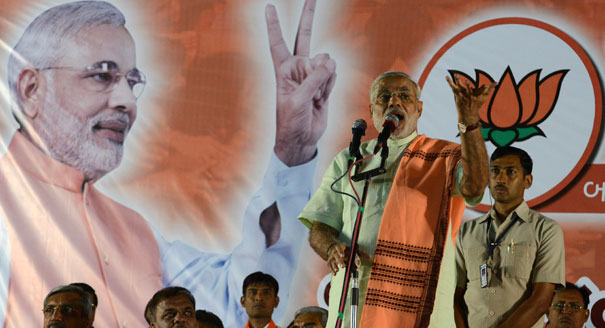
While the recent state elections have been interpreted mostly as a turning point for the Congress, they have been a milestone for another reason and for the whole of India: Hindutva has now reached in a significant manner areas where, till then, it was politically marginal. The rise of BJP majoritarianism may only be resisted by state parties or the articulation of an alternative form of polarisation — not along religious, but social, lines. This repertoire may gain momentum while inequalities are increasing. The state elections next year — especially UP, Gujarat and Punjab — will provide the Opposition parties with one last big opportunity to explore it before the 2019 rendezvous.
This article was originally published in the Indian Express.

Former Nonresident Scholar, South Asia Program
Jaffrelot’s core research focuses on theories of nationalism and democracy, mobilization of the lower castes and Dalits (ex-untouchables) in India, the Hindu nationalist movement, and ethnic conflicts in Pakistan.
Recent Work

Milan Vaishnav, Rahul Verma, Rukmini S., …
Christophe Jaffrelot
Carnegie India does not take institutional positions on public policy issues; the views represented herein are those of the author(s) and do not necessarily reflect the views of Carnegie, its staff, or its trustees.

In any defense establishment, change is an ongoing process. However, despite the best of intentions, existing bureaucracies, bound by habit and years of socialization, have their limits in implementing transformative change.

Anit Mukherjee

As AI grows more sophisticated, as the supply chains that power it become more contested, and as access to frontier models becomes geopolitically charged, India must begin to ask a different set of questions. Not what applications it can build on someone else’s infrastructure but what the world needs.

Konark Bhandari

The Indian Ocean Region hosts one of the densest concentrations of subsea cables in the world. Yet, despite accounting for a significant share of global internet traffic, India’s participation remains limited.

Charukeshi Bhatt

How is AI reshaping space security, creating governance challenges, and where does international diplomacy stand today?


Tejas Bharadwaj, Almudena Azcárate Ortega

After the chill in ties between 2020 and 2024 that brought India–China relations to their lowest point in several decades, the two countries have engaged each other afresh. This paper argues that there are predominantly four imperatives guiding India’s approach to China, and they exist in an order of priority.

Saheb Singh Chadha