

Commentary
Evan A. Feigenbaum
{
  "authors": [
    "Evan A. Feigenbaum"
  ],
  "type": "legacyinthemedia",
  "centerAffiliationAll": "dc",
  "centers": [
    "Carnegie Endowment for International Peace"
  ],
  "collections": [],
  "englishNewsletterAll": "asia",
  "nonEnglishNewsletterAll": "",
  "primaryCenter": "Carnegie Endowment for International Peace",
  "programAffiliation": "AP",
  "programs": [
    "Asia"
  ],
  "projects": [],
  "regions": [
    "South Asia",
    "India",
    "Pakistan",
    "East Asia",
    "China",
    "Central Asia",
    "Kazakhstan",
    "Kyrgyz Republic",
    "Tajikistan",
    "Turkmenistan",
    "Uzbekistan",
    "Russia",
    "Eastern Europe",
    "Belarus"
  ],
  "topics": [
    "Economy",
    "Trade",
    "Foreign Policy",
    "Global Governance"
  ]
}
Source: Getty
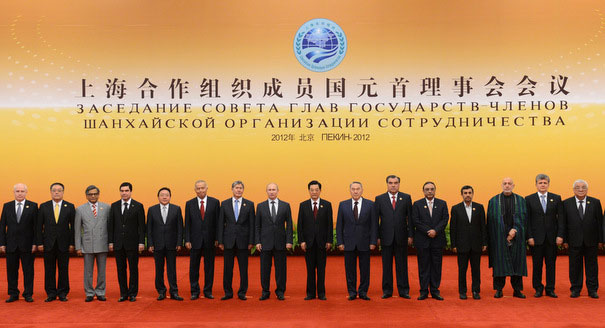
The Shanghai Cooperation Organization will likely become less functional and coherent as the group gets bigger. Form will start to drive function, and the group will begin to search for a purpose.
Source: Voice of America
Speaking to the Voice of America, Carnegie’s Evan Feigenbaum explained why the Shanghai Cooperation Organization (SCO) is likely to become weaker, less coherent, and more diffuse as it expands to include India and Pakistan and potentially other partners in future. He argued that all such institutions weaken when form begins to drive function rather than the other way around. That has been the experience across Asia since the end of the Cold War. Feigenbaum explored the origin of the SCO in a single, focused function: the settlement of border and territorial disputes among China and four Central Asian neighbors. As it has grown to include Uzbekistan and various observers and dialogue partners, the SCO has lost focus and become less functional.
Beyond the SCO itself, Feigenbaum also discussed motivations and drivers for Chinese and Indian strategies and policies in Central Asia. And he reflected on some aspects of the U.S. experience with the SCO from his tenure as Deputy Assistant Secretary of State for the region during the George W. Bush administration.
This broadcast was originally published by Voice of America.

Vice President for Studies
Evan A. Feigenbaum is vice president for studies at the Carnegie Endowment for International Peace, where he oversees work at its offices in Washington, New Delhi, and Singapore on a dynamic region encompassing both East Asia and South Asia. He served twice as Deputy Assistant Secretary of State and advised two Secretaries of State and a former Treasury Secretary on Asia.
Recent Work
Evan A. Feigenbaum
Evan A. Feigenbaum
Carnegie India does not take institutional positions on public policy issues; the views represented herein are those of the author(s) and do not necessarily reflect the views of Carnegie, its staff, or its trustees.

In any defense establishment, change is an ongoing process. However, despite the best of intentions, existing bureaucracies, bound by habit and years of socialization, have their limits in implementing transformative change.

Anit Mukherjee

As AI grows more sophisticated, as the supply chains that power it become more contested, and as access to frontier models becomes geopolitically charged, India must begin to ask a different set of questions. Not what applications it can build on someone else’s infrastructure but what the world needs.

Konark Bhandari

The Indian Ocean Region hosts one of the densest concentrations of subsea cables in the world. Yet, despite accounting for a significant share of global internet traffic, India’s participation remains limited.

Charukeshi Bhatt

How is AI reshaping space security, creating governance challenges, and where does international diplomacy stand today?


Tejas Bharadwaj, Almudena Azcárate Ortega

After the chill in ties between 2020 and 2024 that brought India–China relations to their lowest point in several decades, the two countries have engaged each other afresh. This paper argues that there are predominantly four imperatives guiding India’s approach to China, and they exist in an order of priority.

Saheb Singh Chadha