

Article
C. Raja Mohan, Darshana M. Baruah
{
  "authors": [
    "C. Raja Mohan"
  ],
  "type": "legacyinthemedia",
  "centerAffiliationAll": "dc",
  "centers": [
    "Carnegie Endowment for International Peace",
    "Carnegie India"
  ],
  "collections": [],
  "englishNewsletterAll": "ctw",
  "nonEnglishNewsletterAll": "",
  "primaryCenter": "Carnegie India",
  "programAffiliation": "SAP",
  "programs": [
    "South Asia"
  ],
  "projects": [],
  "regions": [
    "United States",
    "South Asia",
    "India",
    "North America"
  ],
  "topics": [
    "Foreign Policy",
    "Political Reform"
  ]
}
Source: Getty
Trump’s efforts to change America’s trajectory will have huge economic and political consequences for India. Prime Minister Modi must engage in intensive bargaining to close potential deals.
Source: Indian Express
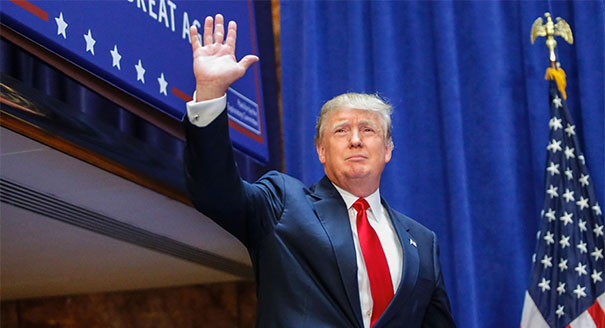
As Donald Trump is sworn in as the 45th president of the United States, India must prepare for the extraordinary turbulence in America’s internal and external orientation. Although the new president is well disposed towards India, his efforts to change America’s trajectory will have huge economic and political consequences for India.
Delhi must be nimble enough to cope with the challenges and take advantage of the new possibilities generated by Trump over the next four years. Nearly two decades of steady improvement in bilateral relations across different administrations in Washington and Delhi has indeed made the relationship less vulnerable to wild oscillations.
In Washington, Delhi has accumulated an abundance of bipartisan goodwill. In Delhi, building on the efforts of his three recent predecessors — P.V. Narasimha Rao, Atal Bihari Vajpayee and Manmohan Singh — Prime Minister Narendra Modi has made bold to declare that India has overcome its past hesitations in engaging America.
On its part, Washington has learnt to curb the recurring itch to mediate in the Kashmir dispute between India and Pakistan. The nuclear dispute that once roiled relations is now behind us. There is a solid business relationship — with annual trade at more than a 100 billion dollars — and a deepening cooperation on bilateral, regional and global issues.
The Indian diaspora has steadily grown in its influence in American domestic politics — it has sent five men and women to the House of Representatives in the 2016 elections. California has also elected Kamala Harris to become the first ever Indian-American senator. This contingent of six from the Indian diaspora is the largest ever to be elected to the US Congress.
Under Modi, India has celebrated the achievements of the diaspora in America and values its role as a bridge between the two nations.
This good news for India is complicated by the fact that the United States has entered an unpredictable phase under Trump. Many propositions that India has taken for granted about the United States — open borders, leadership of the liberal global economic order and military dominance over the Eurasian landmass since the middle of the 20th century — are being challenged by Trump.
Trump has won by promising to curb immigration into the United States by building a wall on the border with Mexico and throwing out those staying on illegally. He has threatened to impose “extreme vetting” on visitors from the Muslim world. He argues that American workers are victims of economic globalisation.
He believes the US taxpayers pay too high a price for American military alliances abroad. He has dismissed the North Atlantic Treaty Organisation, the powerful seven-decade-old Euro-Atlantic alliance, as “obsolete”. Trump demands that US allies in Asia, Japan and South Korea take a larger share of the defence burden.
Trump’s refusal to moderate either the tone or substance of his controversial positions since the election suggests that it will not be business as usual in America for the next four years. To be sure, Trump’s policies will be severely contested in Washington in the US Congress by the opposition Democrats as well as leading lights of his own Republican Party. The mainstream policy and media establishments are already at war with Trump. Even limited successes for Trump, however, would mean that Delhi will be dealing with a very different United States than it has known since Independence.
For one, Delhi will have to quickly come to terms with the historic shift in America’s approach to economic globalisation under Trump. For nearly three decades, Delhi has defined its approach to globalisation in terms of resisting American pressures for liberalisation and standing up to the US in multilateral economic forums. It has repeatedly cried wolf about America’s protectionism. Delhi might now have the opportunity to see what even a moderately protectionist America might really look like.
Insourcing of skilled Indian labour through the H1B visa system and outsourcing of work to Bengaluru are bound to get harder under Trump. Delhi’s somewhat perverse cheer at Trump slaying the Trans Pacific Partnership might be shortlived as many trade partners of the United States embark, kicking and screaming, upon negotiating bilateral deals with Washington.
Delhi needs to end its defensive crouch on external economic engagement and re-position itself to cope with the structural changes that Trump threatens to engineer in the global economic order. As in the economic, so in the political domain, Delhi will have to stop being defensive.
Even as Delhi sought a strategic partnership with America over the last two decades, it invested in insuring against American power in the unipolar world by working with Russia and China for a “multipolar” world. That strategy, arguably, has only helped lend legitimacy to China’s new global role and Russian bargaining power with the West, while slowing down the pace of constructing India’s partnership with the US.
As Moscow pursues a reset with Trump’s Washington, China will seek to postpone, if not limit the potential confrontation with America. Like Moscow and Beijing, Delhi must focus more on securing the national interest in a fluid moment in great power relations.
It can’t afford to remain a prisoner of slogans like multi-polarity. Russia and China will abandon that slogan the minute they have sustainable deals with Trump. The Indian strategic community often complains about America’s “transactional” approach. Delhi must expect Trump, who published the book The Art of the Deal in 1987, to be the epitome of this approach.
While he threatens a trade war and dumps the “One China” policy, Trump has signaled the intent to renegotiate the terms of endearment with Beijing. To succeed in Trump’s world, Prime Minister Modi will need all his skills at identifying India’s potential deals with America and closing the transactions after intensive bargaining.
This article was originally published in the Indian Express.
Former Nonresident Senior Fellow, Carnegie India
A leading analyst of India’s foreign policy, Mohan is also an expert on South Asian security, great-power relations in Asia, and arms control.
Recent Work

C. Raja Mohan, Darshana M. Baruah


Alexander Gabuev, Paul Haenle, C. Raja Mohan, …
Carnegie India does not take institutional positions on public policy issues; the views represented herein are those of the author(s) and do not necessarily reflect the views of Carnegie, its staff, or its trustees.

In any defense establishment, change is an ongoing process. However, despite the best of intentions, existing bureaucracies, bound by habit and years of socialization, have their limits in implementing transformative change.

Anit Mukherjee

As AI grows more sophisticated, as the supply chains that power it become more contested, and as access to frontier models becomes geopolitically charged, India must begin to ask a different set of questions. Not what applications it can build on someone else’s infrastructure but what the world needs.

Konark Bhandari

The Indian Ocean Region hosts one of the densest concentrations of subsea cables in the world. Yet, despite accounting for a significant share of global internet traffic, India’s participation remains limited.

Charukeshi Bhatt

How is AI reshaping space security, creating governance challenges, and where does international diplomacy stand today?


Tejas Bharadwaj, Almudena Azcárate Ortega

After the chill in ties between 2020 and 2024 that brought India–China relations to their lowest point in several decades, the two countries have engaged each other afresh. This paper argues that there are predominantly four imperatives guiding India’s approach to China, and they exist in an order of priority.

Saheb Singh Chadha