Source: Foreign Policy
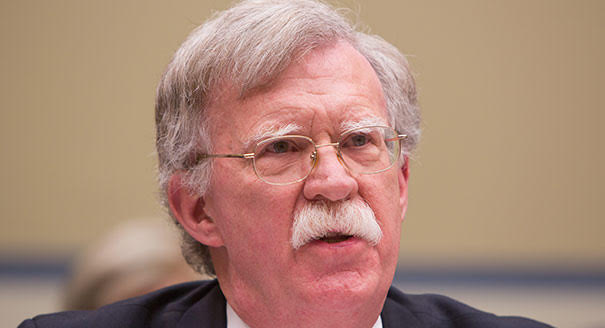
Lt. Gen. H.R. McMaster is out as Trump’s national security advisor, and former U.S. Ambassador to the United Nations (and current Fox News contributor) John Bolton is in. This is no mere rotation of on-screen personalities in the latest episode of “The Trump Show.” It is a move with potentially profound implications for the direction of U.S. foreign policy. Indeed, Bolton’s ascendance increases the risk of not one but two wars—with North Korea and Iran.
McMaster was no dove. But Bolton falls into an entirely different category of dangerous uber-hawk. Fifteen years ago, Bolton championed the Iraq War, and, to this day, he continues to believe the most disastrous foreign-policy decision in a generation was a good idea. Bolton’s position on Iraq was no anomaly. Shortly before the 2003 invasion, he reportedly told Israeli officials that once Saddam Hussein was deposed, it would be necessary to deal with Syria, Iran, and North Korea. He has essentially maintained this position ever since. Put plainly: For Bolton, there are few international problems where war is not the answer.
As the nuclear crisis with North Korea enters a critical period, Trump’s choice of Bolton as national security advisor dims the prospect of reaching a peaceful solution. Bolton, like McMaster, sees Kim Jong Un as fundamentally irrational and undeterrable—a view that seems to justify launching a preventive war if North Korea refuses to denuclearize. But McMaster supported diplomacy and, as a military man with extensive combat experience, understood the costs of war. Bolton, on the other hand, has spent his entire career sabotaging diplomacy with Pyongyang and seems downright giddy about a possible military confrontation.
A little history is helpful here. Bolton was undersecretary of state for arms control and international security when President George W. Bush’s administration made the fateful decision in 2002 to kill the 1994 Agreed Framework with North Korea. The Bill Clinton-era accord froze North Korea’s plutonium program under effective verification. But when it was discovered that Pyongyang was pursuing a separate uranium enrichment program with the help of Pakistan, a key decision had to be made: re-engage in diplomacy to expand the agreement to prohibit uranium enrichment or tear it up, isolate a member of the “Axis of Evil,” and push for regime change. Bush, guided in part by Bolton, chose the latter approach. And once the Agreed Framework collapsed, North Korea took the secured plutonium under its control and built about half a dozen additional nuclear weapons, testing its first in 2006. For many arms control and nonproliferation experts, this case represents a cautionary tale about the risks of foreclosing diplomatic engagement. In Bolton’s mind, however, North Korea’s actions simply prove that diplomacy doesn’t work with rogue states and that the only solution is to end these regimes all together, through U.S. military might if necessary.
More than a decade later, Bolton continues to cling to this dark worldview. In a Sept. 3, 2017, Fox News interview, Bolton declared that the only option left to address the North Korean nuclear challenge is “to end the regime in North Korea” and strike first. “Anybody who thinks that more diplomacy with North Korea, more sanctions, whether against North Korea or an effort to apply sanctions against China, is just giving North Korea more time to increase its nuclear arsenal,” Bolton warned. “We have fooled around with North Korea for 25 years, and fooling around some more is just going to make matters worse.”
In an echo of the rationale that drove the United States to topple Saddam’s regime, Bolton painted an apocalyptic picture of the gathering danger posed by Kim’s nuclear and ballistic missile programs. The North Koreans “are very close to being able to hit targets all across the United States … with thermonuclear weapons,” Bolton said. “Moreover, this regime will sell anything to anybody for hard currency. They could sell these weapons, ballistic missiles and the nuclear devices themselves, to Iran in a heartbeat.… The metaphor of the Axis of Evil is not really a metaphor — it is a reality. North Korea can sell these devices to terrorist groups around the world. They can be used as electromagnetic pulse weapons … destroying our electrical grid’s capabilities. They can be used for nuclear blackmail.” If we fail to act, “it would be a lesson to every would-be nuclear state in the world that if you just have patience enough, you can wear the United States down.” Instead, “we should heed Franklin Roosevelt’s advice.… When you see a rattlesnake poised to strike, you don’t wait until it has struck before you crush it.… I would argue that today North Korean nuclear weapons and ballistic missiles, and Iran’s while we’re on the subject, are the rattlesnakes of the 21st century.”
To further lay the groundwork for taking military action, Bolton penned an op-ed in the Wall Street Journal just last month titled “The Legal Case for Striking North Korea First.” Recalling the Bush administration’s flawed analysis in the run-up to the Iraq War, Bolton argued that “the threat is imminent” and that the United States has every right to take launch a preventive war before it is too late.
On March 8, Trump shocked the world by agreeing to meet with Kim sometime before the end of May. The president’s decision represents a high-stakes gamble that could produce a diplomatic breakthrough — or send the United States and North Korea careening toward a war that could kill hundreds of thousands of people. Reports suggest that the timing of Trump’s move to replace McMaster with Bolton, as well as the president’s earlier decision to fire Secretary of State Rex Tillerson and replace him with Mike Pompeo, is an effort to put key personnel aligned with his views in place leading into the summit. Yet if Bolton reflects, or influences, Trump’s position on North Korea, the entire endeavor is doomed. Indeed, Bolton reacted to news of the summit by dismissing any prospect for success and rooting for a quick failure so the United States can move on to other options. According to Bolton, the only value in having this “unproductive” leader-to-leader meeting now, instead of starting with a more deliberate set of working-level talks, is to “foreshorten the amount of time that we’re going to waste in negotiations that will never produce the result we want, which is Kim giving up his nuclear program.”
Bolton’s doomsaying views are not reserved for North Korea alone; he is equally likely to encourage Trump to chart a path toward military confrontation with Iran. McMaster was no fan of Iran. As an Iraq War veteran who lost troops to Iranian-made rockets and roadside bombs, he favored a muscular policy to push back against the Islamic Republic’s regional ambitions. But McMaster did not favor ditching the 2015 Iran nuclear deal (officially, the Joint Comprehensive Plan of Action, or JCPOA) because he understood that doing so would isolate Washington, not Tehran, and make it even harder to contain Iran’s other destabilizing behavior. Not so with Bolton.
Over the past two years, inspectors with the International Atomic Energy Agency (IAEA) have filed nine consecutive reports showing that Iran is living up to its commitments to constrain its nuclear program in accordance with the JCPOA. Yet Bolton claims, “I don’t think the evidence is there that this agreement is slowing them down.” Bolton has also repeatedly asserted, without any actual evidence, that Iran is on the cusp of acquiring off-the-shelf nuclear weapons from North Korea. “If Tehran’s long collusion with Pyongyang on ballistic missiles is even partly mirrored in the nuclear field,” he wrote last year in the Wall Street Journal, “the Iranian threat is nearly as imminent as North Korea’s. Whatever the extent of their collaboration thus far, Iran could undoubtedly use its now-unfrozen assets and cash from oil-investment deals to buy nuclear hardware from North Korea, one of the world’s poorest nations.” Moreover, for Bolton, actual Iranian compliance with the JCPOA seems beside the point. As he wrote on Twitter in January: “There’s been far too much debate over whether #Iran is in violation of the #NuclearDeal. The point is that this was a bad deal to begin with and it’s a bad deal now and it should be torn up.”
As is the case with North Korea, Bolton’s appointment comes at an incredibly sensitive time for the Iran nuclear deal. In fact, the fate of the JCPOA will likely be decided in May—the same month as the proposed Trump-Kim summit. On Jan. 12, Trump set a 120-day deadline for European allies and Congress to “fix” the agreement, or he would stop waiving U.S. nuclear-related sanctions and withdraw from the deal. McMaster—along with Tillerson and Secretary of Defense James Mattis—repeatedly urged Trump not to trash the JCPOA, searching for a minimally sufficient agreement with Europe and U.S. lawmakers to keep the president in the deal. A State Department team has been working with their counterparts in France, Germany, and the United Kingdom to identify a compromise that would entail additional European commitments to sanction Iran’s ballistic missile program, a reaffirmation of IAEA inspection rights, and a framework to negotiate additional restrictions on Iran’s nuclear program when constraints on uranium enrichment weaken at years 10 and 15 of the JCPOA in exchange for Trump remaining in the accord. Bolton—perhaps with support from fellow Iran hawk Pompeo—is likely to tell the State Department not to bother and encourage the president to reject any arrangement with the Europeans as insufficient.
This article was originally published in Foreign Policy.