

Report
- +2
George Perkovich, Jessica Tuchman Mathews, Joseph Cirincione, …
{
  "authors": [
    "Jon Wolfsthal"
  ],
  "type": "legacyinthemedia",
  "centerAffiliationAll": "dc",
  "centers": [
    "Carnegie Endowment for International Peace"
  ],
  "collections": [
    "U.S. Nuclear Policy",
    "Korean Peninsula"
  ],
  "englishNewsletterAll": "ctw",
  "nonEnglishNewsletterAll": "",
  "primaryCenter": "Carnegie Endowment for International Peace",
  "programAffiliation": "NPP",
  "programs": [
    "Nuclear Policy"
  ],
  "projects": [],
  "regions": [
    "North America",
    "United States",
    "East Asia",
    "North Korea"
  ],
  "topics": [
    "Political Reform",
    "Security",
    "Foreign Policy",
    "Nuclear Policy"
  ]
}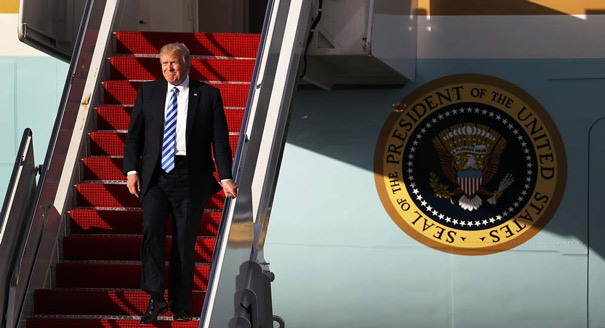
Source: Getty
The hopes for peace and disarmament are understandable, but how quickly will those commitments begin? So far the results are non-existent.
Source: New Republic
The problem with the word “historic” is that it doesn’t mean much, on its own. If it’s all you can say of an event—that it was remarkable for having taken place—then it’s hard to say what it accomplished.
Having worked on and in North Korea for 30 years, I have my doubts that the Singapore meeting and jubilant post-summit presser will lead to the elimination of North Korea’s nuclear weapons. We have seen similar hopes and efforts of past presidents end in failure. “We’re prepared to start a new history and we’re ready to write a new chapter between our nations,” President Trump said at his and Kim Jong Un’s joint press conference Tuesday. The hopes for peace and disarmament are understandable and laudable, and Trump clearly believes that Kim has committed in a real way to achieve the denuclearization that has been sought but never achieved. But turning hope into genuine achievement is why verification exists, and so far we have none to show for our Trump’s efforts.
“President Trump and Chairman Kim Jong Un state the following,” the much-vaunted agreement reads:
1. The United States and the DPRK commit to establish new U.S.-DPRK relations in accordance with the desire of the peoples of the two countries for peace and prosperity.
2. The United States and the DPRK will join their efforts to build a lasting and stable peace regime on the Korean Peninsula.
3. Reaffirming the April 27, 2018 Panmunjom Declaration, the DPRK commits to work toward complete denuclearization of the Korean Peninsula.
4. The United States and the DPRK commit to recovering POW/MIA remains, including the immediate repatriation of those already identified.
This statement has no details, no specifics, and kicks any commitment to concrete steps down the road. “Chairman Kim says North Korea is also destroying a major missile engine testing site. That’s not in your signed document,” Trump added during the joint press conference. But the scope of the test pause by North Korea, what they will have to eliminate and when with respect to their nuclear and missile programs, and what standards of inspections will be required are completely missing. Past agreements have foundered and come apart over small gaps in definitions. Here there are no definitions. Perhaps that is a way to avoid misinterpretations, but more likely that not it leaves the door open for Kim to do whatever he wants, and claim that it is consistent with what the two leaders talked about.
Kim could be making a strategic decision to trade his nuclear capabilities for a new political and economic relationship with the outside world, and particularly the United States. Everyone—Trump supporters or detractors—should hope this is true and support efforts to see if it is. But as indicated by the American decision not to formally lift sanctions yet, there would be quite a few hurdles to clear even were Kim operating in 100 percent good and peaceable faith.
Kim could be making a strategic decision to trade his nuclear capabilities for a new political and economic relationship with the outside world, and particularly the United States. Everyone—Trump supporters or detractors—should hope this is true and support efforts to see if it is. But as indicated by the American decision not to formally lift sanctions yet, there would be quite a few hurdles to clear even were Kim operating in 100 percent good and peaceable faith.
The results of the summit, taken as a stand-alone event, are disappointing and almost meaningless. The test will come starting now. When will the negotiations on what the agreement means start, and how long will they take? President Trump claims there was not enough time to write some of Kim’s commitments to close missile test sites into the joint statement—which raises the question of why they did not take more time, instead of Trump announcing Monday before the summit started that he would in fact be cutting the trip short, jetting out Tuesday evening.
How quickly will those commitments to close missile test sites be codified, and how will they be verified? President Trump said at his press conference after the summit that inspectors will include Americans and international agencies. When will that process start? What rights of access will they have and are there standards for how quickly inspections can take place? All of these questions are the hard part of disarmament. Stating, as North Korea has, that they will work toward the complete elimination of nuclear weapons is the easy part. We know because they have said it a dozen times before.
We are left to wait for the next installment of the Kim-Trump show. To be sure, the process matters: Maybe it does take a direct, personal, friendly relationship to convince Kim to disarm. If it works, we will all rightly stand and applaud a success where others have only found failure. But so far the results are non-existent, and the risks serious.
Trump has helped Kim solidify his position at home, and put him on equal footing with the most powerful country on earth. Kim has also convinced Trump to suspend military exercises and to state that they are, in fact as North Korea has said all along, “provocative.” Despite statements to the contrary, it is clear not least from Beijing’s suggestion immediately following the summit that economic strictures on North Korea could be loosened, that sanctions enforcement will wane. President Trump himself said he had more sanctions ready to go, but held off.
Only time will tell if this historic achievement is more like Reykjavik, which set the stage for the 1987 nuclear treaty with Russia, or Munich, appeasing an authoritarian leader who would take the concessions and run. Neither of those “historic” summits’ results were clear at the time, and only in hindsight did their names become synonymous with success and failure. If Trump has given Kim Jong Un something for nothing, then the ultimate goal of eliminating nuclear weapons from North Korea will become harder than ever.

Former Nonresident Scholar, Nuclear Policy Program
Jon Wolfsthal was a nonresident scholar with the Nuclear Policy Program.
Recent Work

George Perkovich, Jessica Tuchman Mathews, Joseph Cirincione, …
Jon Wolfsthal
Carnegie India does not take institutional positions on public policy issues; the views represented herein are those of the author(s) and do not necessarily reflect the views of Carnegie, its staff, or its trustees.

In any defense establishment, change is an ongoing process. However, despite the best of intentions, existing bureaucracies, bound by habit and years of socialization, have their limits in implementing transformative change.

Anit Mukherjee

How is AI reshaping space security, creating governance challenges, and where does international diplomacy stand today?


Tejas Bharadwaj, Almudena Azcárate Ortega

After the chill in ties between 2020 and 2024 that brought India–China relations to their lowest point in several decades, the two countries have engaged each other afresh. This paper argues that there are predominantly four imperatives guiding India’s approach to China, and they exist in an order of priority.

Saheb Singh Chadha

This piece argues that India’s central challenge is not managing a single flashpoint but resolving the underlying tension between expansion and institutional coherency of the BRICS grouping.

Vrinda Sahai

A partnership between India, a country of subcontinental size, and Africa, a continent of fifty-four countries, may seem asymmetric until one notes that both are home to nearly the same number of people—1.4 billion. This essay spells out the existing challenges to the partnership, its optimal potential, and the possible pathways to realize it over the next quarter-century.

Rajiv Bhatia