

Commentary
Jamie Kwong, Toby Dalton
{
  "authors": [
    "Toby Dalton"
  ],
  "type": "legacyinthemedia",
  "centerAffiliationAll": "dc",
  "centers": [
    "Carnegie Endowment for International Peace"
  ],
  "collections": [
    "U.S. Nuclear Policy",
    "Korean Peninsula"
  ],
  "englishNewsletterAll": "ctw",
  "nonEnglishNewsletterAll": "",
  "primaryCenter": "Carnegie Endowment for International Peace",
  "programAffiliation": "NPP",
  "programs": [
    "Nuclear Policy"
  ],
  "projects": [],
  "regions": [
    "North America",
    "United States",
    "East Asia",
    "South Korea",
    "North Korea"
  ],
  "topics": [
    "Security",
    "Military",
    "Foreign Policy",
    "Nuclear Policy",
    "Arms Control"
  ]
}
Source: Getty
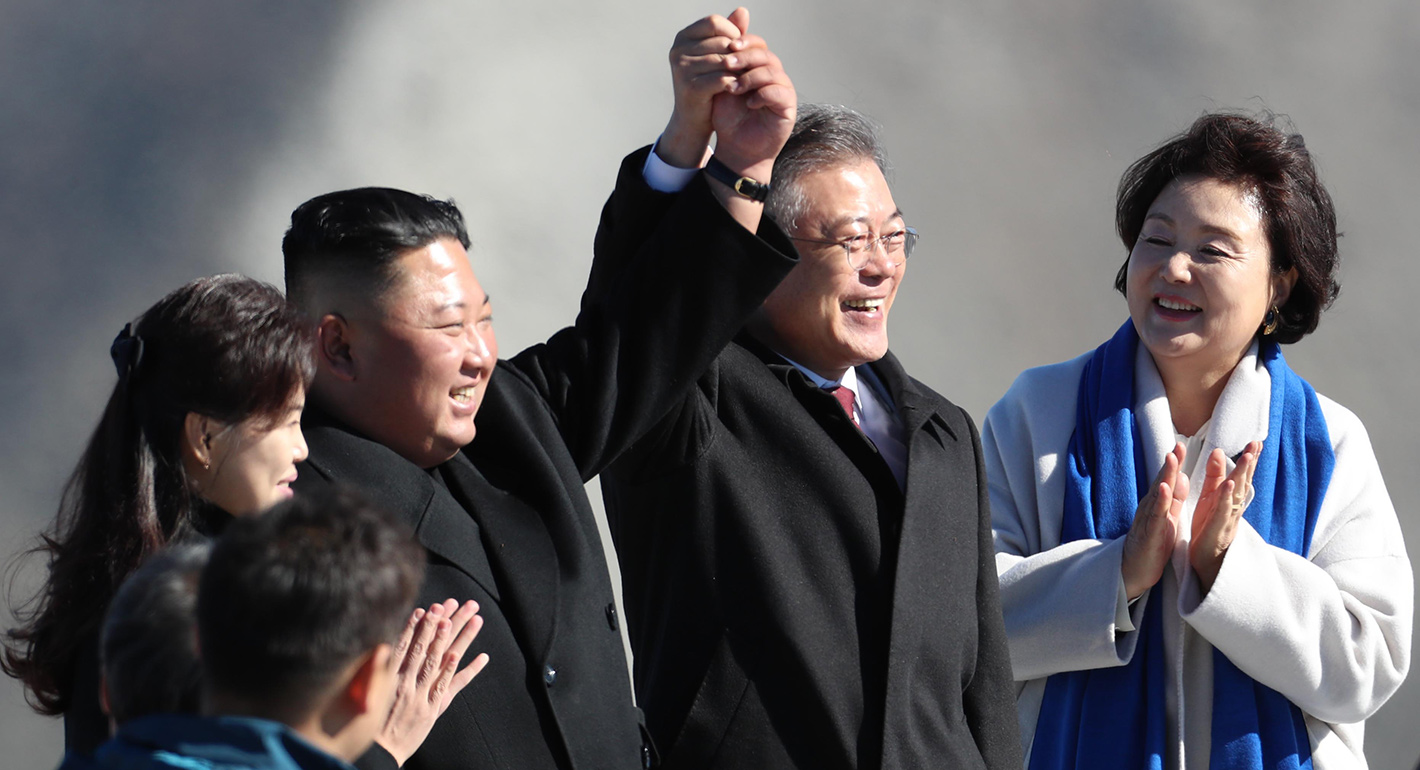
If the new inter-Korean military agreement signed by the leaders of North and South Korea is implemented, the chances of miscalculation or accident escalating to war will subside. However, there a serious challenge to bolster progress towards stable peace on the peninsula.
Source: War on the Rocks
The heavy scrutiny of North Korea’s promises on denuclearization at the September North-South summit in Pyongyang buried otherwise important progress: If the new inter-Korean military agreement signed by the leaders of the two Koreas is implemented, the chances of accidents or miscalculation escalating to full-blown war will decline. But there is an inherent contradiction in the agreement that presents both a serious challenge to its implementation and an opportunity to bolster progress toward a stable peace on the peninsula.
The contradiction is located in the third paragraph of the agreement, which establishes no-fly zones near the military demarcation line that divides the two Koreas for fixed-wing and rotary aircraft, manned or unmanned. These zones are intended to decrease the likelihood that air operations might inadvertently raise tensions or lead to accidental conflict.
Some observers complained that these zones disproportionately affect South Korea by eroding its significant surveillance and reconnaissance advantage over North Korea. The rough mountainous and forested terrain in the demilitarized zone that surrounds the military demarcation line makes aerial monitoring arguably the single most important means of observing military activity on either side, especially for purposes of operational readiness and warning. In agreeing to these restraints, some critics contend that South Korean President Moon Jae-in “risks going too far by lowering allied defenses before North Korea’s conventional threat to South Korea, and U.S. troops stationed there, is reduced.” Since U.S. forces in Korea operate through a Combined Forces Command jointly with South Korean forces, the new inter-Korean agreement presumably places new restrictions on aerial support for U.S. personnel deployed at bases within the no-fly zones.
Yet there is a more pernicious problem. By limiting aerial observation through no-fly zones, the two sides will be less able to actually verify compliance with many of the restraint measures contained in the agreement, such as the proscription on artillery exercises near the military demarcation line. Essentially, the agreement blindfolds both parties such that they will have difficulty confirming that the other side is adhering to the deal – which could diminish the agreement’s ability to deter cheating. Importantly, this limitation portends great difficulty verifying other long-sought military confidence-building measures, such as the withdrawal of deployed artillery pieces or multiple rocket launch systems.
Though South Korea and the United States have satellite and other remote sensing platforms to mitigate data loss from the cessation of aerial monitoring, North Korea does not. Unless it receives such information from a third party such as China, North Korea will be relatively more blind to activity south of the military demarcation line. Pyongyang’s inability to verify Seoul’s compliance with the agreement could well lead to false claims of cheating or worse by North Korea down the road. The bottom line is that given minimal trust between the two Koreas resulting from failures to implement similar prior agreements, verifying military restraint measures is necessary to actually reduce the probability of escalation.
This contradiction in an agreement intended to reduce military tensions could be a critical flaw, but it also presents an opportunity to establish new means of cooperative monitoring that could fill the information gap for both North and South Korea. The idea would be to establish, under the auspices of the inter-Korean military committee created by the September agreement, a system for observation for purposes of verifying agreed military restraints. For instance, the two could undertake joint air patrols on designated aircraft that would utilize commercially available photo equipment or other methods to provide validated and shared information. Such an approach could help the two sides affirm compliance with limits on military activity in the buffer zones on either side of the military demarcation line, as well as deepen patterns of regular military cooperation. Given the involvement of U.S. and U.N. forces in this theater, multi-party or third-party monitoring may facilitate the necessary information-sharing and extend the potential confidence-building benefits.
In other words, joint monitoring would give both sides the same information and a means of resolving any concerns about compliance. It would also forge a degree of cooperation that could be a building block for future peacebuilding agreements. The existence of the military demarcation zone means the potential for cooperative monitoring has, in theory, always existed. But the recent agreement makes such monitoring especially necessary because the no-fly zones limit independent verification.
Cooperative monitoring is not a new idea, of course. Following diplomatic warming in the early 1990s and again during the era of South Korea’s “sunshine” policy in the 2000s, Korean and American experts developed a range of ideas for implementing cooperative monitoring systems to help reduce instability and build confidence on the Korean Peninsula.
These ideas have gathered dust over the last decades, but today it is worth revisiting how they might now help the two Koreas break the cycle of crisis and solidify a lasting peace. The agreement to reduce military tensions has real potential to lower the risk of war and be a building block for lasting peace on the peninsula, but only if this contradiction is managed in a way that provides maximum opportunity for cooperation between these bitter rivals.

Senior Fellow and Co-director, Nuclear Policy Program
Toby Dalton is a senior fellow and co-director of the Nuclear Policy Program at the Carnegie Endowment. An expert on nonproliferation and nuclear energy, his work addresses regional security challenges and the evolution of the global nuclear order.
Recent Work

Jamie Kwong, Toby Dalton

Ariel (Eli) Levite, Toby Dalton
Carnegie India does not take institutional positions on public policy issues; the views represented herein are those of the author(s) and do not necessarily reflect the views of Carnegie, its staff, or its trustees.

In any defense establishment, change is an ongoing process. However, despite the best of intentions, existing bureaucracies, bound by habit and years of socialization, have their limits in implementing transformative change.

Anit Mukherjee

How is AI reshaping space security, creating governance challenges, and where does international diplomacy stand today?


Tejas Bharadwaj, Almudena Azcárate Ortega

After the chill in ties between 2020 and 2024 that brought India–China relations to their lowest point in several decades, the two countries have engaged each other afresh. This paper argues that there are predominantly four imperatives guiding India’s approach to China, and they exist in an order of priority.

Saheb Singh Chadha

This piece argues that India’s central challenge is not managing a single flashpoint but resolving the underlying tension between expansion and institutional coherency of the BRICS grouping.

Vrinda Sahai

A partnership between India, a country of subcontinental size, and Africa, a continent of fifty-four countries, may seem asymmetric until one notes that both are home to nearly the same number of people—1.4 billion. This essay spells out the existing challenges to the partnership, its optimal potential, and the possible pathways to realize it over the next quarter-century.

Rajiv Bhatia