

Commentary
Kheder Khaddour
{
  "authors": [
    "Kheder Khaddour"
  ],
  "type": "other",
  "centerAffiliationAll": "dc",
  "centers": [
    "Carnegie Endowment for International Peace",
    "Malcolm H. Kerr Carnegie Middle East Center"
  ],
  "collections": [],
  "englishNewsletterAll": "menaTransitions",
  "nonEnglishNewsletterAll": "",
  "primaryCenter": "Malcolm H. Kerr Carnegie Middle East Center",
  "programAffiliation": "MEP",
  "programs": [
    "Middle East"
  ],
  "projects": [
    "X-Border Local Research Network"
  ],
  "regions": [
    "Türkiye",
    "Levant",
    "Syria",
    "Middle East"
  ],
  "topics": [
    "Political Reform"
  ]
}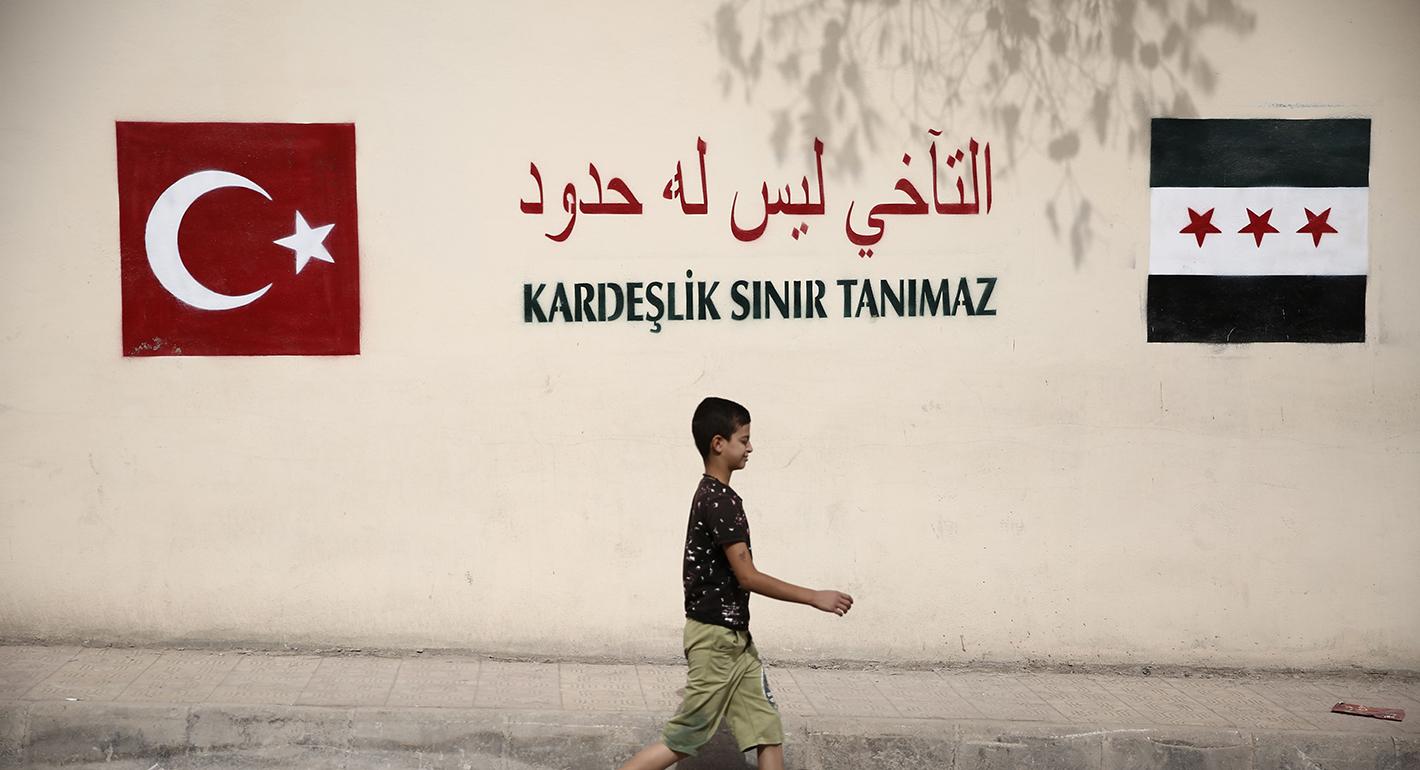
Source: Getty
The Syrian-Turkish border has also allowed Turkey to play a greater role in Syria, fulfilling Turkish regional ambitions while also generating economic activity ensuring that internally displaced Syrian refugees remain inside Syria.
Source: Peripheral Vision
In March 2020, Russia and Turkey agreed to a ceasefire in Idlib Governorate. This followed a fierce military campaign waged by the Syrian regime and its armed forces aimed at regaining control over large parts of Syria’s northwest.
Under the terms of the deal, Turkey will be allowed to keep a foothold in Idlib. In practical terms this means it will have de facto control over the local economy. The Turks have already invested heavily in the area, and have deployed large numbers of troops in Idlib. The end result is likely to be the creation of a border zone between Turkey and Syria after the Turkish military connects the different areas it has come to control in northern Syria.
So far, Turkish military operations have created four such border zones, each named for the military operation in which Turkey seized territory. The Euphrates Shield operation in 2016 and 2017 led to Turkish control over northern Aleppo Governorate. In 2018, Turkey took northwestern Aleppo Governorate through its Olive Branch operation. In 2019, it used its Peace Spring operation to occupy areas east of the Euphrates River. Finally, in 2020 the Turkish army launched an operation in Idlib called Spring Shield.The dynamics of Syria’s civil war changed fundamentally following the Russian intervention in September 2015. Serious efforts to replace the Assad regime in Damascus came to an end, and the rebels, including hardline Islamist groups, were pushed northwards into areas near the Turkish border. Today, tens of thousands of armed men are concentrated near the border with Turkey.
In addition, there are about 3.6 million Syrians currently residing in Turkey. About 1.5 million of them live in cities near or on the southern border, including Gaziantep, Kilis, Hatay and Urfa. About 2 million more Syrians live just over the border in Syria itself. Syrians, many in partnership with Turks, have registered some 3,000 trading companies in Turkey to distribute their products in these four Syrian border zones, and from there all across Syria. Turkey’s control over the zones, therefore, will heavily influence the local economy.
The main border crossings between Syria and Turkey are Bab al-Salameh, which crosses from Idlib Governorate into Turkey’s Hatay Province, and Bab al-Hawa, which crosses from northern Aleppo into Kilis and Gaziantep Provinces. These crossings are lifelines for those areas in northern Syria that are outside the control of the Assad regime, and remain major conduits for people and goods.
While a third of the Syrian population today is somehow tied to Turkey economically and administratively, the Syrians still operate within Syria’s economic landscape. In military terms, the war in Syria is reaching its end. According to the agreement reached in March, the Assad regime will control the M4 and M5 international highways, which connect the key cities of Aleppo, Damascus, and Latakia to each another and to Syria’s east. However, Damascus’ control will not extend to the border with Turkey.
Consequently, the Turkish-controlled zone in northern Syria will be neither a part of Syria nor of Turkey. Rather, it will function as a buffer between the two, while playing an important economic function. On the Turkish side, in provinces such as Gaziantep, Kilis, and Hatay, many Turks have deep economic ties with Syrians on the other side of the border. This buffer zone will therefore bring major economic benefits to both sides—the Turks and the Syrians living in the border are creating an area where it is safe to conduct commercial activities.
In this way, the Syrian regime will have succeeded in changing the nature of the situation in Syria from a domestic uprising into one that involves a border conflict with Turkey. In turn, Turkey’s involvement in the Syrian border economy will mean its greater involvement in Syrian affairs. Therefore, the border has allowed the Syrian regime and Turkey to advance their respective political agendas. For the Assad regime it has focused attention away from the uprising against Assad rule, thereby effectively transcending it. It has also allowed Turkey to play a greater role in Syria, fulfilling Turkish regional ambitions while also generating economic activity ensuring that internally displaced Syrian refugees remain inside Syria.

This article was originally published in Peripheral Vision.

Nonresident Scholar, Malcolm H. Kerr Carnegie Middle East Center
Kheder Khaddour is a nonresident scholar at the Malcolm H. Kerr Carnegie Middle East Center in Beirut. His research focuses on tribal structures in the Levant, civil-military relations in Syria, and the role of borders in shaping local and national identities across the Middle East.
Recent Work
Kheder Khaddour
Kheder Khaddour
Carnegie India does not take institutional positions on public policy issues; the views represented herein are those of the author(s) and do not necessarily reflect the views of Carnegie, its staff, or its trustees.
An Israeli response to Iran’s October 1 attack is imminent. The key question is of its intensity and potential fallout, both within Iran, in terms of nuclear security policy changes, and across the broader region. The coming days are likely to reshape West Asia irreversibly.
Gaddam Dharmendra
As India’s economy recovers from the coronavirus pandemic, Indian businesses need efficient financial structures to regain their ground. Key reforms to India’s Insolvency and Bankruptcy Code could fill these gaps.

Anirudh Burman

Access to cross-border data is an integral piece of the law enforcement puzzle. India is well placed to lead the discussions on international data agreements subject to undertaking necessary surveillance reforms.

Smriti Parsheera, Prateek Jha
After the coronavirus pandemic wanes, how will China’s reorientation of the Belt and Road Initiative to address global health concerns influence its relationships with South Asian countries?
Deep Pal, Rahul Bhatia
Early in the outbreak, government researchers forecast several high-risk scenarios that were downplayed or ignored in public messaging.
Gautam I. Menon