

Commentary
Thomas de Waal
{
  "authors": [
    "Thomas de Waal"
  ],
  "type": "legacyinthemedia",
  "centerAffiliationAll": "dc",
  "centers": [
    "Carnegie Endowment for International Peace",
    "Carnegie Europe"
  ],
  "collections": [
    "Europe’s Eastern Neighborhood"
  ],
  "englishNewsletterAll": "ctw",
  "nonEnglishNewsletterAll": "",
  "primaryCenter": "Carnegie Europe",
  "programAffiliation": "EP",
  "programs": [
    "Europe"
  ],
  "projects": [],
  "regions": [
    "Russia",
    "North America",
    "Eastern Europe",
    "Caucasus",
    "Azerbaijan",
    "Armenia",
    "Iran"
  ],
  "topics": [
    "Foreign Policy",
    "Security"
  ]
}
Source: Getty
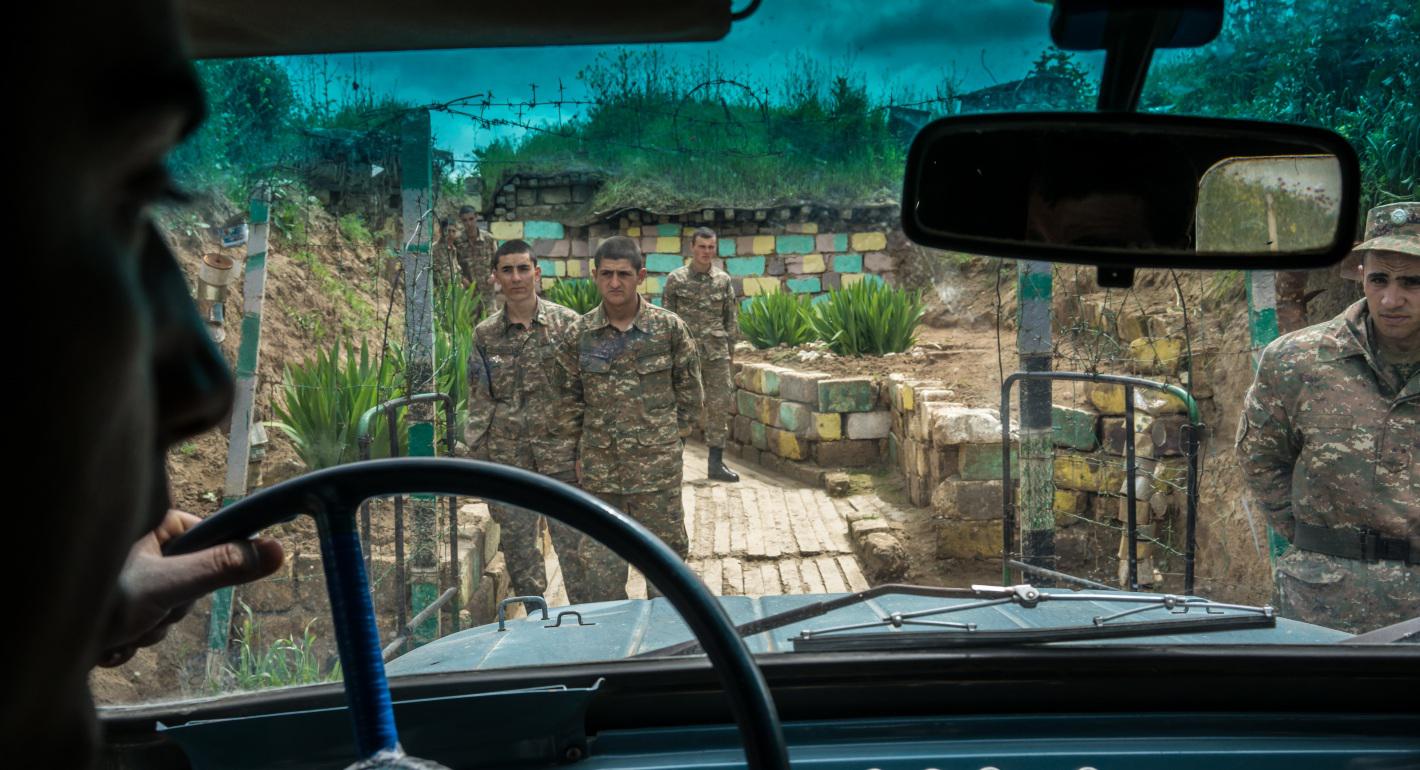
Turkey’s involvement, Iran’s proximity, the enigmatic role of Russia, and the presence of major oil and gas pipelines in the region can quickly turn the new violence between Armenia and Azerbaijan into an international headache.
Source: Politico Europe
More than two decades after it was signed, the cease-fire agreement that—mostly—kept a lid on Europe’s longest-running conflict has broken down.The violence that erupted Sunday between Armenia and Azerbaijan over the breakaway territory of Nagorno-Karabakh looks to be the most serious clash since a Russian-mediated cease-fire in 1994.
And the fighting over the region—which is now entirely populated by Armenians but is officially still regarded as part of Azerbaijan—may only have just begun.
Two new factors make the risk of further escalation and mass destruction alarmingly high.
The first is that Recep Tayyip Erdoğan’s Turkey—a major power and still a member of the only international body mediating the conflict, the so-called Minsk Group of the Organization for Security and Cooperation in Europe (OSCE)—has openly backed Azerbaijan and declared Armenia “the biggest threat to peace and tranquillity in the region.”
While Turkey has always given political support to its Turkic brother Azerbaijan, Ankara also previously acted as a restraining influence on Baku, calling for a peaceful settlement of the conflict.
Those days now appear to be over, breaking the geopolitical equilibrium that has prevailed around the conflict so far.
The second factor is that the United States is unusually disengaged.
Since 1997, Washington has been one of three “co-chairs” of the Minsk Group mediation effort, along with France and Russia. In 2001, in more assertive times, the U.S. invited the presidents of Armenia and Azerbaijan to Key West, Florida, for a major U.S.-mediated meeting that briefly seemed to offer a solution to the conflict.
Yet after violence broke out Sunday, Washington was the last major international actor to issue a statement, indicating a retreat from interest in this region. It is arguably also a sign that President Donald Trump—sponsor of the never-completed Trump Tower in Baku—views Armenia and Azerbaijan solely through a business perspective.
The flare-up can also be seen as a symptom of a world in which the U.S. is no longer acting to defuse regional conflicts. Nagorno-Karabakh is, after all, the third conflict zone in which Turkey is facing off against Russia, after Syria and Libya.
As for the European Union, it has never had a role in this conflict, in strong contrast to the Balkans. When the fighting started in the 1990s, the EU did not have the pretensions to a geopolitical role that it has now. Since 1997, France has been the third mediator but, despite periodic interventions by French presidents, it has not taken a sustained interest in resolving the conflict.
All this has resulted in a great deal of unused international potential. Years have gone by with desultory diplomatic activity: discussions over the wording of a framework document that dates back to 2006 or over how many OSCE monitors should be stationed on the ground.
The big issues—how to resolve the political status issue, or who can be persuaded to staff a peacekeeping force to ensure the two sides disengage, for example—have been avoided or defaulted to Russian diplomats.
Groan as they may about this faraway conflict in the hills of the Caucasus, with its unpronounceable name, the Europeans and Americans will ultimately have no option but to engage with it more seriously. Turkey’s involvement, Iran’s proximity, the enigmatic role of Russia, the presence of major oil and gas pipelines all make this a region where a local flare-up can quickly turn into an international headache.
There is also of course a humanitarian imperative. The last time there was a full-blown war in the region, about 20,000 people were killed and more than 1 million displaced from their homes. Both countries have undergone a fearsome militarization since fighting stopped, buying heavy artillery, attack aircraft, drones and long-range missiles, as there was never a truce on the aggressive rhetoric that stoked fear on both sides.
It is unacceptable that similar devastation could occur in two European countries again.
In 1992, the newly formed Minsk Group called for an international conference to resolve the conflict but it never happened. It is time to convene that conference.

Senior Fellow, Carnegie Europe
Thomas de Waal is a senior fellow at Carnegie Europe, specializing in Eastern Europe and the Caucasus.
Recent Work
Thomas de Waal

Thomas de Waal, Areg Kochinyan, Zaur Shiriyev
Carnegie India does not take institutional positions on public policy issues; the views represented herein are those of the author(s) and do not necessarily reflect the views of Carnegie, its staff, or its trustees.

This piece argues that India’s central challenge is not managing a single flashpoint but resolving the underlying tension between expansion and institutional coherency of the BRICS grouping.

Vrinda Sahai

A partnership between India, a country of subcontinental size, and Africa, a continent of fifty-four countries, may seem asymmetric until one notes that both are home to nearly the same number of people—1.4 billion. This essay spells out the existing challenges to the partnership, its optimal potential, and the possible pathways to realize it over the next quarter-century.

Rajiv Bhatia

The India–EU Free Trade Agreement (FTA) is shaping up to be one of the most consequential trade negotiations, both economically and strategically. But, what’s in the agreement, what’s missing, and what will determine its success in the years ahead
Vrinda Sahai, Nicolas Köhler-Suzuki

This piece argues that the present Indian strategy, based on opportunistic diversification and utilization of limited strategic reserves, remains inadequate when confronting supply disruptions. It evaluates India’s options in the short, medium, and long terms.
Vrinda Sahai

Trump 2.0 has unsettled India’s external environment—but has not overturned its foreign policy strategy, which continues to rely on diversification, hedging, and calibrated partnerships across a fractured order.



Milan Vaishnav, ed., Sameer Lalwani, Tanvi Madan, …