

Paper
Ashley J. Tellis
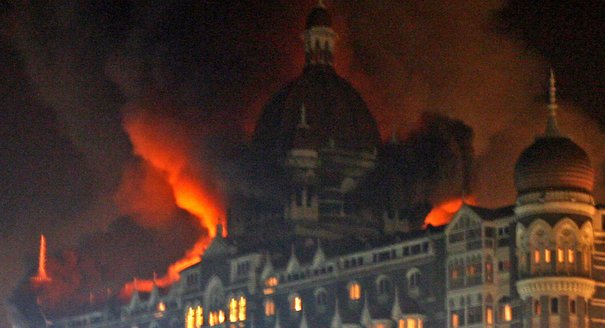
Source: Getty
India will continue to face a serious jihadi threat from Pakistan-based terrorist groups for the foreseeable future. However, India lacks military options that have strategic-level effects without a significant risk of a military response by Pakistan. Neither Indian nor U.S. policy is likely to be able to reduce that threat significantly in the short to medium term.
The November 26, 2008, terrorist attack in Mumbai, which killed at least 172 people, has been referred to as “India’s 9/11.” By most measures, it was not the first significant terrorist attack in India. After all, the July 2006 Mumbai commuter train bombings yielded 209 deaths. There was no use of unconventional weapons. And it was not the first time terrorists had landed by sea in Mumbai. Nevertheless, some aspects of this attack were significant, namely, its audacious and ambitious scope, the complexity of the operation, and the diversity of its targets. The prolonged nature of the episode, which went on for 60 hours with the steadily mounting death toll, made it a slow-motion shoot-out and siege that mesmerized the world’s news media.
Given previous terrorist attacks in India, it was not difficult to situate the motives for the Mumbai attack in the continuing Islamist terrorist campaign. Evidence suggests that Lashkare-Taiba (LeT), a terrorist group based in Pakistan, was responsible for the attack. Pakistanbased terrorists see India as part of the “Crusader-Zionist-Hindu” alliance, and therefore the enemy of Islam. “Muslim” Kashmir ruled by majority “Hindu” India, provides a specific cause, but LeT has always considered the struggle in Kashmir as part of the global struggle, hence
the specific selection of Americans and Britons as targets for murder, and the inclusion of the Jewish Chabad center as a principal target. (While most sources allege that the terrorists deliberately targeted Americans and Britons, others, including Jane’s, suggest that the shootings at the hotel were as indiscriminate as those at the Chhatrapati Shivaji Terminus). LeT has declared that its objective is not merely liberating Kashmir but breaking up India. More pragmatically, a terrorist attack on India can exacerbate antagonisms between India’s Hindu
and Muslim communities and provoke Hindu reprisals that, in turn, divide India and facilitate recruiting by Islamist extremists.
Why Mumbai? Mumbai is India’s commercial and entertainment center—India’s Wall Street, its Hollywood, its Milan. It is a prosperous symbol of modern India. It is also accessible by sea. From the terrorist perspective, the Taj Mahal Palace and Trident-Oberoi Hotels provided ideal venues for killing fields and final bastions. As landmark properties, especially the historic Taj, they were lucrative targets because of the psychological effect of an attack on them. They were filled with people—foreigners and the local elite. The attacks on foreigners
guaranteed international media coverage. The message to India was, “Your government cannot protect you. No place is safe.” And the international publicity would inevitably result in travel to India being cancelled or postponed with consequent damage to India’s economy. The selection of targets—Americans, Britons, and Jews, as well as Indians—suggests that LeT intended the attack to serve a multiplicity of objectives that extended beyond this terrorist group’s previous focus on Kashmir and India.
The terrorists’ attacks have increased tensions between India and Pakistan, which could have been part of the terrorists’ strategic objectives. The prospect of another armed confrontation with India or of India’s conducting military attacks on suspected terrorist training bases in Pakistan, will provoke anger and strengthen Pakistani hardliners. That, in turn, will take the pressure off of the terrorists based in Pakistan by forcing a redeployment of Pakistani forces from the frontier tribal areas to the border with India.
LeT’s role in the attack raises the issue of Pakistan’s own involvement. We do not know for certain whether LeT carried out this operation without the knowledge or approval of Pakistan’s army or intelligence services, or whether the attack was instigated or encouraged by sectors of the Pakistani military or intelligence service to change the course of Pakistan’s own government. (The implications of these possibilities are discussed elsewhere.)
Terrorist attacks are intended not only to cause fear and alarm but also to inspire terrorist constituencies and attract recruits. By succeeding—and here “success” means humiliating the Indian security services, causing large-scale death and destruction, and garnering global media coverage for days—terrorists hope to attract both Pakistani and Indian recruits to their cause.
Other RAND authors of the report include Angel Rabasa, Robert D. Blackwill, Peter Chalk, Kim Cragin, C. Christine Fair, Brian A. Jackson, Brian Michael Jenkins, Seth G. Jones, and Nathaniel Shestak.
Former Senior Fellow
Ashley J. Tellis was a senior fellow at the Carnegie Endowment for International Peace.
Recent Work
Ashley J. Tellis
Ashley J. Tellis
Carnegie India does not take institutional positions on public policy issues; the views represented herein are those of the author(s) and do not necessarily reflect the views of Carnegie, its staff, or its trustees.

In any defense establishment, change is an ongoing process. However, despite the best of intentions, existing bureaucracies, bound by habit and years of socialization, have their limits in implementing transformative change.

Anit Mukherjee

As AI grows more sophisticated, as the supply chains that power it become more contested, and as access to frontier models becomes geopolitically charged, India must begin to ask a different set of questions. Not what applications it can build on someone else’s infrastructure but what the world needs.

Konark Bhandari

The Indian Ocean Region hosts one of the densest concentrations of subsea cables in the world. Yet, despite accounting for a significant share of global internet traffic, India’s participation remains limited.

Charukeshi Bhatt

How is AI reshaping space security, creating governance challenges, and where does international diplomacy stand today?


Tejas Bharadwaj, Almudena Azcárate Ortega

After the chill in ties between 2020 and 2024 that brought India–China relations to their lowest point in several decades, the two countries have engaged each other afresh. This paper argues that there are predominantly four imperatives guiding India’s approach to China, and they exist in an order of priority.

Saheb Singh Chadha