

Other
- +4
Ilana Feldman, Frederic Wehrey, Andrew Bonney, …
Source: Getty
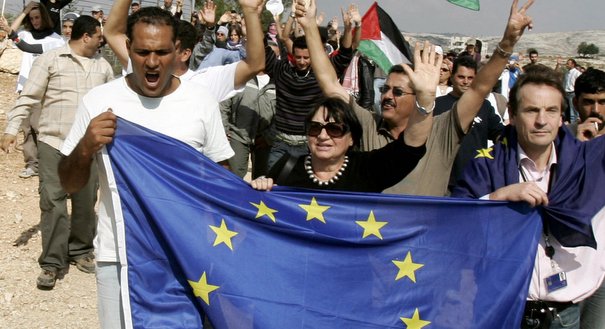
For the EU to be an effective player in the Middle East, it should seek an efficient division of labor with the United States and pursue greater political engagement in the Palestinian territories, Syria, and Lebanon.
Although Europe actively tries to manage Middle East crises it undermines its economic, political, and security interests by assuming a secondary role to the United States and following its policy line. For the EU to be an effective player in the Middle East peace process, it must pursue greater political engagement on three tracks: the Palestinian territories, Syria, and Lebanon.
Drawing on interviews with EU delegations and European embassies as well as a wealth of local actors in Lebanon, Syria, and the Palestinian territories, Muriel Asseburg assesses Europe’s on the ground efforts in conflict management and recommends a more effective European approach to the Arab–Israeli conflict.
Key Conclusions:
Asseburg concludes:
“It is time for Europeans to rethink their policy approaches, refocus their activities, and seek a more effective coordination and division of labor with the new U.S. administration. Not only are intensified efforts needed to reinvigorate the Israeli–Palestinian negotiations, Europeans should also stand ready to help advance the other tracks of the peace process. In the end, for Europeans, it is not about claiming a role as a ‘player,’ but about assuming that role and engaging in politics.”

Former Visiting Scholar, Middle East Center
Asseburg's current research focuses on the Middle East conflict, German and Middle East politics, the Euro–Mediterranean Partnership, and state building, political reform, and political Islam in the Middle East. She was previously with the Friedrich Ebert Foundation’s office in Jerusalem.
Recent Work

Ilana Feldman, Frederic Wehrey, Andrew Bonney, …
Muriel Asseburg
Carnegie India does not take institutional positions on public policy issues; the views represented herein are those of the author(s) and do not necessarily reflect the views of Carnegie, its staff, or its trustees.

How is AI reshaping space security, creating governance challenges, and where does international diplomacy stand today?


Tejas Bharadwaj, Almudena Azcárate Ortega

The U.S.–India semiconductor cooperation story is well-stocked with top-level strategic intent. What remains unresolved, however, are some underlying challenges that will determine whether the cooperation actually functions. Three such friction points stand out.

Shruti Mittal

India and the United States are close to concluding a Reciprocal Defense Procurement Agreement (RDPA) that will allow firms from the two countries to sell to each other’s defense establishments more easily. While this may not remedy the specific grievances both sides may have regarding larger bilateral issues, an RDPA could restore some momentum, following the trade deal announcement.

Konark Bhandari

On the last day of the India AI Impact Summit, India signed Pax Silica, a U.S.-led declaration seemingly focused on semiconductors. While India’s accession to the same was not entirely unforeseen, becoming a signatory nation this quickly was not on the cards either.
Konark Bhandari

This piece examines India’s response to U.S. sanctions and tariffs, specifically assessing the immediate market consequences, such as alterations in import costs, and the broader strategic implications for India’s energy security and foreign policy orientation.

Vrinda Sahai