

• Research
  • About
  • Experts
Carnegie India logoCarnegie lettermark logo
The Egyptian Muslim Brotherhood: Islamist Participation in a Closing Political Environment

Source: Getty

Paper
Malcolm H. Kerr Carnegie Middle East Center

The Egyptian Muslim Brotherhood: Islamist Participation in a Closing Political Environment

By scaling back its political engagement to focus on a traditional religious, educational, and social agenda, the Egyptian Muslim Brotherhood is leaving behind an even greater lack of political competition in the country.

Link Copied
By Amr Hamzawy and Nathan J. Brown
Published on Mar 9, 2010

Additional Links

Full Text

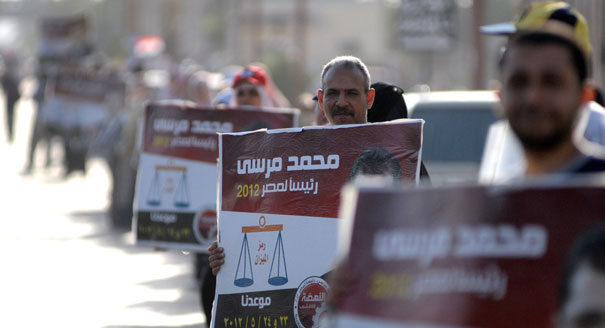
The Egyptian Muslim Brotherhood has begun to scale back its political engagement because the results have been few, government repression continues, and other opposition groups mistrust the movement. Instead it will focus on a traditional religious, educational, and social agenda. The result will be an even greater lack of political competition.

In a detailed profile of the Muslim Brotherhood’s activities over the last decade, this paper examines the Brotherhood’s relations with the Mubarak regime and other opposition groups, its legislative priorities and accomplishments, and its internal debate over the value of political participation.

Key Conclusions:

  • For the last ten years, the Brotherhood focused on political reforms and socioeconomic legislation, largely at the expense of its moral and religious agenda—a strategy now under criticism as the movement suffers increased suppression and has few legislative accomplishments.
     
  • While the Brotherhood is unlikely to renounce political activity altogether, recent internal party elections saw advocates for political participation ousted. The newly-elected head of the movement, Muhammad Badi, is known for emphasizing the movement’s moral and religious activities.
     
  • The Brotherhood has had limited success building ties with other opposition movements, despite its de-emphasis on its moral and religious agenda. Lingering mistrust between Islamists and non-Islamist parties, plus the Brotherhood’s reluctance to join protests (for fear of incurring further crackdowns), has left the movement isolated.
     
  • The international community is unlikely to protest the restrictions placed upon the Brotherhood by the government. While enjoying increased international acceptance and respect—a result of concerted outreach effort following the September 11 attacks—the Brotherhood is aligned with political forces (like Hamas) deemed counter to Western interests.


“With the Brotherhood’s retreat, a fleeting opportunity that seemed to arise in the middle of the decade for building a more pluralistic political system and for an open political contest between competing visions for Egypt’s future appears to have been lost,” the authors conclude.

About the Authors

Amr Hamzawy

Director, Middle East Program

Amr Hamzawy is a senior fellow and the director of the Carnegie Middle East Program. His research and writings focus on governance in the Middle East and North Africa, social vulnerability, and the different roles of governments and civil societies in the region.

Nathan J. Brown

Nonresident Senior Fellow, Middle East Program

Nathan J. Brown, a professor of political science and international affairs at George Washington University, is a distinguished scholar and author of nine books on Arab politics and governance, as well as editor of five books.

Authors

Amr Hamzawy
Director, Middle East Program
Amr Hamzawy
Nathan J. Brown
Nonresident Senior Fellow, Middle East Program
Nathan J. Brown
North AfricaEgyptMiddle EastPolitical Reform

Carnegie India does not take institutional positions on public policy issues; the views represented herein are those of the author(s) and do not necessarily reflect the views of Carnegie, its staff, or its trustees.

More Work from Carnegie India

  • Article
    Risk and Retaliation: Israel, Iran, and the Evolving Situation in West Asia

    An Israeli response to Iran’s October 1 attack is imminent. The key question is of its intensity and potential fallout, both within Iran, in terms of nuclear security policy changes, and across the broader region. The coming days are likely to reshape West Asia irreversibly.

      Gaddam Dharmendra

  • Paper
    India’s Sustained Economic Recovery Will Require Changes to Its Bankruptcy Law

    As India’s economy recovers from the coronavirus pandemic, Indian businesses need efficient financial structures to regain their ground. Key reforms to India’s Insolvency and Bankruptcy Code could fill these gaps.

      Anirudh Burman

  • Paper
    Cross-Border Data Access for Law Enforcement: What Are India’s Strategic Options?

    Access to cross-border data is an integral piece of the law enforcement puzzle. India is well placed to lead the discussions on international data agreements subject to undertaking necessary surveillance reforms.

      Smriti Parsheera, Prateek Jha

  • Article
    The BRI in Post-Coronavirus South Asia

    After the coronavirus pandemic wanes, how will China’s reorientation of the Belt and Road Initiative to address global health concerns influence its relationships with South Asian countries?

      Deep Pal, Rahul Bhatia

  • Commentary
    India’s Unheeded Coronavirus Warning

    Early in the outbreak, government researchers forecast several high-risk scenarios that were downplayed or ignored in public messaging.

      Gautam I. Menon

Get more news and analysis from
Carnegie India
Carnegie India logo, white
Unit C-4, 5, 6, EdenparkShaheed Jeet Singh MargNew Delhi – 110016, IndiaPhone: 011-40078687
  • Research
  • About
  • Experts
  • Projects
  • Events
  • Contact
  • Careers
  • Privacy
  • For Media
Get more news and analysis from
Carnegie India
© 2026 Carnegie Endowment for International Peace. All rights reserved.