

Commentary
Alexey Malashenko
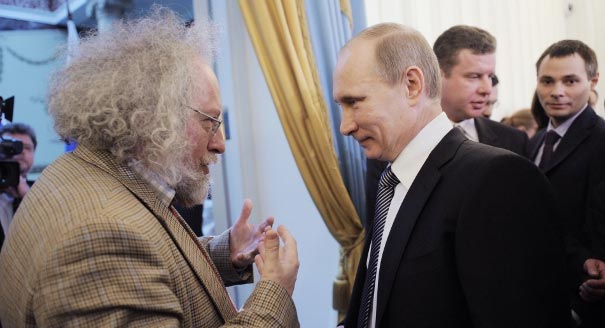
Source: Getty
The reshuffling of the board of Russia's liberal radio station Ekho Moskvy illustrates that Putin's government is becoming increasingly intolerant of criticism.
Facing mounting protests, increased criticism, and an upcoming presidential election, Prime Minister Vladimir Putin seems to be going on the offensive. Putin recently accused the liberal radio station Ekho Moskvy, which has long been a source of unrestrained criticism of the Kremlin and a resource for the protest movement, of indecent attacks against him. Now, the station’s board of directors is being reshuffled.
Alexei Venediktov, editor in chief of Ekho Moskvy, and his deputy, Vladimir Varfolomeev, as well as the station’s two independent directors, Evgeny Yasin and Aleksandr Makovsky, have been forced to leave Ekho’s board of directors. Since 2001, the station has been under the control of the Russian state gas company Gazprom, which owns 66 percent of the station’s shares.
So, for whom does the bell toll?First of all, it might not toll for anyone, according to a statement by the prime minister’s spokesman, Dmitry Peskov. Peskov said that the shake-up of the station’s board stemmed from a regular rotation of its directors and had no connection to any objections about Ekho Moskvy’s editorial policies.
However, no one believes this official declaration coming from the Putin administration. The bell has indeed tolled for the liberal Ekho, established in 1990.
It is well known that the main and only real presidential candidate, Vladimir Putin, never liked the station’s policies—and he certainly does not now. He typically does not like criticism and is annoyed by it, especially when it is well argued and systematic. Criticism becomes even more dangerous in the run-up to a presidential election, as it robs Putin of potential votes he so urgently needs to confirm his legitimacy. Therefore, the prime minister demanded changes using Gazprom as his mouthpiece.
Second, the bell has been tolling for a while for all of the mass media in Russia. It did not start yesterday, but rather some time ago when independent television was laid to rest. Back then, there were also statements that the “reformatting” of television channels had no connection to politics; that at issue was nothing more than business disputes between managing owners. It all ended with harsh, lethal censure.
Now it seems to be radio’s turn. (Will the Internet be next?)
Third, those who found delight in the Khrushchev-era information “thaw” were forced to bite their tongues. But television did not become any different when long-forgotten faces of real opposition leaders started to once again appear on some channels. On the contrary, it has become much easier to fool a trusting television viewer. By touting full pluralism, stations can convince viewers that they are trustworthy and that what they say about Putin is also very true.
Fourth, the bell tolls for Ekho Moskvy’s enormous audience, which probably includes the majority of demonstrators who joined the recent protests on Bolotnaya Square and Sakharov Avenue. On the one hand, the current situation regarding the radio station is a warning to everyone who is still disappointed with the situation in Russia.
On the other hand, when people listen to Ekho these days, they cannot help but wonder why the station has been allowed to criticize the Kremlin so openly. Could it be that it was ordered to say those things? That is what I would call hitting below the belt—the station’s credibility with the skeptics in its audience has been damaged.
And finally, the bell tolls for all hopes that once the elections are over, the authorities might soften their stance a bit and start listening to public opinion more. The Kremlin has cast very serious doubts on those hopes.
Former Scholar in Residence, Religion, Society, and Security Program
Malashenko is a former chair of the Carnegie Moscow Center’s Religion, Society, and Security Program.
Recent Work
Alexey Malashenko
Alexey Malashenko
Carnegie India does not take institutional positions on public policy issues; the views represented herein are those of the author(s) and do not necessarily reflect the views of Carnegie, its staff, or its trustees.

This piece argues that India’s central challenge is not managing a single flashpoint but resolving the underlying tension between expansion and institutional coherency of the BRICS grouping.

Vrinda Sahai
Unless the government can up its communications game, anti-vax movements could prolong India’s pandemic effects.

Shruti Sharma
The proposal aims to produce high and sustained growth to get the country back on track after slowdowns that preceded the coronavirus pandemic.
Suyash Rai
India’s proposed data protection law would create an enormous task for the new agency formed to regulate it. Given stretched resources, the new Data Protection Authority should take a strategic approach.
Shivangi Tyagi
The COVID-19 crisis in India is devastating. The Biden administration must consider exceptions to the Defense Production Act and ease the global vaccine supply chain.

Arvind Gupta, Rudra Chaudhuri, Harsh Pant, …