

In The Media
Vikram Nehru
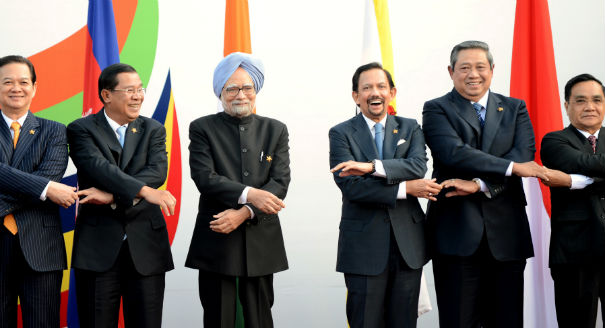
Source: Getty
As its economy decelerates, India has a golden opportunity to look east and sustain high growth rates for years to come.
India’s recent economic deceleration highlights a simple truth: the reforms of the 1990s are no longer enough. While the current slowdown is partially cyclical, growth is unlikely to return to above 8 percent per year without further reform. But India also has a golden opportunity to “look east” and sustain high growth rates for years to come.
The reform agenda is long and well understood—India needs to reform its trade, infrastructure, education, and labor markets. What is needed now is the will to act. Perhaps the sense of urgency among Indian policymakers would be heightened if they had a greater appreciation of the new, significant opportunities in East Asia that will boost India’s growth.
The long-term benefits of capturing these opportunities cannot be overestimated. Further economic reforms remain essential for India, but they must be implemented with an eye toward the east. India needs to hitch its wagon to East Asia’s growth engine.There are six reasons—three economic and three geopolitical—for India to look and act east.
First, the combination of rising real wages and an appreciating real exchange rate in China creates an opening for India’s labor-intensive industries. These trends are a natural upshot of China’s rapid development and technological upgrading, and they will encourage the migration of labor-intensive industries to labor-surplus countries.
Because of their close proximity to China, mainland Southeast Asian economies—Vietnam, Laos, Myanmar, and Cambodia—will likely be the early beneficiaries. But India could also profit, provided it can improve its infrastructure, especially along its east coast. India’s large domestic market, industrial depth, urban centers, and sophisticated financial services are comparable to China’s in the 1990s.
Second, the coming wave of liberalization in the services trade in East Asia gives India’s strong services sector a chance to get ahead. Just as trade in manufactures drove growth in East Asia over the last three decades, trade in services is likely to drive growth in the next three. Services are relatively underdeveloped in virtually all East Asian countries and account for a small proportion of trade.
But services account for over a third of Indian exports, and access to the large markets of East Asia could give this sector a further boost. Markets in the region are gradually opening. China and the ten countries of the Association of Southeast Asian Nations (ASEAN) have a trade-in-services agreement, and India recently negotiated a similar deal with ASEAN.
Third, wider regional trade agreements offer a way for these opportunities to be even more beneficial. India’s access to East Asian markets could increase further if the Regional Comprehensive Economic Partnership were to become a reality, especially as the agreement will cover services. The partnership, which includes ASEAN members along with Australia, China, India, Japan, New Zealand, and South Korea, would be the largest free trade agreement in the world.
Rather than being a reluctant participant in the negotiations, India should be an enthusiastic champion. The agreement will provide India with an external motive to implement desperately needed trade reforms at home and encourage India to lower trade costs (per container, India’s trade costs are more than double those in East Asia). It’s important for New Delhi to remember that, for the first time, Indian services could compete on an even playing field with Australia, Japan, and New Zealand.
Fourth, the fallout from rising Japan-China tensions over the Senkaku/Diaoyu Islands is forcing Japanese investors to diversify their investments away from China. Earlier, the natural choice to relocate labor-intensive operations would have been Thailand, but the vulnerability to periodic flooding there is now pointing the Japanese toward India. As a prominent Japanese conglomerate said, “Japan in the past, Thailand now, India in [the] future.”
Fifth, Southeast Asia is also looking for alternatives to China. While economic integration with China has brought considerable benefits to countries in the region, it has curtailed independence in other spheres. So just as Southeast Asia welcomed the U.S. pivot, the region is now looking to India with fresh eyes as a possible economic hedge against the growing economic clout of China.
And finally, Myanmar’s own pivot away from autarky and toward the outside world has created new opportunities for India, opening a potential land bridge to Southeast Asia and southern China. Although it maintained commercial relations with Myanmar during the military junta’s rule, India’s reputation in the country is not tainted like China’s.
Nevertheless, India has to nurture this relationship. Myanmar is in a strategic location, and many other countries are beating a path to the country’s door—India enjoys an advantage, but it must act before it is too late.
Together, these trends present a remarkable opportunity for India to integrate further with East Asia. India’s trade growth with Southeast Asia over the last decade was a healthy 20 percent per year. But New Delhi could double that as trade with India only constitutes 3 percent of Southeast Asia’s total.
Less than half of this trade is in manufactures today. India is clearly not yet a part of the East Asian production network, but it must aspire to become one. This will give it new opportunities to specialize, capture economies of scale, gain international competitiveness in a wide range of manufactures, and boost growth.
Now is the time for India to look east. And there is hope that the long-stalled reform process will once again move forward. Finance Minister Palaniappan Chidambaram has given India’s economic reformers renewed drive, as has the appointment of Raghuram Rajan as India’s new chief economic adviser. They recognize that the world—especially East Asia—is moving ahead rapidly and India cannot afford to be left behind.
Nadia Bulkin provided background research for this article.

Former Nonresident Senior Fellow, Asia Program
Nehru was a nonresident senior fellow in the Carnegie Asia Program. An expert on development economics, growth, poverty reduction, debt sustainability, governance, and the performance and prospects of East Asia, his research focuses on the economic, political, and strategic issues confronting Asia, particularly Southeast Asia.
Recent Work
Vikram Nehru
Vikram Nehru
Carnegie India does not take institutional positions on public policy issues; the views represented herein are those of the author(s) and do not necessarily reflect the views of Carnegie, its staff, or its trustees.

The Indian Ocean Region hosts one of the densest concentrations of subsea cables in the world. Yet, despite accounting for a significant share of global internet traffic, India’s participation remains limited.

Charukeshi Bhatt

How is AI reshaping space security, creating governance challenges, and where does international diplomacy stand today?


Tejas Bharadwaj, Almudena Azcárate Ortega

After the chill in ties between 2020 and 2024 that brought India–China relations to their lowest point in several decades, the two countries have engaged each other afresh. This paper argues that there are predominantly four imperatives guiding India’s approach to China, and they exist in an order of priority.

Saheb Singh Chadha

This piece argues that India’s central challenge is not managing a single flashpoint but resolving the underlying tension between expansion and institutional coherency of the BRICS grouping.

Vrinda Sahai

The ASML MoU with Tata Electronics is an indicator of how far the Indian semiconductor ecosystem has come. This ecosystem has been years in the making and represents real commercial logic.

Konark Bhandari