

Commentary
Andrey Pertsev
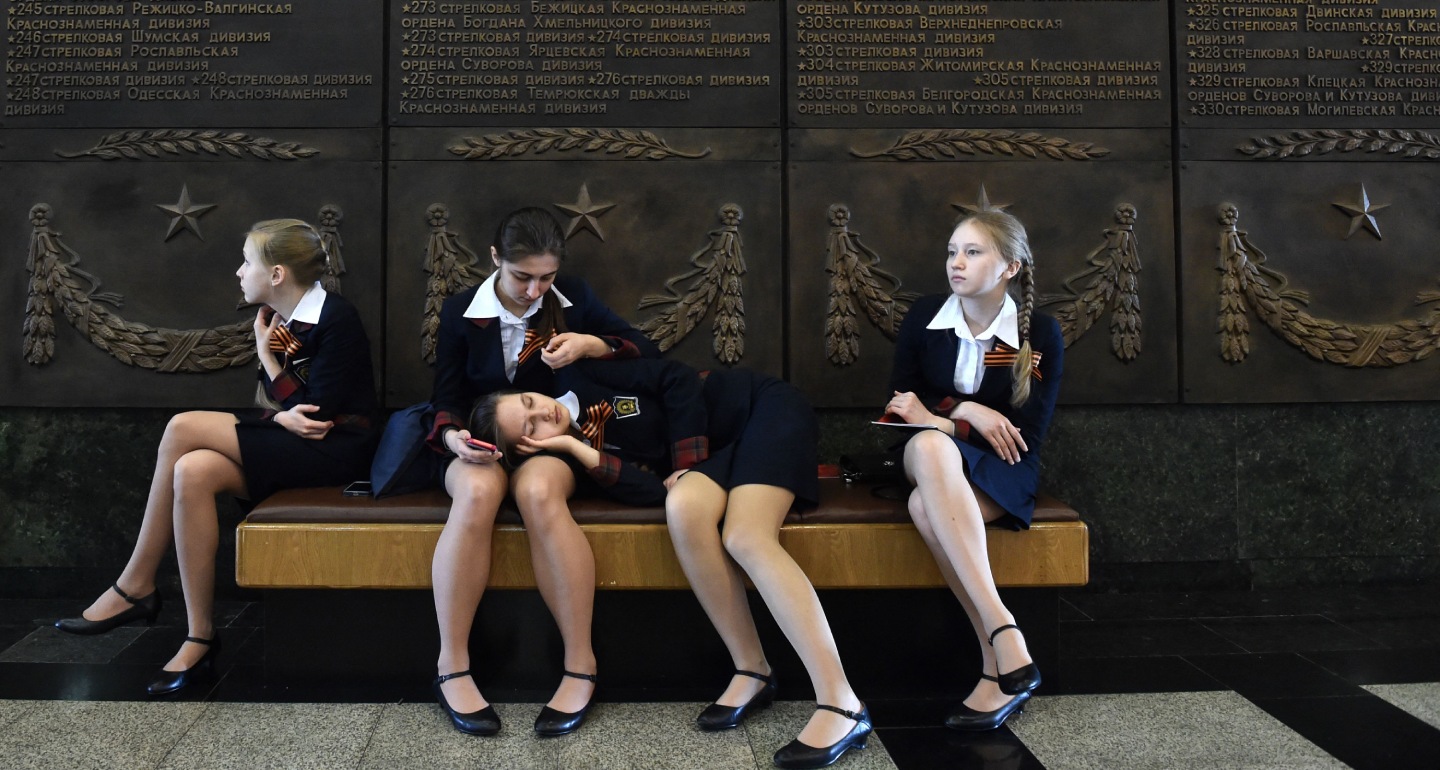
Source: Getty
The concept authored by Sergei Kiriyenko and his team can be considered not only an apologia for the Putin regime, but also a blueprint for Russia’s future configuration.
In the fifth year of Russia’s full-scale war against Ukraine and more than a quarter-century since Vladimir Putin entered the Kremlin, his regime finally has something approaching an ideological foundation: a set of ideas formulated by First Deputy Chief of Staff Sergei Kiriyenko and his domestic policy team. There is no single compilation of these ideas, but their essence can be gleaned from detailed ideological writings by Kremlin officials and from Putin’s own statements. This quasi-ideology justifies the existence of an imperial-style state in which society is relegated to the status of a passive object, with the ruling authorities setting the agenda and guarding control over the tools for implementation.
One of the key elements of Kiriyenko’s approach is the articulation of a set of norms—described in Kremlin parlance as “Russia’s civilizational code”—by which the population is supposed to live. The key tenets of this code include the sacralization of power, collectivism, a preference for faith over rationality or logic, and readiness to sacrifice one’s interests and even life for the sake of the state. They are laid out in articles written by Kremlin officials1 and in the new compulsory course for university students, “Foundations of Russian Statehood.”2
The other pole of Kiryenko’s conceptual framework is a “theory of civilizations” that borrows heavily from the work of Lev Gumilev, a Soviet-era historian and cult figure who was the son of the famed poet Anna Akhmatova. According to Gumilev, Russia is a young civilization with everything still ahead of it, unlike the supposedly decaying West.3 In this multipolar world of civilizations, there are no universal rules. This concept is in line with President Putin’s public views, enabling him to justify virtually any action, including the ongoing war against Ukraine.
Kiriyenko’s team is striving to graft this doctrinal construct onto another of its inventions: the technocratic dictatorship. This is a model of governing the country in which the bureaucracy works efficiently and in harmony with the objectives for the Russian state that are determined by the leadership. According to this construct, society at large is excluded from both the processes of power formation and strategic decisionmaking. The technocratic dictatorship can be clothed in the doctrine of a civilization and sacrifice, or it can be left in its de-ideologized form.
Perhaps equally important is that in the event of Putin’s departure from the Kremlin, Russia’s current political model could be embraced by virtually any autocratic leader or dictator who replaces him. Put another way, technocratic dictatorship is distilled Putinism—without the disadvantages of real Putinism, including personal obsessions like the reassertion of Moscow’s dominion over Ukraine.
The Kremlin’s political bloc has already succeeded in creating mechanisms for disseminating this doctrine. Those mechanisms reach all first-year university students in Russia and are also gradually being introduced to the corporate sector.4
This paper assesses in detail the elements that make up the jigsaw puzzle of the Kremlin’s ideological foundations and shows how they are interlinked. It argues that the concept authored by Kiriyenko and his team can be considered not only an apologia for the Putin regime, but also a blueprint for Russia’s future configuration. Finally, it analyzes the specific mechanisms that are being used to indoctrinate the population.
For most of its existence, the Putin regime managed to govern the country without an official ideology. When Vladislav Surkov was in charge of the Kremlin’s domestic political team (until the end of 2011), he and his team prioritized ideas over ideology, placing their emphasis on the importance of “stability under Putin” and “sovereign democracy.”5 The former notion sought to shape the attitudes of the general public, highlighting a rapid rise in living standards under Putin and an implicit assurance that the county’s economic situation would not worsen on his watch. The latter was aimed at the more politically active part of society and solicited their buy-in for “Russian-style democracy.” (How the Russian version actually differed from the universally accepted definition of democracy was never made clear.) Under Surkov’s successor Vyacheslav Volodin (who served until October 2016), “sovereign democracy” was replaced by the “Crimea consensus.”6 Ideas or ideology meant far less to the Kremlin than leveraging a spike in public support for the regime following the illegal annexation of Crimea in 2014.
Yet none of these concepts offered a clear vision of the future or explained why the relationship between the Russian authorities and society was constructed the way it was. When Kiriyenko, who had always emphasized that he was first and foremost a technocrat, entered the Kremlin in 2016, he replaced any hints of ideology with corporate practices such as key performance indicators (KPIs).7 This was a deliberate tactic: Kiriyenko appreciated that foisting a distinct ideology on Russia would inevitably alienate citizens who did not share the key tenets, which ran against Putin’s belief in always seeking the approval of the majority.
At the same time, Putin himself steadily became more ideological over the years of his lengthy reign. Starting in 2012 when he had to campaign to be re-elected as president after a term as prime minister to circumvent constitutional term limits, his public speeches increasingly featured musings on “spiritual bonds,”8 “traditional values,”9 and Russia’s “special civilizational path.”10 Putin’s ideas were (and remain) more historical, philosophical, and geopolitical than ideological per se. Putin also repeatedly expressed regret over the collapse of both the Russian Empire and the Soviet Union,11 which he described as vast, powerful, and populous states.12
Putin’s early political career was within the circle of the liberal Anatoly Sobchak, the first mayor of St. Petersburg. Sobchak had a keen interest in Russia’s pre-revolutionary history, and, long before many other regional and municipal leaders, he initiated a referendum on changing his native city’s name back from Leningrad to its historical name of St. Petersburg. Interest in the pre-Soviet era and the search for positive sides to it were not all that unusual, especially among representatives of the late-Soviet intelligentsia and dissidents who typically viewed the period as a time of sustained development that was interrupted by revolutionary upheaval.
In the late 1980s and early 1990s, historians and writers who had once been banned from the political mainstream were finally given a platform. Gumilev, the aforementioned historian who had developed a theory of passionarity to describe the unique qualities of the Russian people, became a constant on TV. According to Gumilev, passionarity is the desire of an individual or a group of people to change the world around them and move forward, as well as to sacrifice their comfort or even their lives for certain goals, which are often abstract and illusory.13
In 1994, Gumilev’s fellow Gulag survivor, the Nobel Prize-winning dissident author Alexander Solzhenitsyn, returned to Russia after decades in exile. Works by émigré philosophers including Nikolai Berdyayev and Ivan Ilyin started being published inside Russia. Their presence in Russian intellectual currents in the early 1990s—a time of great hardship for ordinary Russians—helped foster a prevailing feeling of nostalgia for the pre-Soviet era, even though few people had any lived experience of that time.
By all indications, Putin shared some of these sentiments. His speeches have included favorable references to Gumilev,14 Ilyin, and Berdyayev, and over time became more pointed in their hostility toward the 1917 October Revolution and Vladimir Lenin’s role in taking Russia off-course. The longer Putin remains in office, the more such ideas seem to have taken hold. This interest is also shared by others in his inner circle, including longtime crony Yury Kovalchuk; the head of the Foreign Intelligence Service, Sergei Naryshkin; and former culture minister Vladimir Medinsky.
After the full-scale invasion of Ukraine, it was no longer possible to manage without a vision of the future and explanations for Russia’s economic problems and rows of freshly dug graves at cemeteries.
For the Kremlin’s political bloc under both Volodin and then Kiriyenko, the widespread embrace of what were effectively White Russian émigré ideas was, if anything, counterproductive. (As noted above, during the Surkov era, Putin showed no inclination toward ideology.) The musings of Putin’s favorite philosophers and historians did not contain a clear vision of the future, which made them less useful for forming the foundations of an ideology. Worse still, they actually threatened to reduce public support for the regime and deepen a rift within the so-called Putin majority. The president’s core electorate included groups with varying and often opposing views, such as those who were nostalgic for the Soviet Union and fervent anti-Communists. The same phenomenon applied to proponents of a market economy versus those who preferred a planned economy. All of them could fill the vacuum with an ideology of their choosing and ascribe it to the regime, while adopting a White Russian émigré set of values would inevitably have raised concerns among both staunch Putinists and apolitical Russians alike.
Ahead of the 2018 presidential election, the Kremlin’s political team was actively searching for a vision of the future. The old argument about stability under Putin no longer looked so convincing following the annexation of Crimea, a wave of U.S.-EU sanctions, and a decline in living standards. But the search proved fruitless.15 It largely boiled down to attempting to find technical solutions (such as studying populist election strategies and tactics) and to the abstract triad of “fairness, respect, and trust.”16 In the end, Putin’s campaign was just the same as those of previous years, with a focus on maintaining stability.
After that election, the search for a vision of Russia’s future became irrelevant. In 2020, the COVID-19 pandemic reduced the planning horizon even further. The 2021 State Duma elections were held at the tail end of the pandemic, and key factors in United Russia’s victory included corporate mobilization tactics (galvanizing public sector and state-owned company employees to vote) and attempts to use electronic voting in Moscow.17
After the full-scale invasion of Ukraine, it was no longer possible to manage without a vision of the future and explanations for Russia’s sudden economic problems, partial mobilization of the population to fill out the army’s badly depleted units, and the rows of freshly dug graves at cemeteries. The authorities had no explanation beyond Putin’s rhetoric about the “de-Nazification” and “demilitarization” of Ukraine.18 Following the failure of Russia’s planned blitzkrieg in spring 2022, the Kremlin’s political bloc began trying to formulate a more coherent ideological framework.19 But those attempts proved futile.
In the end, it proved easier for Kremlin officials to fall back on the illusion of stability. Essentially, the message was that the war was taking place far away, and that the people fighting it on Russia’s behalf were professionals. Sanctions would have no impact on the economy (most importantly, on the assortment of goods available). This very simple psychological reassurance, when combined with the efforts of the government’s financial and economic bloc, proved highly effective. The partial mobilization in fall 2022 tested the public’s nerve (Putin’s approval rating fell by 5 percent, according to the Public Opinion Foundation), but was hardly critical, since the mobilization mainly affected those living in small towns and rural areas.20 Luckily for the Kremlin, the resulting unwelcome wave of political uncertainty was over relatively quickly.
The Kremlin’s political team returned to the issue of ideology at the end of 2022, first and foremost at the instigation of Putin, who was becoming increasingly ideological. He moved from occasional references to Ivan Ilyin to presenting Russia as a distinct civilization, in the spirit of Gumilev, in 2020.21 The target audience for the Kremlin’s renewed efforts was Putin himself, and those around him who shared his views. At the same time, the general public continued to be fed the idea of stability with an added sprinkling of patriotic ideas (such as “Sanctions aren’t working” and “We’re doing just fine, despite the enemy’s best efforts.”)
The focus of the quest for an ideology was obvious from the start. Kiriyenko’s team had to take into account Putin’s conservative-imperial views and develop congruent ideas. Accordingly, the same political team that had in 2016–2017 started by consulting with very progressive philosophers, sociologists, and political scientists now turned to figures who had previously been considered marginal. The corridors of power were now frequented by the fringe nationalist philosopher Alexander Dugin,22 who was erroneously described in Western media reports as “Putin’s brain,” and the historian Vardan Bagdasaryan.23 Bagdasaryan had made his reputation as the proponent of the theory that Western countries have lost their sovereignty and are controlled by global corporations.
Following the outbreak of the full-scale war, Alexander Kharichev, the head of the presidential administration’s directorate for social analysis and a Kiriyenko associate since the late 1990s, was given responsibility for ideology within the Kremlin. At the end of 2022, Karichev and a group of authors from the Expert Institute for Social Research published an article titled “The Perception of Key Values, Factors, and Structures of Russia’s Socio-Historical Development.”24 The authors tried to describe a so-called nationwide civilizational code: Russians’ ideas about the role of the state and the individual in society, as well as the sum-total of their “pan-national values.”
Their research can hardly be described as thorough or serious: It is based on the results of brainstorming sessions held among university students loyal to the regime. But Karichev still tried to adhere to academic standards in this first ideological text. He cited the sociologists Serge Moscovici and Jonathan H. Turner. The authors concluded that the “basic factors and structures of socio-historical development” were what they called a “pentabasis”: a five-pronged structure consisting of the individual person, family, society, the state, and the country. Each of those factors, according to Kharichev, has its own “dominant.” As luck would have it, these “dominants” are all concepts that Putin loves to talk about. For the individual, it is “creation;” for the family, “tradition;” for society, “consensus;” for the state, “trust in public institutions;” and for the country, “patriotism.”
According to Kharichev’s “code,” the sacralization of power is supposedly ingrained in Russians.
The article also contained some early tentative reflections on the supposedly unique nature of the Russian people—a subject explored in more detail in another article by Kharichev published in spring 2025 titled “Civilization Russia.”25 According to Kharichev, the country had long been a bridge between the civilizations of the East and the West. Russia constituted a civilization in its own right as a result of its “special statehood” that supposedly plays a “leading role in shaping society” and is “not just a political institution, but a spiritual center.” Hence, wrote Kharichev, “the unique attitude of the Russian people: paternalism, an inclination toward centralized authority, and the personification and sacralization of power.”
Kharichev claimed that spiritual values—“service, love for mankind, and self-sacrifice”—are more important to the Russian people than material riches. They prefer faith to rationality and logic, he argued, and “fairness” to “the letter of the law.” He also attributed the characteristic of “team spirit,” one of Kiriyenko’s favorite corporate buzzwords, to Russians. Russians are, Kharichev concluded, “patriots by conviction, capable of collective work, and of building and improving the world.”
In May 2025, Kharichev’s article “Who Are We?” rehashed some of his previous work while also introducing new ideas.26 The authorities’ main aim, wrote Kharichev, was to cultivate a “person of the future” who would be responsible for “preserving and developing our civilizational system.” In this article, the neutral, corporate concept of “teamwork” was replaced by that of ideologically charged “collectivism,” and the idea of “self-sacrifice” was taken to absurd levels. “As it turns out,” wrote Kharichev, “life is worth far less to us than it is to a Westerner.”
It’s hard not to notice that Kharichev’s works describe the perfect characteristics for the subjects of any dictatorship, autocracy, or tyranny. At the same time, his writings are more akin to state doctrine than to ideology per se. Ideology presupposes a vision of the future, and goals, whereas for a doctrine—as a system of beliefs—they are not necessary. Kharichev’s articles describe a present in which the state dominates the general public and can do what it wants with people. After all, according to his “code,” the sacralization of power is supposedly ingrained in Russians. People are prepared to sacrifice their comfort and even their lives if the state asks it of them.
Kharichev’s first two articles also had input from another longtime Kiriyenko associate, political scientist Andrei Polosin. In 2022, Polosin was put in charge of developing a compulsory propaganda course for university students titled “Foundations of Russian Statehood.”27 Starting in fall 2023, first-year students at all Russian universities have been required to take and pass this course.
At the initial stage of the course’s development, Polosin—who has a doctorate in political science—tried to conform to at least basic academic standards. Back then, the recommended reading list included works by prominent Russian and Western political thinkers and historians such as Vladimir Gelman, Daniel Bell, and Alvin Toffler. Students were encouraged to study various approaches to understanding history. The “civilization” approach—a concept espoused by Russian Slavophiles such as Gumilev, and Western thinkers like Oswald Spengler and Arnold Toynbee—was presented as just one of several legitimate approaches. But ultimately, only the “civilization” approach made it through to the final curriculum, all because of Putin’s love for Gumilev’s theory that civilizations emerge and flourish (thanks to “passionaries” who are prepared to sacrifice themselves) before declining and dying out.
The course features by now familiar concepts such as “self-sacrifice for the sake of lofty goals” inherent to passionaries. The educational film “Russia’s DNA: State-Civilization” echoes Kharichev’s idea, arguing that “rationalism never caught on” in Russia.28 “The changeable climate could contain surprises, and an impromptu decision that was often not the most obvious one saved the day more than the pragmatic approach,” the film teaches students. It also informs them that Russian avos—faith in chance or hoping everything will turn out OK in the end—has become “a mainstream decision-making technique.”
Another element of the course is the justification of Moscow’s imperial ambitions. The authors consider empire to be Russia’s natural state of existence. Students are taught that “empire was not tantamount to imperialism,” and that the attempt made during the presidency of Boris Yeltsin to “borrow a way of ruling from another country was not just a failure—it was almost lethal.”29
The conclusions drawn by Kharichev and Polosin complement each other and comprise a state theory that perfectly suits Putin and his inner circle. The ideas of a “special composition” of the Russian people—a youthful civilization loyal to the authorities—are very convenient for the aging autocrat in the Kremlin. If the civilization is young, that means it is destined to flourish in the near future, while its opponents—the countries of the West—are doomed to die out. Meanwhile, the notion of the “special character” of each civilization offers a get out clause from rules that are generally seen as universal. Putin says that outright in his musings on the “multipolar world” and the diversity of rules.30 Within this paradigm, any deviation from generally accepted norms can be explained by a “special path” and national traditions.
Also telling in this context is the article “Digital Legitimacy,” written by another ideologist from Kiriyenko’s team, the political strategist Gleb Kuznetsov.31 The article compares the efficiency (a term lifted straight from the corporate lexicon) of “liberal” and “non-liberal” regimes that use modern digital services. It’s likely that Kuznetsov actually means democratic and non-democratic, since his article focuses on concepts such as free elections and media freedoms.
Kuznetsov defines efficiency by the number of infrastructure projects completed and the speed with which they start operating. In this respect, democratic regimes are losing, according to the author, because they are dependent on electoral cycles. “Every four to five years, there is a change in priorities, long-term projects are abandoned . . . Liberal politics is degenerating into performance . . . What matters is not solving the problem, but demonstrating that you care about it.” In this respect, Kuznetsov also considers the principle of the separation of powers to be a hindrance: It only “slows the actions” of the state.
The apologia for dictatorship crafted by Kiriyenko’s team appeared first as a program for cultivating the ideal citizen, before being developed as an ideological construct.
In the meantime, the author continues, non-liberal technocracies “are focused on results,” and derive their legitimacy not from competitive elections, public oversight, and the separation of powers, but thanks to technical efficiency and providing people with digital services. In such a system, state management remains a closed loop: It sets priorities, the criteria for “efficiency,” and the internal selection mechanisms itself. Ideology takes a back seat, or might be lacking entirely. Comfort in their everyday lives and “efficient” services, Kuznetsov explains, might be enough for people.
This approach of technocratic autocracy appeals to Kiriyenko: a man who has long expressed disdain for public politics and political battles.32 He has introduced key performance indicators (KPIs) into all the sectors he is involved in,33 adheres to “meritocratic” selection processes, and works to tighten the government’s control over society. As a result, society itself is again becoming an object that is acted upon by the authorities, rather than a body with its own goals and the ability to define its own relationship with the powers that be.
This view of the composition of the state can also be considered as quasi-ideological or a doctrine. The framework of a “technocratic dictatorship” might remain bare, or it might be clothed in another quasi-ideological layer, or even an ideological one. The “public well-being,” for example, that the technocratic dictator is supposedly working toward, might be presented as universal material equality, or, on the contrary, as a meritocratic utopia, in which everyone who proves themselves worthy of a managerial post is guaranteed to get one.
The Kremlin needs channels to transmit these elements of an ideological doctrine to the broader masses, and propaganda is simply not sufficient in this instance. What’s needed is a full-fledged teaching mechanism complete with tests to check that the “knowledge” has been absorbed by the target audience. The Kremlin’s political team also needs to show the leadership that they have introduced such mechanisms.
The path chosen was the most straightforward and predictable one. Putin and his entourage are, of course, well acquainted with Soviet-era indoctrination. In its day, the formal ideology of the Soviet state—Marxism-Leninism—was taught to all students: Every university had courses of “scientific communism” and compulsory examinations for students. Today, the process has happened the other way around: The apologia for dictatorship crafted by Kiriyenko’s team appeared first as an academic subject—a program for cultivating the ideal citizen—and only then began to be developed as a broader ideological construct.
This further underscores the utilitarian nature of the initiative. The primary task is to ensure the general population’s loyalty and obedience, and the corresponding “ideology” is predicated upon that specific premise.
The scale of the indoctrination machinery that has been created is impressive. The Kremlin has already trained approximately 8,500 teachers, and in the three years the course has been taught, some 4 million first-year university students have taken it.34
The Kremlin has also set its sights on older generations of Russians. In February 2026, employees of Gazprom, Rostec, and other state corporations attended a week-long “Foundations of Russian Statehood” course.35 That experiment could easily be expanded to public-sector workers, with lectures held at the regional and municipal levels. People dependent on the state, the so-called budzhetniki, would effectively have no choice in the matter if the state ultimately decides to force them all to attend such a course.
How effective the Kremlin’s propaganda course will be in practice remains to be seen. The theses expounded during lectures will inevitably differ from any individual’s own reality in today’s Russia. It’s all reminiscent of the teaching of “scientific communism” at the twilight of the Soviet era, when teachers of the subject were simply going through the motions. When the Soviet Union collapsed, people did not take to the streets en masse in support of the Communist Party. They simply shrugged their shoulders and adapted to the new reality. Absent various types of coercion by the state, it is easy to anticipate that this latter-day form of indoctrination is not likely to be very effective.
The Soviet system, of course, forced people to adopt its language, taught them to understand the demands of the state, explained the rules of the game, and imposed a code of desired behavior. Sadly, the historical antecedents of Putin’s presidential administration’s political team are all too easy to spot.
The Kremlin doctrine that has emerged during the full-scale war against Ukraine thanks to Kiriyenko’s team is a jigsaw puzzle. The outside pieces are the “technocratic dictatorship” described by Gleb Kuznetsov: the justification for turning away from democratic procedures and for excluding the general public from decisionmaking processes. The inside pieces are Kharichev’s articles on Russians’ “civilizational code” and the “Foundations of Russian Statehood” course that teaches students that Russian civilization is young and therefore has a bright future ahead of it.
All the pseudo-research done by Kremlin officials and political strategists boils down to one thing: an apologia for dictatorship and the legitimization of any actions taken by Russia’s current leadership. It describes a nation-state in which the collective takes precedence over the individual, power is sacred, and ordinary people should be prepared to give up everything, even their lives. This is an extremely convenient construction for an autocratic leader and a dictator. It’s particularly convenient for Putin, who shows no sign of wanting to end the war in Ukraine and who has been completely indifferent to the staggering loss of life on the Russian side. Even as war fatigue among the Russian public and economic problems mount, it is hard to envision circumstances that would force Putin’s hand.
In its current form, the doctrine is primarily aimed at mobilization. It demands sacrifice and concessions from people and explains this need through a civilizational code. People are not even told what goals the state and regime are pursuing. Indeed, the doctrine eliminates any need for the regime to expound upon its vision for the future. In any case, the Kremlin has conveniently avoided articulating one.
The technocratic-autocratic part of these ideas looks a little more positive, since it at least envisages efficient work by the state to benefit the general public. It effectively amounts to an improved version of the concept of “Putin stability” that accompanied the early years of his tenure. Such notions would have been perfectly viable at a time of economic growth, limited political repression, relative freedom of expression, and, of course, no unprovoked full-scale war against Ukraine. But to restore those conditions, the regime would need to reverse course and try to reestablish the prevailing conditions as of February 2022. Neither Putin nor the Kremlin have shown the least desire to do any such thing.
A nation-state in which power is sacred and ordinary people should be prepared to give up their lives is an extremely convenient construction for an autocratic leader and a dictator.
The country’s public and elites, meanwhile, are already beginning to show signs of growing discontent.36 The authorities’ approval ratings have fallen so much that the VTsIOM pollster that works with the Kremlin is having to change the methodology of its polls to produce figures that are more palatable to the powers that be.37 The comforting illusions of eternal rule enshrined in the doctrine of Kiriyenko and his team could ultimately collide with reality for Putin and his system.
At the same time, the doctrine—if stripped of its civilizational-patriotic elements—could prove more than viable in post-Putin Russia, too. The framework of a technocratic dictatorship onto which any desired façade can be mounted would suit virtually any of the people currently being discussed as potential successors to Putin, from Kiriyenko himself to Prime Minister Mikhail Mishustin and Moscow Mayor Sergei Sobyanin. The machinery for corporate indoctrination is already up and running: It would just need some adjustments to its operating software.
Andrey Pertsev is a journalist with Meduza website.
Recent Work
Andrey Pertsev
Andrey Pertsev
Carnegie India does not take institutional positions on public policy issues; the views represented herein are those of the author(s) and do not necessarily reflect the views of Carnegie, its staff, or its trustees.

This piece argues that India’s central challenge is not managing a single flashpoint but resolving the underlying tension between expansion and institutional coherency of the BRICS grouping.

Vrinda Sahai
Unless the government can up its communications game, anti-vax movements could prolong India’s pandemic effects.

Shruti Sharma
The proposal aims to produce high and sustained growth to get the country back on track after slowdowns that preceded the coronavirus pandemic.
Suyash Rai
India’s proposed data protection law would create an enormous task for the new agency formed to regulate it. Given stretched resources, the new Data Protection Authority should take a strategic approach.
Shivangi Tyagi
The COVID-19 crisis in India is devastating. The Biden administration must consider exceptions to the Defense Production Act and ease the global vaccine supply chain.
Arvind Gupta, Rudra Chaudhuri, Harsh Pant, …