

Q&A
- +1
Amr Hamzawy, Andrew Leber, Eric Lob, …
{
  "authors": [
    "Marwan Muasher"
  ],
  "type": "commentary",
  "blog": "Diwan",
  "centerAffiliationAll": "dc",
  "centers": [
    "Carnegie Endowment for International Peace",
    "Malcolm H. Kerr Carnegie Middle East Center"
  ],
  "collections": [],
  "englishNewsletterAll": "menaTransitions",
  "nonEnglishNewsletterAll": "",
  "primaryCenter": "Malcolm H. Kerr Carnegie Middle East Center",
  "programAffiliation": "MEP",
  "programs": [
    "Middle East"
  ],
  "projects": [],
  "regions": [
    "North America",
    "United States",
    "Middle East",
    "Israel",
    "Palestine",
    "Levant"
  ],
  "topics": [
    "Political Reform"
  ]
}
Source: Getty
Recent U.S. steps taken against the Palestinians ignore that Israel has already entered into a demographic dilemma.
It is difficult to regard the decisions taken by the Trump administration in recent months regarding the Palestinian question as an attempt to credibly resolve the conflict between Palestinians and Israelis. More likely, these decisions can be aptly described as attempts to naively—or maliciously—negate the Palestinians’ right to achieve a viable state of their own.
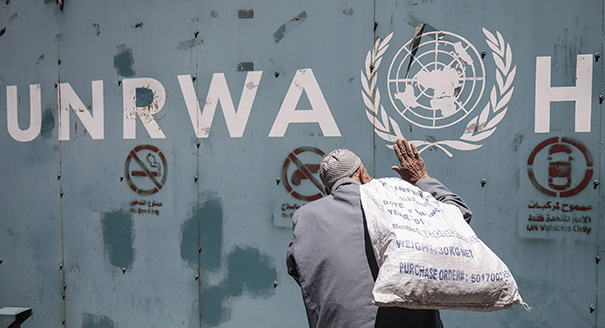
The United Nations General Assembly session this year might witness the unveiling of the long-awaited “deal of the century” by the United States, as President Donald Trump has described a Palestinian-Israeli peace settlement. Whether or not this takes place, it appears that the Trump administration has already started implementing its provisions through a series of steps that have all been directed against key Palestinian interests. The recent decisions on moving the U.S. embassy to Jerusalem, closing the Palestine Liberation Organization office in Washington, and withdrawing financial support for the United Nations Relief and Works Agency, the UN body entrusted with providing support for Palestinian refugees, appears to have only made things worse for the region.
All these moves seem to be part of a strategy to remove essential Palestinian demands from the negotiating table—above all Jerusalem as the capital of a Palestinian state and a return of refugees. Furthermore, the president of the Palestinian National Authority, Mahmoud Abbas, recently revealed that the U.S. proposed to him that those Palestinian areas in the West Bank that Israel might not wish to keep be joined in a confederation with Jordan. This idea has been rejected by both the Palestinian and Jordanian leaderships.
The U.S. strategy appears to be to decide beforehand the fate of Jerusalem and the refugees in Israel’s favor, and to force Palestinians to accept an inferior deal on the grounds that they are weak and cannot hope to get what they were offered in previous negotiations. This strategy also assumes that by forging close ties with other Arab countries such as Saudi Arabia, Egypt, and Jordan, the United States and Israel can bypass the Palestinian National Authority in favor of those countries, who will then be expected to deliver the Palestinians in any American settlement.
This strategy naively assumes that Arab states can endorse a deal that does not include East Jerusalem, or that they can push the Palestinians to accept any arrangement with which they are not happy. The fact remains that the perceived parameters of the deal presently being negotiated by the U.S. are so inferior, indeed insulting, that no Palestinian or Arab leader can accept them. Visits by presidential envoys Jason Greenblatt and Jared Kushner to Arab countries in recent months have highlighted this fact in a glaring way.
The Trump administration appears to be attempting to create new facts on the ground. Israel has so far not been asked to give up on any of its demands. But the United States seems to ignore that a majority of the new generation of Palestinians has shifted its focus from the shape of a solution to a rights-based approach. In other words the priority is no longer the establishment of a Palestinian state, but achieving civil and political rights for Palestinians, even as they are looking to raise the costs of the occupation.
The most probable outcome is a deal that will be stillborn, but also a continuation of the status quo. The situation is unlikely to remain peaceful, while the continued building of Israeli settlements in the West Bank and East Jerusalem—given the presence of over 650,000 settlers in the occupied territories today—kills any real prospect for resolving the conflict according to the two-state formula.
The bottom line is that the international community must come to grips with the death of the two-state solution. It is no longer taboo to talk about alternatives—including different variations on a one-state solution. This presents new problems for Palestinians and Israelis. There is parity in the number of Israeli Jews and Palestinians in areas under Israel’s control, while Palestinians are slowly becoming a majority under Israeli occupation.
If the United States and Israel hope to do away with the Palestinian issue in Israel’s favor, they have a strange way of trying to achieve such a result. No minority in history has ever been able to rule indefinitely over a majority within its own borders. Neither Israel nor the United States appears to have grasped this simple but powerful fact.

Vice President for Studies
Marwan Muasher is vice president for studies at Carnegie, where he oversees research in Washington and Beirut on the Middle East. Muasher served as foreign minister (2002–2004) and deputy prime minister (2004–2005) of Jordan, and his career has spanned the areas of diplomacy, development, civil society, and communications.
Recent Work



Amr Hamzawy, Andrew Leber, Eric Lob, …
Marwan Muasher
Carnegie does not take institutional positions on public policy issues; the views represented herein are those of the author(s) and do not necessarily reflect the views of Carnegie, its staff, or its trustees.

Reconciliation councils are emerging throughout the country to mediate in intracommunal disputes, many from the war years.
Natacha Danon
In an interview, Rozina Ali discusses her new book on the rise and manifestations of Islamophobia in the United States.

Michael Young
As the U.S.-led Coalition withdraws, the Kurds’ reliance on Baghdad, and on themselves, will only increase.
Wladimir van Wilgenburg

In an interview, Ian Lustick and Eli Clifton discuss their new book on why a prominent ally has so much influence in America.
Michael Young

As the U.S. stumbles in its war with Iran, we are likely to see an acceleration of its disengagement from the region.
Michael Young