

Commentary
Michael Young
{
  "authors": [
    "Michael Young"
  ],
  "type": "commentary",
  "blog": "Diwan",
  "centerAffiliationAll": "dc",
  "centers": [
    "Carnegie Endowment for International Peace",
    "Malcolm H. Kerr Carnegie Middle East Center"
  ],
  "collections": [
    "Inquiring Minds"
  ],
  "englishNewsletterAll": "menaTransitions",
  "nonEnglishNewsletterAll": "",
  "primaryCenter": "Malcolm H. Kerr Carnegie Middle East Center",
  "programAffiliation": "MEP",
  "programs": [
    "Middle East"
  ],
  "projects": [],
  "regions": [
    "Gulf",
    "Levant",
    "Iran",
    "Saudi Arabia",
    "Yemen",
    "Syria",
    "Iraq",
    "Palestine",
    "Middle East",
    "Türkiye",
    "Qatar",
    "United States",
    "Russia",
    "Egypt",
    "North America",
    "North Africa"
  ],
  "topics": [
    "Political Reform"
  ]
}
Source: Getty
A regular survey of experts on matters relating to Middle Eastern and North African politics and security.
Raghida Dergham | Founder and executive chairman of Beirut Institute, columnist for The National newspaper, Abu Dhabi
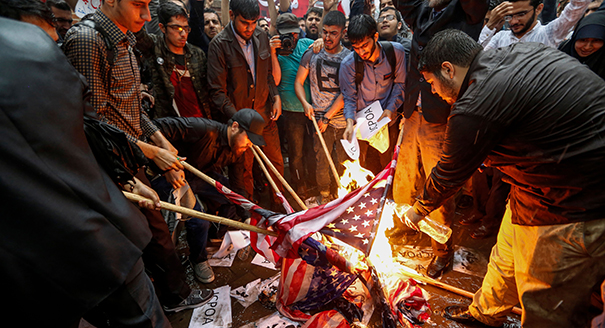
President Donald Trump’s reset of U.S.-Saudi relations, reversing former president Barack Obama’s policies toward the kingdom and Iran, was the most significant development in the Middle East in 2018. Trump announced on May 8 that the United States would pull out of the nuclear deal with Iran, negotiated by his predecessor, and imposed far-reaching sanctions on Iran. This forced companies worldwide to choose between continued relations with Tehran or facing a backlash from Washington.
Trump’s doctrine of using sanctions as an incentive to make a better deal came as a stark contrast to Obama’s concessions to reach the nuclear deal. The shift in Washington’s Iran policy changed the landscape, reinstating the strategic alliances that had been in place previously between the U.S. and Arab Gulf states and Egypt. Trump’s active reengagement in the Middle East erased Obama’s “pivot” to Asia and his doctrine of “leading from behind.” By reviving the traditional U.S. role as a major regional player, the administration showed Russia that it would no longer be in the driver’s seat, which Obama had conceded to the Kremlin in Syria. This reset was the most significant development in the Middle East in 2018.
Dalia Dassa Kaye | Director of the Center for Middle East Public Policy at the RAND Corporation
With the Middle East embroiled in multiple conflicts and destabilizing moves by the Trump administration—most notably moving the U.S. Embassy to Jerusalem and withdrawing from the nuclear agreement with Iran—it is a tough year to single out a single “most significant” development. Yet the one event that encapsulates nearly every negative regional trend at play today is the tragic murder of Washington Post journalist Jamal Khashoggi. His death brought to the fore the assault on independent voices in the region (including in Turkey where his murder took place), the manipulation of his murder to advance regional rivalries in both the Saudi- and Iranian-led regional camps, and the unfortunate reluctance of the U.S. administration to push back against regional partners and deescalate regional conflicts. His murder could either be a turning point to galvanize fresh thinking about the region that would pay as much attention to the needs of the region’s people as to its leaders; or it could sadly embolden autocratic leaders and radical non-state groups to double down on repression and violence.
Hussein Ibish | Senior resident scholar at the Arab Gulf States Institute in Washington, D.C.
The most significant Middle Eastern development of 2018 was the Trump administration’s “maximum pressure” campaign against Iran, especially the U.S. withdrawal from the nuclear agreement with Tehran and wide-ranging new economic sanctions. If this policy is intensified and expanded, it could strongly reshape the strategic landscape and balance of power in 2019, especially if combined with regional pressure against Iranian proxies in the Arab world.
Sanctions have already been more successful than many skeptics anticipated, and they are only just beginning to bite. But external financial pressure alone almost never leads to regime change, and rarely provokes policy change. A purely financial campaign against Iran could produce an impoverished Iran, but also one that is unified and aggressive, deploying its regional proxies for ever more nefarious purposes. However, if Iran is also dealt a series of strategic blows in Syria, Iraq, Yemen, and elsewhere, it may modify its policies and behavior to protect its assets.
Michele Dunne | Director and senior fellow in the Carnegie Middle East Program
In the game of Jenga, players take turns removing wooden blocks from a tower until one causes the whole edifice to tumble down. I have been wondering lately if the October 2 murder of Jamal Khashoggi was the moment in which the regional strategy defined by Saudi Arabia’s Crown Prince Mohammed bin Salman and Abu Dhabi’s Crown Prince Mohammed bin Zayed started to come apart. The unusually strong, sustained international reaction has been directed not only against the brazen murder itself, but against the disastrous Saudi-led military campaign in Yemen, the kingdom’s pointless power struggle with Qatar, and its vicious treatment of royal rivals as well as rights activists. While U.S. President Donald Trump has sought to shield Mohammed bin Salman, key U.S. senators (who are quite powerful in the U.S. system) have decided the crown prince cannot be trusted and will now play a blocking game similar to what they have done with Russia. Meanwhile, other nations are cutting off arms sales to Saudi Arabia. The question for 2019 is whether the royal family retains the ability to change course.

Editor, Diwan, Senior Editor, Malcolm H. Kerr Carnegie Middle East Center
Michael Young is the editor of Diwan and a senior editor at the Malcolm H. Kerr Carnegie Middle East Center.
Recent Work
Michael Young
Michael Young
Carnegie does not take institutional positions on public policy issues; the views represented herein are those of the author(s) and do not necessarily reflect the views of Carnegie, its staff, or its trustees.
Reconciliation councils are emerging throughout the country to mediate in intracommunal disputes, many from the war years.
Natacha Danon

In an interview, Rozina Ali discusses her new book on the rise and manifestations of Islamophobia in the United States.
Michael Young
As the U.S.-led Coalition withdraws, the Kurds’ reliance on Baghdad, and on themselves, will only increase.
Wladimir van Wilgenburg

In an interview, Ian Lustick and Eli Clifton discuss their new book on why a prominent ally has so much influence in America.
Michael Young

As the U.S. stumbles in its war with Iran, we are likely to see an acceleration of its disengagement from the region.
Michael Young