

Commentary
Maha Yahya
{
  "authors": [
    "Maha Yahya"
  ],
  "type": "commentary",
  "blog": "Diwan",
  "centerAffiliationAll": "dc",
  "centers": [
    "Carnegie Endowment for International Peace",
    "Malcolm H. Kerr Carnegie Middle East Center"
  ],
  "collections": [],
  "englishNewsletterAll": "menaTransitions",
  "nonEnglishNewsletterAll": "",
  "primaryCenter": "Malcolm H. Kerr Carnegie Middle East Center",
  "programAffiliation": "MEP",
  "programs": [
    "Middle East"
  ],
  "projects": [],
  "regions": [
    "Iran",
    "Levant",
    "Israel",
    "Lebanon",
    "Syria",
    "Palestine",
    "Middle East"
  ],
  "topics": [
    "Political Reform"
  ]
}
Source: Getty
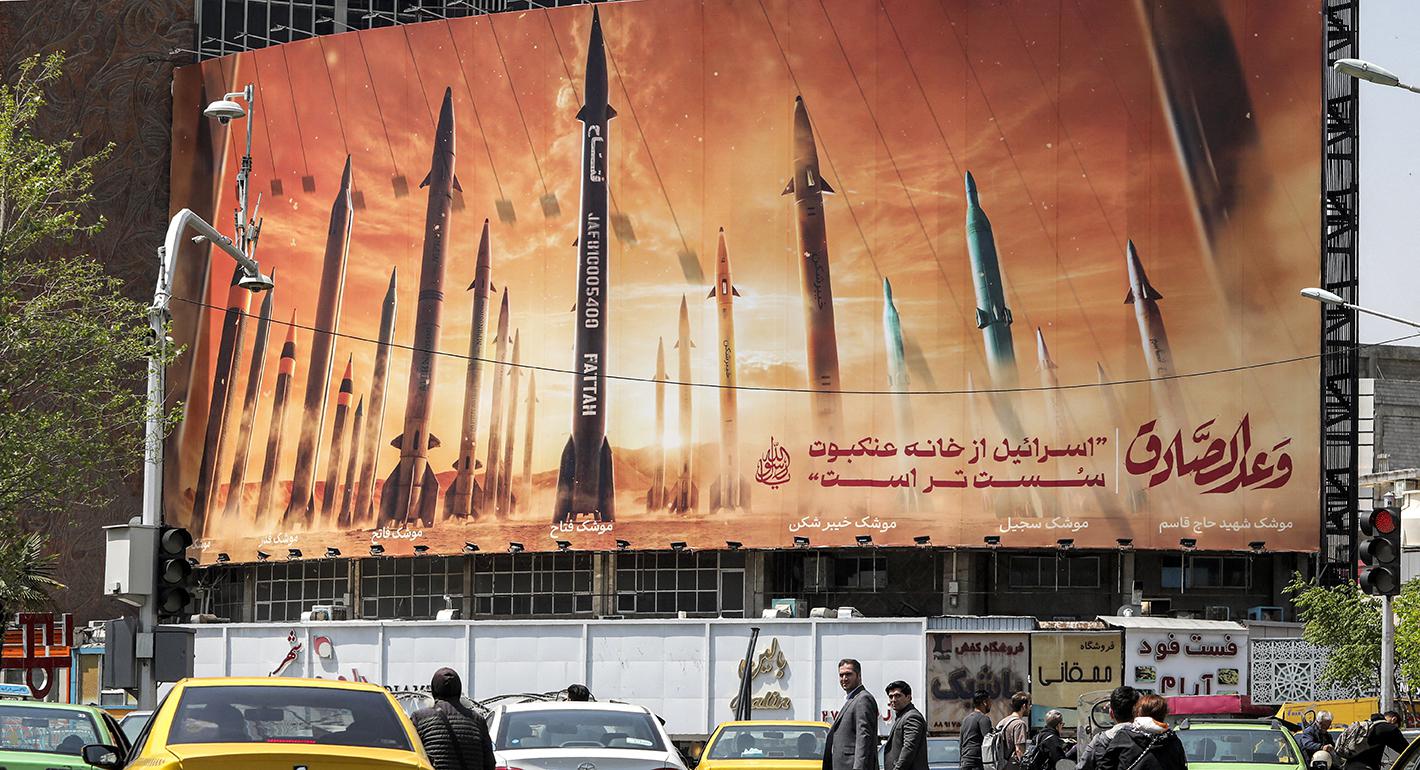
Tehran’s strike against Israel last weekend doubtless reflected its strengths, but also may have included a strategic blunder.
Iran’s April 14 retaliation for Israel’s bombing of the Iranian consulate in Damascus was both dramatic and anticlimactic. The buildup was worthy of an Oscar, beginning with grainy images of drones flying out of Iran and toward Israel, followed by missiles. The Iranian operation brought the decades-long shadow war between the two countries out into the open.
It also apparently set new rules of engagement between Iran and Israel. Hossein Salami, the commander in chief of the Islamic Revolutionary Guard Corps (IRGC), told Iranian television that Iran had put in place what he called “a new equation.” Salami declared, “From now on, if the Zionist regime attacks our interests, assets, people or citizens at any point, we will counterattack from the Islamic Republic of Iran.” Tensions between Iran and Israel have taken the Middle East to the edge of the precipice with the threat of a regional war greater than ever.
For years, Iran’s reactions to Israel’s bombardment of its positions in Syria, and those of Hezbollah, had remained muted as it built up its strategic partnerships across the region and sought to avoid an all-out regional conflict that could draw in the United States and other global actors. But the embassy attack was seen as an assault on sovereign Iranian territory, which, if left unaddressed, could ultimately encourage direct Israeli attacks against Iran itself.
Since October 7, Iran had used its proxies and partners across the region to capitalize on the Gaza conflict and assert its regional influence and capacity to disrupt. Ansar Allah in Yemen has hindered global trade in the Red Sea, while Hezbollah has maintained the heat on Israel’s northern border, displacing close to 80,000 Israelis. Iran’s improved ties with neighboring Arab countries keen to avoid a conflict has also helped secure acceptance of Tehran’s regional influence. Iran has exploited Israel’s diminishing status, its entanglement in the Gaza quagmire, the West’s moral embarrassment over the slaughter in Gaza, and the seeming ineffectiveness of the United States in preventing this. Prior to the conflict, the Palestinian issue appeared to have become more of a burden for the Gulf Arab countries. However, because the situation in Gaza has provoked outrage among the region’s societies and beyond, the response to the Iranian attack against Israel seemed to range from satisfaction that someone was finally standing up to Israel, to regret that it was the Iranians doing so, to apprehension about what lies ahead.
In retaliating against Israel, Iran chose to respond directly, not through proxies, and without triggering a regional conflict. The United States and countries in the region were notified of the attack 72 hours ahead of time, and the slow-moving Iranian drones gave Israel time to prepare before they reached Israeli airspace. While some saw the attack as embarrassing because so few drones or missiles reached their targets, others interpreted it as a well-calibrated effort to reestablish deterrence, which exposed Israel’s potential vulnerabilities and its reliance on the support of its allies. Irrespective of which interpretation is correct, what is clear is that the attack was a drop in the bucket compared to what would have happened had Iran’s partners also entered the fray and had Iran not been so careful in telegraphing its intentions. But in attacking Israel directly, Iran also crossed a Rubicon that opens the door for direct military strikes against Iran by Israel.
Assuming the Iranians care about Gaza, their operation could also constitute a strategic blunder, for several reasons. First, the attack pushed Gaza down on the global agenda, at least for now, violating Napoleon’s dictum to never interrupt an enemy when he is making a mistake. A week ago, global horror at the civilian death toll and famine in Gaza, in a war now widely perceived as being a strategic and moral failure, drove even Israel’s closest allies to consider imposing restrictions on arms transfers. Today, this conversation has shifted as the terrible situation in Gaza and the killing of the World Central Kitchen aid workers have been displaced by the image of Israel under attack. In the days just before the Iranian retaliation, the rift between the United States and Israel had been replaced by the Biden administration’s declaration of support for Israel’s defense. Now, concern about Gaza has been superseded by talk of a regional escalation, while an Israeli ground incursion into Rafah may become more likely as the chances of a negotiated ceasefire and hostage release have never seemed further away.
Second, the Iranian attack may lend greater credence to Israel’s security posture encouraging preemptive strikes against its enemies, which October 7 only reinforced. In part, this is what Israel has used to justify its war in Gaza and its promised ground invasion of Rafah, as well as its repeated strikes in Lebanon and threats to launch an all-out war against the country. In the coming weeks, we may see greater international acceptance of Israeli offensive actions. It also remains unclear whether Iran’s attack actually reestablished the deterrence “equation” of which Salami spoke. Unfortunately, the Iranians have also given the beleaguered Israeli prime minister, Benjamin Netanyahu, an opportunity to prolong the war and the emergency powers keeping him in office.
However, the Iranian attack also created a dilemma for Israel. Iran’s response did not cause major destruction, but was brazen enough that Israel cannot simply brush it off. It signaled that the path of a relatively cost-free Israeli escalation with Iran was no longer viable. The economic burden of the conflict—estimates are that it cost Israel over $1 billion to defend against Iranian drones and missiles that cost around $30 million—as well as the psychological impact on Israel’s population are also things Israel will have to consider before taking further steps.
The onus is on the international community to compel Israel to end the carnage in Gaza, tamper down its response to Iran, and avert a regional conflict that all sides (except the Israeli government) say they want to avoid, but toward which we seem to be hurtling. This can only be done by implementing a regionwide ceasefire.

Director, Malcolm H. Kerr Carnegie Middle East Center
Maha Yahya is director of the Malcolm H. Kerr Carnegie Middle East Center, where her research focuses on citizenship, pluralism, and social justice in the aftermath of the Arab uprisings.
Recent Work
Maha Yahya
Maha Yahya
Carnegie does not take institutional positions on public policy issues; the views represented herein are those of the author(s) and do not necessarily reflect the views of Carnegie, its staff, or its trustees.
Reconciliation councils are emerging throughout the country to mediate in intracommunal disputes, many from the war years.
Natacha Danon
As the U.S.-led Coalition withdraws, the Kurds’ reliance on Baghdad, and on themselves, will only increase.
Wladimir van Wilgenburg

In an interview, Ian Lustick and Eli Clifton discuss their new book on why a prominent ally has so much influence in America.

Michael Young

As the U.S. stumbles in its war with Iran, we are likely to see an acceleration of its disengagement from the region.
Michael Young
The Zaidi government’s objective to collect weapons is constrained by regional conflict, but it can take certain measures at home.
Ali Al-Mawlawi