

Commentary
Issam Kayssi
{
  "authors": [
    "Issam Kayssi"
  ],
  "type": "commentary",
  "blog": "Diwan",
  "centerAffiliationAll": "",
  "centers": [
    "Carnegie Endowment for International Peace",
    "Malcolm H. Kerr Carnegie Middle East Center"
  ],
  "englishNewsletterAll": "",
  "nonEnglishNewsletterAll": "",
  "primaryCenter": "Malcolm H. Kerr Carnegie Middle East Center",
  "programAffiliation": "",
  "programs": [],
  "projects": [],
  "regions": [
    "Lebanon",
    "Israel"
  ],
  "topics": []
}
Source: Getty
As Lebanon’s war imposes suffering on civilians, the capital city is yet living an illusion of peace.
The hum of an Israeli surveillance drone is constant, an unshakable background noise that now defines the daily rhythm of Beirut. The drones hover above our heads like birds of prey, their continuous buzzing frequently punctuated by more violent sounds—distant thuds that signal new airstrikes.
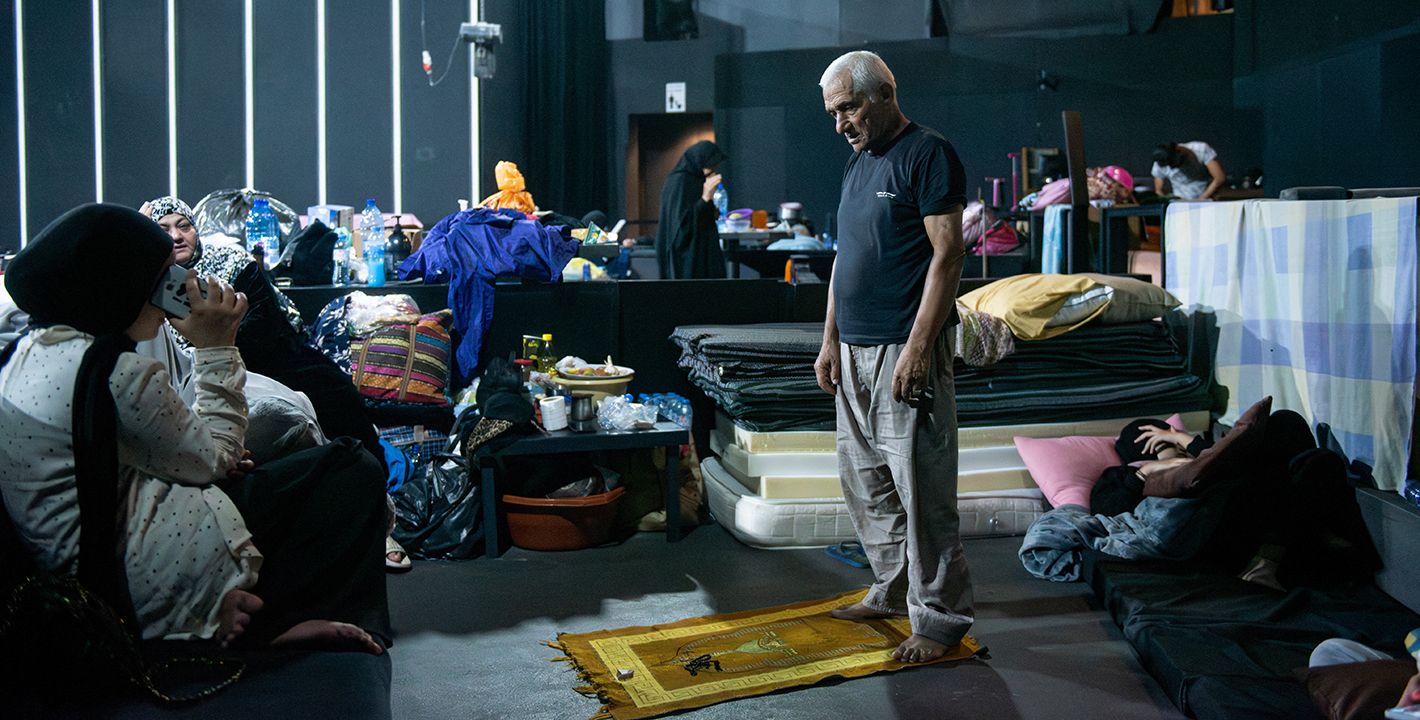
For those who fled from the South, the Beqaa Valley, or Beirut’s southern suburbs that are collectively referred to as “Dahieh,” the drones are not merely an annoyance but an unremitting reminder of what the current conflict with Israel has wrought: the displacement of a large population now seeking refuge in public facilities throughout Lebanon. Some have sought shelter along the capital’s seaside Corniche, their makeshift tents flapping in the sea breeze, against the backdrop of a placid Mediterranean horizon.
Around 1.2 million people have been forced from their neighborhoods, villages, or towns, many of which have been completely destroyed. Beirut is straining under the weight of this human tragedy. Public schools, no longer serving their intended role, have been overrun with Lebanese who are refugees within their own country. Their halls echo with the murmurs of families wondering how long this war will last, their worries compounded by the approaching winter and the uncertainty of whether they will have homes to return to at all. Beirut’s streets, never known for their serenity, are even more chaotic. The double- and triple-parked cars of the displaced clog intersections, causing gridlock. Above all, there is the constant ping of cell phones—a population hyperconnected, checking updates, monitoring if their homes have been hit, bracing for the next strike. And it comes, it always comes.
The nights are worse. There is a certain cruelty to the darkness now. Though the drones fade into the night and the streets might empty, leaving a sense of false calm, the after-midnight bombings, particularly in Dahieh, obliterate any illusion of peace. Everyone around the city knows to leave their windows slightly open—an instinctive preparation for the impact of bombs, a way to avoid shattered glass when the strikes arrive.
The Israelis frequently claim that their targets are Hezbollah weapons depots, but from here the bombing often feels random, scattering civilians like chaff in a storm. But at times, the intent becomes unmistakably clear: to eliminate key Hezbollah figures in the most devastating manner possible. When the party’s secretary general, Hasan Nasrallah, was killed on September 27, the reverberations of that strike, which leveled at least four large buildings, echoed across Beirut. Even those who had grown accustomed to violence were left stunned. His death seemed impossible, a turning point few believed could come. For some, he was the glorious symbol of the pro-Iran Axis of Resistance; for others, he was an arch-terrorist, responsible for years of conflict. But there it was, as loud as any truth that overcomes you in the night: Nasrallah was dead.
It’s hard to fathom that over 2,400 people have been killed, 11,500 have been injured, and more than a year of conflict has passed since October 8, 2023. On that day, Hezbollah, in a show of solidarity with Hamas, began firing at Israeli positions following Hamas’s assault on Israeli towns a day earlier. The Hezbollah attacks stemmed from the so-called “Unity of the Fronts” strategy—the coordination of operations among militias within the Axis of Resistance. Israel immediately responded with its own strikes, and for eleven months the two sides exchanged fire.
However, by September 17, it seemed clear that Israel had shifted its primary focus from Gaza to Lebanon, intensifying its offensive against Hezbollah. Israel’s stated goal was to neutralize Hezbollah’s threat and secure its northern border, allowing tens of thousands of Israelis to return to their homes. But those ambitions stirred deep echoes in the Lebanese psyche. In 1982, when Israel advanced all the way to Beirut, it sought to expel the Palestine Liberation Organization. Today, the question is whether Israel will again push into the beleaguered city.
Beirut has been at the epicenter of proxy wars for so long that even memory feels disjointed. In his last tweet, posted shortly before his assassination in 2013, former Lebanese finance minister Mohammad Chatah warned that Hezbollah was positioning itself as the new Syria in Lebanon, attempting to dominate Lebanon’s security and foreign policy much as Damascus did after 1976. Hezbollah, in all likelihood, killed Chatah, and it’s hard to deny that we now live in the reality he warned us about. An international tribunal also accused the party of involvement in the assassination of former prime minister Rafiq al-Hariri in 2005, a killing that ultimately led to Syria’s military withdrawal from Lebanon in April of that year. Yet here we are again, with Lebanon a pawn on the chessboard of regional rivalries, where power struggles, sectarian politics, and foreign interests are converging to dictate our reality of life and death.
For those living in Beirut now, the weight of history feels oppressive. When an overzealous driver hits the gas pedal too hard on the Corniche, the sound reverberates like the prelude to an airstrike. The imagination, in times like these, is no friend. The city’s infrastructure—already fragile—is buckling under the strain. Hospitals in the country are overflowing with casualties, schools are serving as shelters, and a sulfur-like stench lingers in the streets after Israeli bombings.
No place feels safe. Strikes are not only hitting Dahieh but also deeper into the heart of Beirut’s municipal boundaries. There have already been four major attacks in central Beirut—first in the Cola neighborhood on September 30, then in Bashoura on October 3, followed by almost simultaneous bombings in Basta and on Nuwairi Street on October 10—which in total have killed dozens of people and scarred both the landscape and the spirit of the city. The Israelis claimed they were targeting Hezbollah commanders, weapons depots, and even officials of Palestinian organizations that had conducted operations in the West Bank. But that didn’t change the fact that many innocent civilians were killed, and continue to be. It feels like there is no clear boundary between civilian bystanders and combatants, no line between safety and danger.
Yet despite the sense of impending doom, Beirut is still alive. People drive their cars, crowd the city’s narrow streets, chat with strangers, and argue with friends. The old jokes about Lebanon’s traffic take on a darker tone when one realizes the congestion is made worse by the sheer number of displaced in the city. Motorbikes weave between cars, often carrying entire families. But there is no outrunning the conflict.
If you manage to drown out the sound of the surveillance drone overhead and the distant explosions, sonic booms will jolt you in your fleeting moments of calm, awakening you just as you begin to forget that Beirut is under the shadow of war. There is no real peace, only an impulse to endure. This war, like those before it, will end eventually. But for those of us in Beirut, after this first month of the war, life remains suspended between the drone of the present and the echo of a future we cannot predict.

Research Analyst, Malcolm H. Kerr Carnegie Middle East Center
Issam Kayssi is a research analyst at the Malcolm H. Kerr Carnegie Middle East Center.
Recent Work
Issam Kayssi
Issam Kayssi

In an interview, Ian Lustick and Eli Clifton discuss their new book on why a prominent ally has so much influence in America.

Michael Young

It is improbable that Israel’s forthcoming elections will alter much in terms of how the country thinks about security.

Nathan J. Brown
Lying at the heart of Lebanon’s dysfunction is an inability to secure accountability and institutional legitimacy.

Maha Yahya
In an interview, Sohaib Jawhar analyzes the profound changes in the ties between the neighboring countries.
Michael Young

By failing to address Palestinian representation, the current process is bound to lead to just another temporary arrangement.
Nathan J. Brown