

Commentary
Azeema Cheema, Mohanad Hage Ali
{
  "authors": [
    "Mohanad Hage Ali"
  ],
  "type": "commentary",
  "blog": "Diwan",
  "centerAffiliationAll": "",
  "centers": [
    "Carnegie Endowment for International Peace",
    "Malcolm H. Kerr Carnegie Middle East Center"
  ],
  "collections": [
    "Decoding Lebanon"
  ],
  "englishNewsletterAll": "",
  "nonEnglishNewsletterAll": "",
  "primaryCenter": "Malcolm H. Kerr Carnegie Middle East Center",
  "programAffiliation": "",
  "programs": [],
  "projects": [],
  "regions": [
    "Türkiye",
    "Lebanon",
    "Levant",
    "Middle East"
  ],
  "topics": []
}
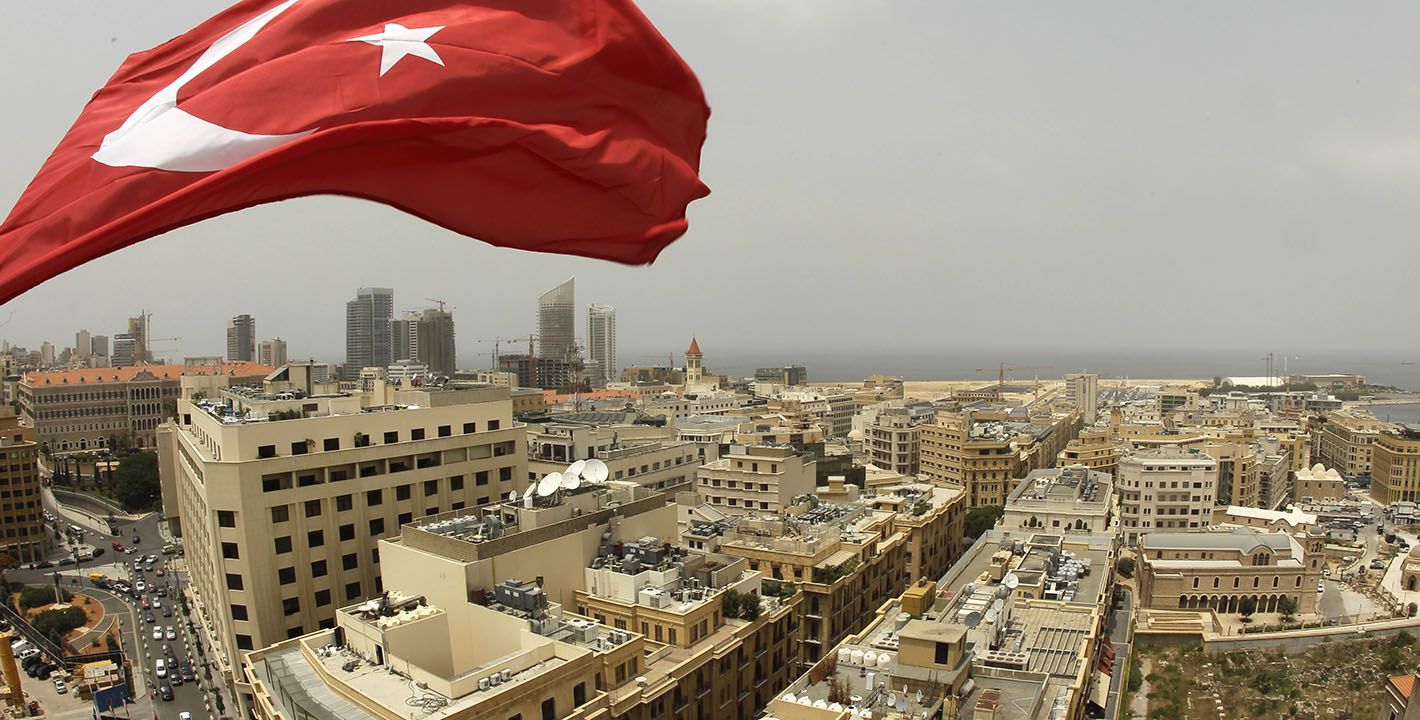
Source: Getty
Ankara may seek to annul a maritime deal with Cyprus and expand its influence in the next parliament.
Since the downfall of the Assad regime in Syria on December 8, 2024, the expansion of Türkiye’s influence has been repeatedly highlighted by U.S. and Israeli officials. President Donald Trump regularly points to Türkiye as the principal external actor behind the former regime’s collapse rather than the forces led by Hay’at Tahrir al-Sham, while Israel has conducted airstrikes against military airbases reportedly scouted by Türkiye.
Against this broader regional backdrop, Türkiye’s interest in Lebanon has come under the spotlight in recent weeks after Lebanese President Joseph Aoun signed a maritime demarcation deal with Cypriot President Nikos Christodoulides on November 26. Ankara was quick to reject the agreement, saying it “violates the rights of Turkish Cypriots on the island and is therefore unacceptable.”
Türkiye’s direct condemnation of the deal stems from fears that Lebanon will be permanently embedded in the opposing Greece-Cyprus-Israel alignment in the East Mediterranean. Lebanon’s government has been positively engaging with a United States-brokered ceasefire agreement to disarm Hezbollah, amid sustained pressure for the country to normalize relations with Israel as part of a comprehensive peace deal.
Given the potential impact of such a Lebanese realignment on Türkiye’s East Mediterranean strategy, Ankara appears to be leveraging its influence in Damascus and Beirut to preempt any attempt to reshape Lebanon’s regional direction.
Following the deal with Cyprus, Turkish sources told Lebanon’s Al-Akhbar newspaper that they were concerned with the current “vacuum” in Sunni representation in Lebanon, the potential rise of pro-normalization [with Israel] figures in the community, and political activity by the Kurdish-led Syrian Democratic Forces in the country. This comes in the aftermath of former prime minister Saad Hariri’s decision in 2022 to withdraw from politics, amid Saudi criticism. Hariri, a dual Lebanese-Saudi citizen, currently lives in the United Arab Emirates and is seen as Lebanon’s most powerful Sunni politician.
The Turkish sources quoted in Al-Akhbar suggest an interest in influencing Sunni representation in the next parliamentary elections, scheduled for May. Ankara might need the support of the new Syrian regime to achieve this. It’s first go-to ally is Lebanon’s Muslim Brotherhood branch, known locally as the Jamaa al-Islamiyya. The group has already signaled it aim to expand its parliamentary presence by leveraging Qatari, Turkish, and Syrian support.
The most concerning dimension of the Jamaa al-Islamiyya’s ambitions lies on the security front, not only because Ankara seeks to counter Israeli influence in Lebanon, but because of the group’s armed wing, the Fajr Forces, which has been allied with Hezbollah. Israel said it targeted a Fajr cell in Beit Jinn in southern Syria on November 28, after it opened fire on Israeli troops. Israel killed thirteen people, while six of its soldiers were injured.
Last week, Türkiye’s TRT interviewed the head of the Jamaa al-Islamiyya’s Political Council, Ali Abou Yassin, who criticized the United States’ recent designation of certain chapters of the Muslim Brotherhood as terrorist organizations, including the Jamaa al-Islamiyya. Yassin said that disarming the group by force would be “a mistake.” This begs the question of whether Türkiye has joined Iran in rejecting the Lebanese government’s disarmament of nonstate armed groups in Lebanon.
In addition to this, Ankara can mobilize its own network in Lebanon. This includes Lebanese citizens of Turkish origin and members of the Turkmen minority in northern Lebanon and the Beqaa Valley, for whom it has expedited Turkish citizenship. Under the current proportional representation electoral law, such an expansion is poised to have an impact on shaping Sunni representation in the next parliament. In tandem with this effort, Türkiye’s development institutions, among them International Humanitarian Relief, remain active inside Lebanon.
Perhaps the most remarkable signal of Ankara’s influence was the celebrations across Lebanon’s major cities—Beirut, Tripoli and Sidon—organized on the first anniversary of Bashar al-Assad’s downfall on December 8. According to a Lebanese security source and another figure close to Türkiye, these were mostly coordinated by Islamist groups and activists, some of whom maintain Turkish residences and are frequent visitors to Syria. These celebrations came a week after an unannounced visit by a Turkish security envoy, who met with Lebanese intelligence officials to reiterate Ankara’s disapproval of the maritime deal with Cyprus, according to the same sources.
The celebrations, like the new Syrian regime’s network of supporters inside Lebanon, indicate that Türkiye’s sway has expanded beyond the Muslim Brotherhood, to Salafist figures and local Islamic associations. If Türkiye consolidates these networks with thousands of Turkmens, dual citizens, and the Syrian’s regime influence, it could potentially expand its leverage in the country’s parliament.
However, Türkiye’s policy also faces potential tensions and constraints. Reports of Ankara’s recent attempts to broker a rapprochement between Hezbollah and Syria’s new leadership are noteworthy, but ultimately they conflict with Damascus’s close alignment with the United States to lift sanctions and end ongoing Israeli strikes. Such steps may also be intended as a one-off signal to the Lebanese government of Türkiye’s capacity to influence the disarmament process, in order to force Beirut to backtrack on its Cyprus deal.
Another important limitation on Türkiye’s influence is Saudi Arabia. Riyadh remains a key actor in Lebanese Sunni politics and a supporter of Syria’s current leadership. Should Ankara’s role expand too much, Saudi Arabia would have the capacity to push back, both in Lebanon and Syria. For now, however, there are no clear signs of tension between the two countries over Lebanon, largely because Ankara’s ambitions remain unclear—particularly whether they are confined to containing or annulling the Cyprus deal, or establishing broader long-term influence.
Finally, Türkiye’s ambitions could be further constrained if Syria’s political transition falters. President Ahmad al-Sharaa’s control over Syria is far from consolidated, and he may face significant challenges ahead. Any renewed instability could entangle Türkiye more deeply in Syrian affairs and limit its ability to project influence beyond the country.
Regardless of Türkiye’s next moves in Lebanon, it would be prudent for Beirut to factor Türkiye’s influence and role in Syria into its own regional approach with regard to maritime demarcation and more, rather than maintaining an exclusive focus on the United States and Israel. However, if Türkiye’s approach in Lebanon aims to replicate Tehran’s, this time through the Sunni community, Beirut has every reason to be concerned.

Deputy Director for Research, Malcolm H. Kerr Carnegie Middle East Center
Mohanad Hage Ali is the deputy director for research at the Malcolm H. Kerr Carnegie Middle East Center.
Recent Work

Azeema Cheema, Mohanad Hage Ali
Mohanad Hage Ali
Carnegie does not take institutional positions on public policy issues; the views represented herein are those of the author(s) and do not necessarily reflect the views of Carnegie, its staff, or its trustees.

As the U.S. stumbles in its war with Iran, we are likely to see an acceleration of its disengagement from the region.

Michael Young
The Zaidi government’s objective to collect weapons is constrained by regional conflict, but it can take certain measures at home.
Ali Al-Mawlawi

Huawei pushed hard to enter the Egyptian data centers market, until the Americans made a better offer.

Angie Omar

The accord represents a pivotal moment in the region to avert a security vacuum in the Gulf.
Azeema Cheema, Mohanad Hage Ali
In an interview, Jason Burke discusses his sweeping account of the “revolutionists” who so shaped the 1970s and early 1980s.
Michael Young