

Commentary
Lying at the heart of Lebanon’s dysfunction is an inability to secure accountability and institutional legitimacy.
Maha Yahya
{
  "authors": [
    "Hasan Hamra"
  ],
  "type": "commentary",
  "blog": "Diwan",
  "centerAffiliationAll": "",
  "centers": [
    "Carnegie Endowment for International Peace",
    "Malcolm H. Kerr Carnegie Middle East Center"
  ],
  "englishNewsletterAll": "",
  "nonEnglishNewsletterAll": "",
  "primaryCenter": "Malcolm H. Kerr Carnegie Middle East Center",
  "programAffiliation": "",
  "programs": [],
  "projects": [],
  "regions": [
    "Iraq",
    "Levant",
    "Israel",
    "Lebanon"
  ],
  "topics": []
}
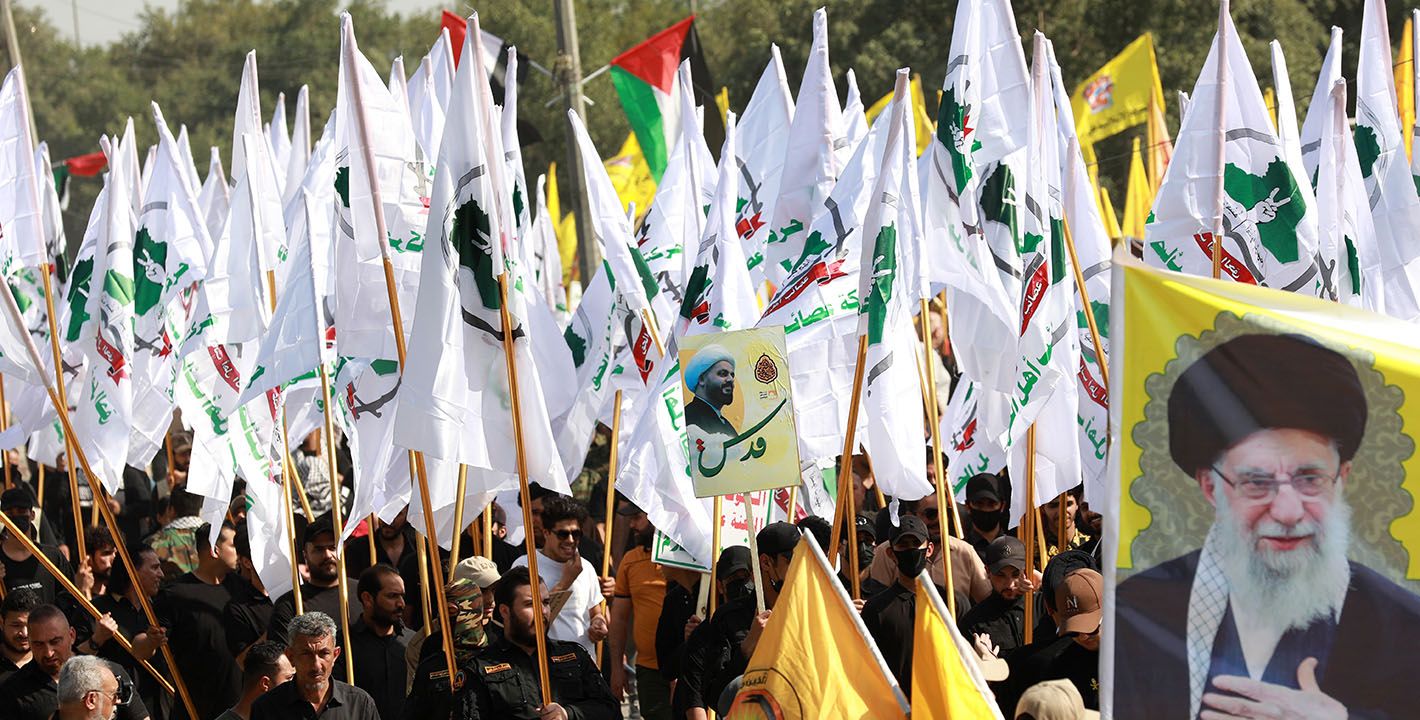
Source: Getty
Beirut and Baghdad are both watching how the other seeks to give the state a monopoly of weapons.
In the aftermath of the recent conflict between Hezbollah and Israel, Lebanon’s ongoing push to impose a “state monopoly of arms” has ceased to be a purely Lebanese story. When, on the first day of this year, the Lebanese cabinet urged the army to secure a monopoly of weapons “as quickly as possible,” and President Joseph Aoun framed the objective as returning the “decisions of war and peace” to the state, Iraqi politics heard something familiar: a sovereignty slogan that could quickly become political leverage.
That feeling intensified on January 8, when Lebanon’s military announced it had completed the first phase of a plan to deploy across the south, disarm nonstate groups, and prevent them from “irreversibly rebuilding their capabilities.” Taken together, these statements pushed the debate beyond Lebanon’s domestic politics and into the register of regional security and external enforcement. Indeed, in response to the Lebanese military’s statement, the Israeli prime minister’s office asserted that “Hezbollah must be fully disarmed.” To Iraqi ears, this sounded less like Lebanese governance reform and more like an externally enforced security architecture.
As with Lebanon, the pro-disarmament argument in Iraq is often articulated in terms of state prerogatives. The most explicit version of this formulation came from the head of Iraq’s Supreme Judicial Council, Faiq Zidan, who argued on January 4 that there was “no legal or constitutional justification” for arms outside official state institutions. The logic was straightforward: following the defeat of the Islamic State, it was incumbent on Iraq to restore and build up its political and military institutions. This, in turn, required unified decisionmaking, with weapons controlled by the state rather than by parallel chains of command. Prime Minister Mohammed Shia al-Sudani has also endorsed restricting the possession of weapons to the state, presenting it as a sovereign Iraqi decision rather than a capitulation to outsiders. But even in Sudani’s framing, a monopoly of arms is achieved through bargaining with parties that might at any point walk away.
In fact, not all Iraqi armed actors are amenable to negotiations. Many Iran-aligned factions in Iraq not only reject disarmament, they have bestowed a near-exalted status on their weapons. Consider a recent statement by the Iraqi Resistance Coordination, the body that speaks on behalf of the Popular Mobilization Forces (PMF), an umbrella organization grouping together a number of armed Iraqi factions, most prominently Iran-backed factions. The statement declared the PMF’s weapons “sacred” and nonnegotiable until such time as foreign forces withdrew from Iraq and the country achieved full sovereignty. This redefinition of the debate as one about occupation and sovereignty first, and governance second, is emerging as a core strategy against the push for disarmament.
This debate is sometimes influenced by external factors. One recent example came in the form of a backlash to a foreign diplomat’s statements. When the British ambassador to Iraq said last August that the PMF was no longer necessary now that the conflict against the Islamic State was over, and that some of the organization’s factions operated outside the law, condemnation by Iraqi officials and politicians was swift and unforgiving. This and other incidents in both Iraq and Lebanon illustrate how quickly “arms beyond the state” becomes a sovereignty and dignity issue, as opposed to one of technocratic security reform.
Another reason the issue is complicated is that, in both Iraq and Lebanon, it is not just about guns, but also about what happens to armed actors and their patronage networks. What will become of them if their weapons are folded into the state? Sudani has proposed an off-ramp whereby the factions in question would either be absorbed into the security forces or become political parties. In Lebanon, politicians and analysts have floated similar solutions. Interestingly, however, when he was asked about international pressure brought to bear on nonstate armed groups, “such as Lebanon’s Hezbollah,” for the purpose of disarming them, Sudani replied, somewhat defensively, that “the situation here is different than Lebanon.”
Sudani’s aversion to the use of Lebanon as a yardstick may stem from the fact that Iran’s footprint is more deeply embedded in Iraq’s political and armed landscape. In Lebanon, pro-state rhetoric has tended, implicitly or explicitly, to place the responsibility for the phenomenon of arms outside the state at Iran’s feet. This was on display, for example, when Aoun’s office called on friendly countries not to send weapons to Lebanon except through state institutions. In Iraq, by contrast, advocates of restricting the possession of weapons outside the state have been more circumspect, portraying disarmament as an internal, sovereignty-related issue, rather than giving more prominence to Iran’s role.
Nevertheless, Lebanon continues to “reignite conversation in Iraq” about disarming nonstate actors. However, there is a crucial and paradoxical distinction. In Iraq, the question of Lebanon’s disarmament functions less as a blueprint than as a pressure amplifier. It strengthens one camp’s claim that a “monopoly of arms” is the normal language of statehood, while simultaneously strengthening the other camp’s assertion that disarmament is selective sovereignty—of the sort demanded when an armed actor is inconvenient and postponed when the actor in question proves militarily useful.
Lebanon’s “state monopoly” drive is therefore fast becoming a point of reference for each side in the Iraqi debate, and even stoking the debate itself.
Hasan Hamra
Lying at the heart of Lebanon’s dysfunction is an inability to secure accountability and institutional legitimacy.

Maha Yahya
In an interview, Sohaib Jawhar analyzes the profound changes in the ties between the neighboring countries.

Michael Young

By failing to address Palestinian representation, the current process is bound to lead to just another temporary arrangement.

Nathan J. Brown
Following its deal with the United States, Iran may act against Iraq-based dissidents.
Wladimir van Wilgenburg
Any move by the United States to make good on Trump’s suggestion that Washington persuade Damascus to confront Hezbollah militarily would have catastrophic consequences.

Kheder Khaddour