

Commentary
Michael Young
{
  "authors": [
    "Michael Young"
  ],
  "type": "commentary",
  "blog": "Diwan",
  "centerAffiliationAll": "",
  "centers": [
    "Carnegie Endowment for International Peace",
    "Malcolm H. Kerr Carnegie Middle East Center"
  ],
  "collections": [
    "Decoding Lebanon"
  ],
  "englishNewsletterAll": "",
  "nonEnglishNewsletterAll": "",
  "primaryCenter": "Malcolm H. Kerr Carnegie Middle East Center",
  "programAffiliation": "",
  "programs": [],
  "projects": [],
  "regions": [
    "Lebanon",
    "Levant"
  ],
  "topics": [
    "Economy"
  ]
}
Source: Getty
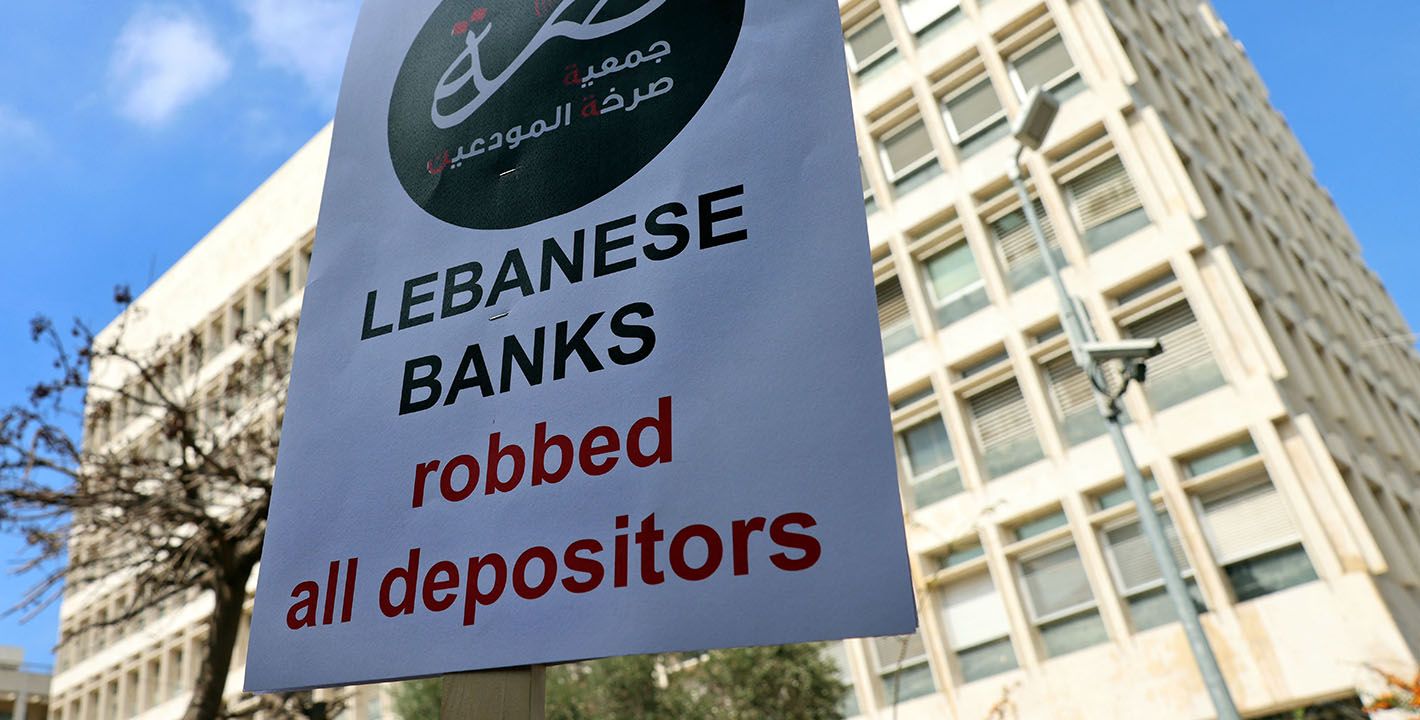
In an interview, Ishac Diwan looks at the merits and flaws in the draft legislation distributing losses from the financial collapse.
Ishac Diwan is research director at the Finance for Development Lab, a think tank based at the Paris School of Economics that specializes in the resolution of financial crises. He is also a professor of economics at the American University of Beirut. In 2025, he was a member of the United Nations’ International Commission of Experts on Financing for Development, and participated in the Vatican’s “The Jubilee Report: A Blueprint for Tackling the Debt and Development Crises and Creating the Financial Foundations for a Sustainable People-Centered Global Economy.” He has published widely on issues of international finance and development strategies. His recent books (co-authored) include a Political Economy of the Middle East (2015) and Crony Capitalism in the Middle East (2019). Carnegie’s Diwan interviewed him in late December, soon after he had published a paper analyzing the so-called financial gap law released by the Lebanese government, which distributes the $70 billion in losses from the financial collapse of 2019–2020.
Michael Young: Can you begin by explaining what the recent gap law formulated by the Salam government does, or fails to do? Why has it taken so long to be issued?
Ishac Diwan: That it took six years to come up with this law, since the 2019 bank run, is a national disaster. The financial collapse is only the tip of the iceberg; it reveals a deeper crisis of governance and a bankrupt economic model. The restructuring of the banking system should be seen as only one workstream in the government’s broader reform program. The only way to resolve a banking crisis is to rebuild trust. A necessary—but insufficient—condition is to reequilibrate balance sheets by reducing liabilities (through haircuts) and increasing assets (through bailouts). This is what the law seeks to do. It distributes losses progressively, with a much higher burden on larger accounts. The law also confirms that the state will pay for a share of the cost, but without specifying how much. The law’s objective is not to “return” deposits, as is commonly believed. Its real purpose is to restore confidence in a restructured, much smaller banking system, so that remaining deposits (after haircuts) stay in the system and finance a more productive economic model.
The main challenge over the next four years will be to secure deposits of up to $100,000, totaling about $20 billion. Assets of this magnitude are thought to be available at the Banque du Liban, or central bank, and in banks—more than half in a liquid form. If banks are properly recapitalized, much of these funds should remain in the system. Restored trust could also attract an estimated $10 billion currently held in cash. One of the main wagers of the draft law is that a large portion of deposits can be eliminated on accounts in a list of “anomalies.” It remains to be demonstrated whether this is administratively and legally feasible.
MY: What do you see as positive in the law?
ID: A great deal. First, the draft law distributes losses equitably among depositors, according to means. Small depositors get 100 percent of their deposits back, while in financial present-value terms, the largest get only 28 percent back. Second, the hierarchy of claims is respected, with bank equity wiped out first. Third, the draft law begins to expose past corrupt practices, including insider advantage, discriminatory treatment, and money laundering, and it does not offer amnesty for past financial crimes. Fourth, it recognizes that the crisis is systemic, socializing part of the losses. Based on my calculations, the state would need to pledge around $10 billion in treasury bills to the Banque du Liban to help it service the certificates received by large depositors. This is, in my estimate, at the limit of what the state can do given its obligations to society, reconstruction, and Eurobond holders. The agreement, therefore, stretches the boundaries of financial feasibility and depositors could not reasonably expect more.
This plan is also feasible and necessary, and it could generate a virtuous cycle enabling complementary reforms. However, risks remain. A loss of confidence along the way could trigger a new run of withdrawals. Safeguards and risk-mitigation measures are therefore essential. The draft law allows payment schedules to slow if conditions deteriorate, but this provision should be strengthened given regional turbulence.
MY: The law was immediately surrounded by controversy. Can you explain the main criticisms and what motivated them?
ID: Opposition ranges from right to left. Strong resistance will continue to come from segments of the financial elite that would bear a significant share of the burden. More generally, there is widespread shock among average citizens at the scale of the losses, partly reflecting years of disinformation disseminated by a captured media. There is also a broad-based demand for more clarity about how the banking restructuring fits into the larger vision for the future of the country and the economy. Finally, many people welcome the reformist drive, but question the gradual, pragmatic approach. They seek faster and more radical change—not just more funds to the middle class, but more accountability and punishment for past crimes.
MY: One of the main points of contention involve Lebanon’s gold reserves, which you have estimated at around $38 billion. What are the main arguments, and what do you see as the optimal use of the gold?
ID: Rising gold prices have roughly tripled the value of Lebanon’s gold reserves. Selling all the gold at current prices would allow repayment of most deposits, but this would disproportionately benefit wealthy citizens. One can estimate that 5 percent of the population holding large accounts would get at least 60 percent of the gold. Eurobond holders would also have an argument to claim their share.
Most citizens, I believe, prefer to preserve most of the gold to help build a Third Republic rather than clean up the legacy of the Second. There is also a fear of misappropriation. Losses after 2019 exceeded by far those before it, benefiting special interests. About $30 billion in foreign currency reserves evaporated in capital flight and import subsidies, and $30 billion in bank loans were repaid on the cheap. The plan of former prime minister Hassan Diab could have returned five times more funds than the current plan. There is a grave risk that gold would also be looted if the legal prohibition on touching it is lifted before governance becomes more disciplined and just.
The draft law’s stance on gold is deliberately ambiguous. Securities for large depositors are issued by Banque du Liban, in contrast to earlier proposals which had envisaged a separate deposit recovery fund. While gold is not formally pledged as collateral, failure by the central bank to service the securities would force a recourse to the gold reserves. To limit this risk, the state budget must provide a sufficiently large counter-guarantee to the Banque du Liban.
More fundamentally, two problems arise. In an ideal world, gold would be sold and its proceeds invested in a diversified global portfolio that is less risky and produces a financial return. However, the law commits 70 percent of the Banque du Liban’s asset sales to large depositors, effectively blocking diversification for two decades. This provision is redundant and harmful and should be removed. Second, the law promises accelerated payments to large depositors if the conditions permit it, creating incentives for elites to support the return of a regime that is friendly to big capital. Offering upside incentives to large depositors is not inherently wrong, but these should be tied to objective, verifiable criteria, rather than left to a discretionary decision.
MY: What do you expect will be the fate of the law in a divided parliament dominated by conflicting interests?
ID: The economy has been in collapse for six years, constrained by too many veto players, an ineffective political class, and powerful rent-seekers. Could things be different now? Perhaps a Third Republic is emerging from the ashes, embodying the dreams of the popular revolt of 2019–2020 for a new political regime at the service of citizens. We are fortunate to have a reformist president and dynamic prime minister, but we remain constrained by a fragmented parliament and a confessional system that complicates decisionmaking.
One possibility, as with the passage last year of a law lifting banking secrecy, is that sufficient external pressure can secure passage of the gap law. Another is that an amended version of the draft law can command a parliamentary majority. For example, including a bailout of the social security fund and the professional associations’ pension plans would help secure much stronger support from the middle class—but this would need to rely on some gold sales.
MY: Finally, how do you expect the International Monetary Fund to react, and does the Salam government genuinely intend to pursue an IMF program?
ID: The law is broadly consistent with international best practice in its current form. The government appears genuinely committed to an IMF program, recognizing that international support is key to secure backing for its reformist plan. The main risk is parliamentary distortion of the current draft. Resistance to an IMF program runs high within some banking circles, which prefer a restructuring without international oversight.
Technically, the main remaining hurdle is the development of a credible medium-term macro framework with an adequate budget, recovery-oriented reforms, and the start of negotiations with Eurobond holders. This needs to include a reasonable balance between commitments to depositors, bondholders, and national stakeholders—a challenging task that has not yet been sufficiently addressed.

Editor, Diwan, Senior Editor, Malcolm H. Kerr Carnegie Middle East Center
Michael Young is the editor of Diwan and a senior editor at the Malcolm H. Kerr Carnegie Middle East Center.
Recent Work
Michael Young
Michael Young
As the U.S.-led Coalition withdraws, the Kurds’ reliance on Baghdad, and on themselves, will only increase.
Wladimir van Wilgenburg
The Zaidi government’s objective to collect weapons is constrained by regional conflict, but it can take certain measures at home.
Ali Al-Mawlawi
Lying at the heart of Lebanon’s dysfunction is an inability to secure accountability and institutional legitimacy.

Maha Yahya
In an interview, Sohaib Jawhar analyzes the profound changes in the ties between the neighboring countries.
Michael Young
Any move by the United States to make good on Trump’s suggestion that Washington persuade Damascus to confront Hezbollah militarily would have catastrophic consequences.
Kheder Khaddour