

Commentary
Nikolay Petrov
{
  "authors": [
    "Nikolay Petrov"
  ],
  "type": "legacyinthemedia",
  "centerAffiliationAll": "",
  "centers": [
    "Carnegie Endowment for International Peace",
    "Carnegie Russia Eurasia Center"
  ],
  "collections": [],
  "englishNewsletterAll": "",
  "nonEnglishNewsletterAll": "",
  "primaryCenter": "Carnegie Russia Eurasia Center",
  "programAffiliation": "",
  "programs": [],
  "projects": [],
  "regions": [
    "Caucasus",
    "Russia"
  ],
  "topics": [
    "Political Reform"
  ]
}
Source: Getty
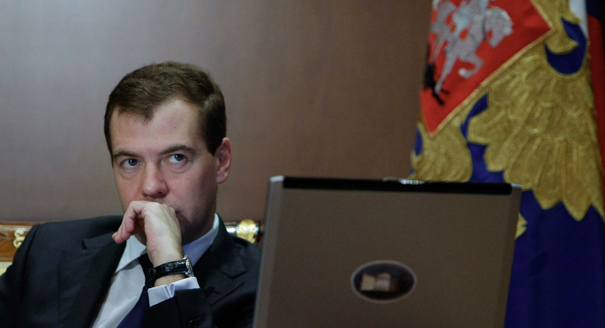
The Kremlin is trying to present President Dmitry Medvedev's new bill as a way of bringing back direct gubernatorial elections, but in fact governors will still remain beholden to the president, not the people.
Source: The Moscow Times

According to the bill's language, regional heads will be "vested with authority." Previously, "vested with authority" was a euphemism for the president appointing them directly, with regional assembly deputies rubber-stamping his choice. Otherwise, they would run the risk of seeing their parliament dissolved by the president if they balked. Now, the phrase "vested with authority" is meant to mean "elected by the people." But this is not a return to the previous system of direct gubernatorial elections that was in place before then-President Vladimir Putin cancelled them following the Beslan school terrorist attack in 2004.
Medvedev's bill aims to free the Kremlin of responsibility for governors that the people supposedly elected, while preserving the same control it always had over gubernatorial appointments. Under the new rules, parties would have the right to put forward a gubernatorial candidate of their choice but only in "consultation" with the president. Translated into Kremlin lexicon, "consultation with the president" essentially means "with the president's approval." In this way, the Kremlin very much retains the "filter" that it claims it had removed.In addition, the bill allows the president to fire a governor who was elected by the people if the president has "lost confidence" in him based on just allegations of corruption or a conflict of interest. No court decision is required. Thus, the mere threat of being accused of corruption or a conflict of interest is enough to keep a governor loyal to the Kremlin.
In other words, it is only important if the president loses confidence in a governor. Apparently, the confidence of the governor's electorate — the very people who voted for him and entrusted him with authority — matters little.
As simple as it is for the Kremlin to remove undesirable governors, Russian voters have no mechanism to do the same thing. To strip a governor of his post, voters would have to first obtain a court decision and then win an absolute majority among all registered voters, which is a near impossibility.
The main problem with Medvedev's bill is that it doesn't change the most important part of the old system, in which governors were appointed by the Kremlin. Governors still remain beholden to the president, not the people. Given a choice of loyalties, a governor will always throw in his lot with the president, who can strip him of power overnight by one stroke of his pen.
It is already clear that the Kremlin has no interest in improving the quality of governors. Take, for example, the unpopular Volgograd Governor Anatoly Brovko, who "voluntarily" stepped down just one day after Medvedev submitted his bill concerning gubernatorial elections. In his place, the president appointed someone even worse — the scandal-plagued former Astrakhan Mayor Sergei Bozhenov. This decision has already provoked public protests. Moreover, Medvedev's bill specifically states that any governor who is appointed will enjoy diplomatic immunity for one full year.
As long as the dual Kremlin filters remain in the bill — de facto requiring gubernatorial candidates and their parties to "consult" with the president and giving the president to fire governors basically at will — the new law will be meaningless.
Former Scholar-in-Residence, Society and Regions Program, Moscow Center
Nikolay Petrov was the chair of the Carnegie Moscow Center’s Society and Regions Program. Until 2006, he also worked at the Institute of Geography at the Russian Academy of Sciences, where he started to work in 1982.
Recent Work
Nikolay Petrov
Nikolay Petrov
Carnegie does not take institutional positions on public policy issues; the views represented herein are those of the author(s) and do not necessarily reflect the views of Carnegie, its staff, or its trustees.
In an interview, Sergei Melkonian discusses Armenia’s and Azerbaijan’s careful balancing act among the United States, Israel, and Iran.

Armenak Tokmajyan
The country’s leadership is increasingly uneasy about multiple challenges from the Levant to the South Caucasus.
Armenak Tokmajyan
In an interview, Daniela Richterova speaks about her book on Czechoslovakia’s Cold War ties to Palestinian groups and others.

Michael Young
The downfall of the Assad regime represented a setback, but Russia’s primary focus remains Ukraine.
Sergei Melkonian

Why did Bashar al-Assad’s armed forces fail to act, unlike those in Egypt, Libya, Algeria, and Sudan?

Yezid Sayigh