

Article
C. Raja Mohan, Darshana M. Baruah
{
  "authors": [
    "C. Raja Mohan"
  ],
  "type": "legacyinthemedia",
  "centerAffiliationAll": "dc",
  "centers": [
    "Carnegie Endowment for International Peace",
    "Carnegie India"
  ],
  "collections": [],
  "englishNewsletterAll": "ctw",
  "nonEnglishNewsletterAll": "",
  "primaryCenter": "Carnegie India",
  "programAffiliation": "SAP",
  "programs": [
    "South Asia"
  ],
  "projects": [],
  "regions": [
    "South Asia",
    "India"
  ],
  "topics": [
    "Security",
    "Military",
    "Foreign Policy",
    "Nuclear Policy",
    "Nuclear Energy"
  ]
}
Source: Getty
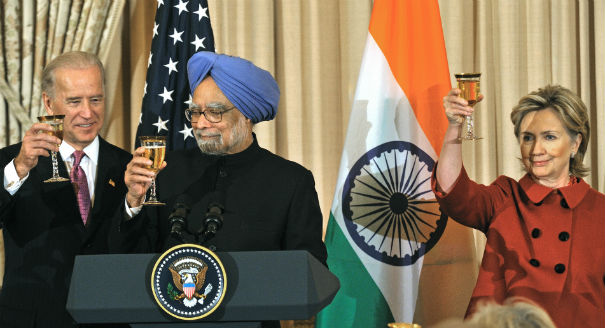
In the face of mounting international skepticism, India must take real steps to pursue strategic partnerships with the United States and other nations.
Source: Indian Express

Secretary of State Hillary Clinton, who enthusiastically led the Obama administration’s engagement with India, will step down soon. Her designated successor, Senator John Kerry, unfortunately, has been dubbed by some analysts as being less than warm towards India and “soft on Pakistan.”
Such preemptive labeling is not of much help in the conduct of India’s diplomacy. Yet, there is no denying the concerns in Delhi that America might offer too many concessions to the Pakistan army and the Taliban as it prepares to end its combat role in Afghanistan by 2014.Within the State Department, India has had a very supportive South Asia bureau led by Assistant Secretary Robert Blake, who might be moving on. Blake and many of the deputies had served in Delhi earlier, understood India’s concerns and rooted for a strong partnership.
Kurt Campbell, currently assistant secretary of state for East Asia, was at the forefront of a bold effort to compel the US establishment to see Delhi from the perspective of Asian balance of power rather than India’s quarrels with Pakistan. Campbell too is said to be leaving the administration.
There will also be a change of guard at the Pentagon, where the current Secretary of Defense Leon Panetta and his deputy Ash Carter have sought to lift the current US restrictions on defense collaboration with India.
In both Washington and Delhi, personnel are often policy. While Delhi should prepare itself for the current round of changes in the US government, its real concern should be about an argument that has gained some traction in Washington’s policy community. Put simply, the proposition is that the prospects for a partnership with India were “oversold” in Washington by the Bush administration. The argument has four parts.
First, the civil nuclear initiative, which the US launched at “great cost” to the nonproliferation regime, has not produced the promised “rewards” for Washington. India is nowhere close to buying nuclear reactors from the United States.
Second, if commerce has not flowed from the deal, the argument goes, the political gains have been conspicuous in their absence. On multilateral issues, India has shown no signs of drawing closer to the US and on the Middle East, Delhi remains at odds with Washington.
Third, on the US pivot to Asia, Delhi’s ambiguity has disproved the widespread assumption in Washington that India is a natural partner in balancing China.
Finally, the civil nuclear initiative has not in any way reduced American difficulties in dealing with the Indian bureaucracy, which is either truculent or lacks the bandwidth to cope with the dramatic expansion of American interest in India.
The argument in Washington that India is not ready for a serious relationship with America has not gone uncontested. Ashley Tellis, who played a key role in transforming the India-US relationship over the last decade and more, has challenged the premises and logic of the skeptics.
In a study to be released this week in Washington by the Carnegie Endowment, Tellis argues that the substantive expansion of the bilateral relationship over the last few years could not have taken place without the historic civil nuclear initiative.
The report titled, “Opportunities Unbound: Sustaining the Transformation in US-Indian Relations,” recalls that the civil nuclear initiative was about “conclusively eliminating” the “most significant source of alienation” between the two countries for more than three decades — the question of India’s place in the global nuclear order.
Tellis insists that the US investment in the nuclear initiative was not about winning immediate commercial contracts, nor was it based on any expectation that India would become a camp-follower of the United States on the global stage. He posits that the Bush initiative towards India was rooted in America’s own self-interest and “shaped by what US policy makers believed was critical to the success of American aims in Asia”. This in turn, according to Tellis, was not about containing China or isolating it — both are hopelessly unrealistic objectives for the US — but strengthening other powers in Asia and facilitating cooperation among them.
“New Delhi’s part in this plan,” Tellis argues, “hinges not so much on what India does for the United States, but on whether it rises rapidly enough to produce an Asian strategic balance that advances American interests.” Hence the American policy of assisting India’s rise on the Asian and world stage.
Besides setting the record straight on the evolution of US relations with India, Tellis has outlined a forward-looking agenda for the second term of the Obama administration. He urges Delhi to accelerate India’s economic reforms and calls on Washington to actively consider negotiations with India on a free trade agreement.
Deepening defense cooperation is high on Tellis’s list for the bilateral ties. He asks Washington to make it easier for India to acquire advanced defense technologies and build a modern defence industrial base. Tellis wants India to shed its current inhibitions about operational ties with the US military. He also calls for greater consultation and coordination between Washington and Delhi on regional security, especially on Iran and Afghanistan.
Tellis has effectively countered the American misperceptions about the making of the India-US partnership. But there is no escaping the international perception that Delhi has lost the political will to pursue strategic partnerships with any of its friendly interlocutors.
From America to Bangladesh and Australia to Europe, those who bet on big breakthroughs with India in the last few years can’t hide their disappointment at its seeming inability to seize the opportunities at hand. It is up to Delhi to prove that the concerns of its friends and partners around the world are misplaced.
This article originally appeared in the Indian Express on January 8, 2013.
Former Nonresident Senior Fellow, Carnegie India
A leading analyst of India’s foreign policy, Mohan is also an expert on South Asian security, great-power relations in Asia, and arms control.
Recent Work

C. Raja Mohan, Darshana M. Baruah


Alexander Gabuev, Paul Haenle, C. Raja Mohan, …
Carnegie does not take institutional positions on public policy issues; the views represented herein are those of the author(s) and do not necessarily reflect the views of Carnegie, its staff, or its trustees.

In an interview, Ian Lustick and Eli Clifton discuss their new book on why a prominent ally has so much influence in America.

Michael Young

By failing to address Palestinian representation, the current process is bound to lead to just another temporary arrangement.

Nathan J. Brown

The armed forces champion a form of capitalism that is generating revenue, but its reliance on rent faces diminishing returns, leaving the country with massive sunk costs and deferred returns, deepening dependency on external borrowing.

Yezid Sayigh

In an interview, Marc Lynch discusses his new book decrying the post-1990 U.S.-dominated order in the Middle East.
Michael Young

Just look at Iraq in 1991.

Marwan Muasher