

Commentary
Sarah Chayes
{
  "authors": [
    "Sarah Chayes"
  ],
  "type": "legacyinthemedia",
  "centerAffiliationAll": "dc",
  "centers": [
    "Carnegie Endowment for International Peace"
  ],
  "collections": [],
  "englishNewsletterAll": "ctw",
  "nonEnglishNewsletterAll": "",
  "primaryCenter": "Carnegie Endowment for International Peace",
  "programAffiliation": "SAP",
  "programs": [
    "South Asia"
  ],
  "projects": [],
  "regions": [
    "South Asia",
    "Afghanistan"
  ],
  "topics": [
    "Security",
    "Foreign Policy"
  ]
}
Source: Getty
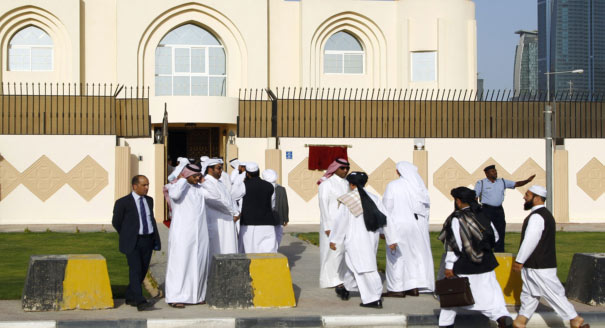
The prospects for a peace agreement between Hamid Karzai’s government and the Afghan Taliban are undermined by the Pakistani military’s influence over the Taliban and the exclusion of groups not allied with Karzai or the Taliban.
Source: KCRW Los Angeles
Speaking on KCRW Los Angeles, Carnegie's Sarah Chayes explained that efforts to end America's 12-year war in Afghanistan are on shakier ground than ever. President Obama called talks between the Taliban and Afghanistan's government "an important first step in reconciliation," but Chayes explained that any progress was undermined when the Taliban opened an office in Qatar called the "Political Office of the Islamic Emirate of Afghanistan," the name they used when they ruled Afghanistany. President Karzai has said he would not attend after the Taliban started behaving like a former government with plans to return to power. Chayes discussed whether the Taliban running out the clock, taking advantage of President Obama's announced plan to withdraw troops by 2015. She also addressed how the conflicting agendas of Pakistan and India are adding to the diplomatic confusion.
Former Senior Fellow, Democracy, Conflict, and Governance Program
Sarah Chayes is internationally recognized for her innovative thinking on corruption and its implications. Her work explores how severe corruption can help prompt such crises as terrorism, revolutions and their violent aftermaths, and environmental degradation.
Recent Work
Sarah Chayes
Carnegie does not take institutional positions on public policy issues; the views represented herein are those of the author(s) and do not necessarily reflect the views of Carnegie, its staff, or its trustees.

By failing to address Palestinian representation, the current process is bound to lead to just another temporary arrangement.

Nathan J. Brown

Just look at Iraq in 1991.

Marwan Muasher

A coalition of states is seeking to avert a U.S. attack, and Israel is in the forefront of their mind.

Michael Young

Baku may allow radical nationalists to publicly discuss “reunification” with Azeri Iranians, but the president and key officials prefer not to comment publicly on the protests in Iran.

Bashir Kitachaev

The country’s leadership is increasingly uneasy about multiple challenges from the Levant to the South Caucasus.

Armenak Tokmajyan