

In The Media
John Judis
{
  "authors": [
    "John Judis"
  ],
  "type": "legacyinthemedia",
  "centerAffiliationAll": "",
  "centers": [
    "Carnegie Endowment for International Peace",
    "Malcolm H. Kerr Carnegie Middle East Center"
  ],
  "collections": [
    "Arab Awakening"
  ],
  "englishNewsletterAll": "",
  "nonEnglishNewsletterAll": "",
  "primaryCenter": "Carnegie Endowment for International Peace",
  "programAffiliation": "",
  "programs": [],
  "projects": [],
  "regions": [
    "North Africa",
    "Egypt"
  ],
  "topics": [
    "Political Reform",
    "Democracy",
    "Security"
  ]
}
Source: Getty
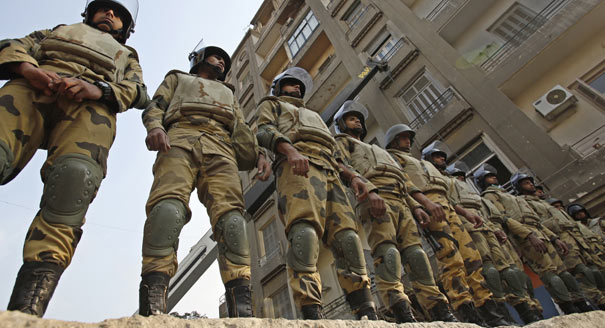
The army remains the power behind the scenes in today’s Egypt.
Source: New Republic
The Egyptian military has reportedly issued an ultimatum to Mohamed Morsi’s government that if it fails to restore order in 48 hours, the army will intervene in the country’s affairs. Whether it is threatening to remove Morsi remains unclear, but what does seem to be clear is that the army remains the power behind the scenes in today’s Egypt.
I want to reiterate something that I wrote two-and-a-half years ago about the ouster of Egyptian President Hosni Mubarak. I wrote at the time that it was a mistake to describe Mubarak’s ouster a “revolution.” My argument, drawn from Max Weber and Lenin, is that the possession of state power requires a monopoly over the use of force. In Egypt, in the wake of the 1952 coup that brought Gamel Abdel Nasser and a group of officers to power, the military gradually fashioned a state apparatus in which they would not formally govern, but would function as a ruling class—enjoying not merely control over the country’s armed forces, but also over a large part of its economy.In State and Revolution, Lenin wrote that a revolution would have to “smash the state.” That was a vivid way of saying that it would have to alter fundamentally the terms of state power. That did not happen in Egypt, where the military itself eased Mubarak out of power. Mubarak—unlike Syria’s Bashar al-Assad—did not control the military, but served at its behest. Morsi or some opposition movement may in the future dislodge Egypt’s military from power, but it doesn't seem to have happened yet; and those opposition forces who have called on the military to intervene may live to regret it.

Former Visiting Scholar
As a visiting scholar at Carnegie, Judis wrote The Folly of Empire: What George W. Bush Could Learn from Theodore Roosevelt and Woodrow Wilson.
Recent Work
John Judis
John Judis
Carnegie does not take institutional positions on public policy issues; the views represented herein are those of the author(s) and do not necessarily reflect the views of Carnegie, its staff, or its trustees.

Just look at Iraq in 1991.

Marwan Muasher

The recent African Cup of Nations tournament in Morocco touched on issues that largely transcended the sport.


Issam Kayssi, Yasmine Zarhloule

Baku may allow radical nationalists to publicly discuss “reunification” with Azeri Iranians, but the president and key officials prefer not to comment publicly on the protests in Iran.

Bashir Kitachaev

The UN Support Mission in the country should reassess its approach so that consensus between the warring parties becomes the eventual goal, rather than a procedural matter that dogs the negotiating process at every turn.

Soraya Rahem

Mustaqbal Misr has expanded its portfolio with remarkable speed, but a lack of transparency remains.

Yezid Sayigh