

Commentary
Dmitri Trenin
{
  "authors": [
    "Dmitri Trenin"
  ],
  "type": "legacyinthemedia",
  "centerAffiliationAll": "",
  "centers": [
    "Carnegie Endowment for International Peace",
    "Malcolm H. Kerr Carnegie Middle East Center",
    "Carnegie Russia Eurasia Center"
  ],
  "collections": [],
  "englishNewsletterAll": "",
  "nonEnglishNewsletterAll": "",
  "primaryCenter": "Carnegie Russia Eurasia Center",
  "programAffiliation": "",
  "programs": [],
  "projects": [
    "Eurasia in Transition"
  ],
  "regions": [
    "Levant",
    "North America",
    "United States",
    "Middle East",
    "Syria",
    "Russia"
  ],
  "topics": [
    "Security",
    "Foreign Policy",
    "Global Governance"
  ]
}
Source: Getty
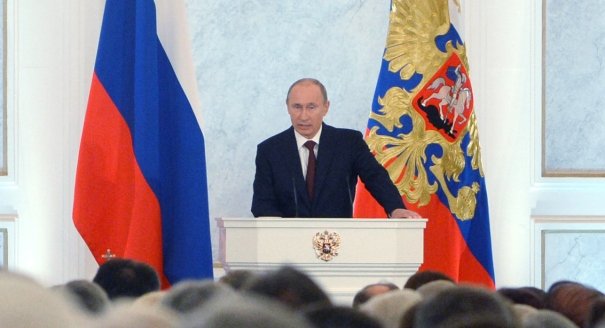
The main goal of Vladimir Putin’s op-ed in the New York Times is to force the United States back into the U.N. Security Council-centered international system.
Source: Washington Post
Dmitri Trenin is the director of the Carnegie Moscow Center, where he chairs the center's research council and the Foreign and Security Policy Program. He's written a number of articles over the years trying to make sense of Russian ties to Syria and Russia's position on the Syria civil war. We spoke by phone Wednesday.
There were many things that struck me in that op-ed, an it's hard to deconstruct or summarize in a sentence. I think Putin is basically saying something that a lot of people will find objectionable — that the United States has been soaring above international law and it’s time the country to return inside the framework of international law as codified by the United Nations charter, especially with the Security Council.
I think Putin believes that an inertia can be created that would lead to progressively more and more U.S. actions around the world which might collide at some point with Russia's core interests, to use a Chinese expression. They want to stop the use of force by the United States outside of the U.N. Security Council framework. They're trying to keep a hold on the use of force internationally.
I think that Mr. Putin would say to that in Georgia we acted in response to an aggression committed against our forces. So we were acting in accordance with Article 51 of the UN Charter. And Putin has said before that the United States does not face any threat of an aggression from Syria.
Syria is marginally important. It's important as a market for Russian arms. But Russia is not involved in the geopolitics of the Middle East the way the Soviet Union was, so Syria's not important as a foothold in geopolitical terms. There are some other things like the Tartus naval facility [a naval station in Syria and Russia's only resupply spot on the Mediterranean], but I would say they are relatively marginal in Russia's thinking here.
Yeah, it's happened before. Russia was left out of Iraq, Russia was left out of Libya, although Libya it didn't have much of a position. They are concerned that if Russia is eased out of Syria that will reflect badly on Russia's international image abroad or on Putin's foreign policy at home.
Well I think that they've been thinking of former Soviet republics as areas where the United States might eventually become involved. Places like Belarus. It looks far-fetched, and seems far-fetched, but those are definitely places where the Russians would not want to see the U.S. do anything militarily.
But I think Putin is really more concerned with this inertia of using military power to solve political issues. And of course Russia has no parity in conventional military terms with the United States.
Militant Islamist groups are seen as a big concern by the Russians. They think that the longer the war in Syria continues, the worse off everyone including Russia will because of the militants gaining ground. And that's something that could come back to Russia itself, absolutely.
Russia thinks its veto right at the Security Council as perhaps the only thing that can prevent activities that Russia strongly dislikes and disapproves of by making them illegal. That’s the only instrument that it has. It has nuclear weapons, yes, but in real life you can not use deterrence, certainly not often. The veto threat is something you can use quite often if you need to.
This whole business with chemical disarmament is exceedingly difficult. They're in uncharted waters and we don't know how this will turn out. It's never been done before. It's never been thought of as a procedure to be undertaken under conditions of civil war. So it's exceedingly difficult. Whether they put it off or not is a big, big, question of mine. But I think in Putin’s view and in many others, that’s the one option that’s better than the others.
I think they see the chemical frame as something that leads to a wider political frame. In a way you cannot treat the two separately, you have to ensure a ceasefire in the areas where chemical weapons are kept in order to proceed with the mission. So that calls for the beginning of political process. But this is really the first time that Russians have tried anything like that.
Former Director, Carnegie Moscow Center
Trenin was director of the Carnegie Moscow Center from 2008 to early 2022.
Recent Work
Dmitri Trenin
Dmitri Trenin
Carnegie does not take institutional positions on public policy issues; the views represented herein are those of the author(s) and do not necessarily reflect the views of Carnegie, its staff, or its trustees.

As the U.S. stumbles in its war with Iran, we are likely to see an acceleration of its disengagement from the region.

Michael Young
The Zaidi government’s objective to collect weapons is constrained by regional conflict, but it can take certain measures at home.
Ali Al-Mawlawi

Huawei pushed hard to enter the Egyptian data centers market, until the Americans made a better offer.

Angie Omar

Middle Eastern states should welcome an accelerated U.S. disengagement from their region.
Michael Young

In an interview, former ambassador Charles Freeman assesses the Trump administration’s war against Iran.
Michael Young