

Commentary
Bayram Balci
{
  "authors": [
    "Bayram Balci"
  ],
  "type": "commentary",
  "centerAffiliationAll": "",
  "centers": [
    "Carnegie Endowment for International Peace",
    "Carnegie Russia Eurasia Center"
  ],
  "collections": [],
  "englishNewsletterAll": "",
  "nonEnglishNewsletterAll": "",
  "primaryCenter": "Carnegie Endowment for International Peace",
  "programAffiliation": "",
  "programs": [],
  "projects": [],
  "regions": [
    "Caucasus",
    "Azerbaijan"
  ],
  "topics": [
    "Political Reform"
  ]
}
Source: Getty
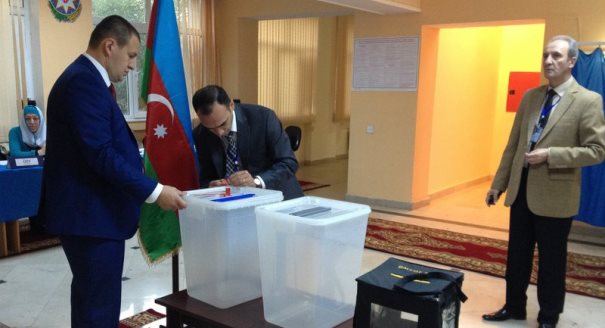
The presidential election results in Azerbaijan should be no surprise. However, they were a real test for the regime as it was the first time it was confronted with a serious opposition. But most importantly these elections also became a test for the Azerbaijani opposition itself.
According to many analysts observing the presidential campaign in Azerbaijan, there was no doubt that President Ilham Aliyev would win reelection. But this certainty posed the inevitable question: what was the use then for elections? Many believed they are unnecessary. Nonetheless, the campaign which continued for several months taught us several lessons on both the Azerbaijani domestic and regional politics. The interesting part about these elections was not about who the winner would be, or whether they were fair or not, but how they contributed to a new political process at work in Azerbaijan.
Ilham Aliyev came to power in 2003, succeeding his father who had played a major political role both in Soviet and post-Soviet times. Like almost all of the post-Soviet states, the regime is characterized by harsh authoritarianism, widespread corruption, clan rivalry, and nepotism. What made a difference here is how the Aliyev family successfully established itself as a dynasty and set an example for neighboring Uzbek and Kazakh dictators and their descendants seduced by such a model of authoritarian continuity. Unsurprisingly, Ilham Aliyev was reelected in 2008 with more than 88 percent. So we knew who the winner is.
What made these elections unique was the regional and domestic context. In the latter, Moscow’s attitude is always interesting to observe. It is noteworthy that Russia wants to be and is influential in Azerbaijani elections. When the opposition group National Council of Democratic Forces (NCDF) chose a candidate with two citizenships—Rustam Ibragimbekov is both Russian and Azerbaijani world renowned and Oscar winning filmmaker and resided in Russia for many years—it provided Moscow a leverage to intervene in the election process. The Azerbaijani Constitution imposes a one citizenship requirement for presidential candidates which was forcing Ibragimbekov to renounce his Russian citizenship. The official request dragged on as the Russian bureaucracy and authorities were reluctant to let him go. Moscow had some issues to negotiate first with Ilham Aliyev, like energy issues and Baku’s refusal to join the Eurasian Union or Customs Union. Russia is still very much pressing to maintain its former Soviet possessions in its sphere of influence. Moreover, a couple of months ago, Russian authorities let several rich Azeri oligarchs from Russia create a new Azerbaijani diaspora organization, sending a clear message to Ilham Aliyev that Russia still has a word to say in Azerbaijani domestic affairs, a thinly veiled threat reminding of the Bidzina Ivanishvili scenario in Georgia. When negotiating their support, the Russians now resort to threatening to use the Russian-based Azerbaijani opposition. One does not know what Moscow got in exchange for not having permitted Rustam Ibragimbekov to compete in the presidential election against Ilham Aliyev. What is clear however is that Russia is not automatically and unconditionally supporting any more the Aliyev regime as it used to.
Besides, Azerbaijani domestic politics have changed a great deal in recent years. The regime has never been more tense and suspicious of the opposition. All-out repression against all opposition forces has reached an unparalleled intensity. According to the Human Rights Watch and other independent human rights organizations, political activists like Ilgar Mammedov, the prestigious leader of the REAL movement, and many others have been arrested and two dozen of them at least remain behind bars. The repression and intimidation campaign also affects bloggers and independent journalists. Last but not least, as documented in the latest Freedom House report, the government has tightened controls on the Internet use and Internet users. So what has made the regime more anxious now than it was before? The first reason is the changing face of Azerbaijan’s opposition.
It is the first time in recent history that all opposition forces managed to unify and call for a positive political change with a unified voice. The unprecedented coming together of various political parties, associations, intellectuals, and religious figures proves the Azerbaijani opposition capable of organizing itself to challenge the incumbent president. The newly created coalition force represents many segments of the society. It is run by prestigious and highly popular community leaders, Rustam Ibrahimbekov and Jamil Hasanly. With Ibragimbekov barred from the competition, Hasanly, a respected historian and academic, was designated as the NCDF candidate against Ilham Aliyev. The old and traditional opposition figures like Isa Gambar and Ali Kerimli had to give way to a new and young generation of Western-educated and Web 2.0 political activists, who are now the driving force in the ranks of the Azerbaijani opposition.
The election results should be no surprise. However, they were a real test for the regime as it was the first time it was confronted with a serious opposition. But most importantly these elections also became a test for the Azerbaijani opposition itself. The political dice were thrown against the opposition, and they were to prove unity and cohesion, substance, and stamina, which made them come out of this as the real winners. One can only encourage them to keep up with the good work and prepare for the prospective 2015 parliamentary elections in which only a united and experienced opposition has a real chance to challenge the regime.
Former Nonresident Scholar, Russia and Eurasia Program
Balci was a nonresident scholar in Carnegie’s Russia and Eurasia Program, where his research focuses on Turkey and Turkish foreign policy in Central Asia and the Caucasus.
Recent Work
Bayram Balci
Bayram Balci, Daniyar Kosnazarov
Carnegie does not take institutional positions on public policy issues; the views represented herein are those of the author(s) and do not necessarily reflect the views of Carnegie, its staff, or its trustees.
In an interview, Sergei Melkonian discusses Armenia’s and Azerbaijan’s careful balancing act among the United States, Israel, and Iran.

Armenak Tokmajyan

Baku may allow radical nationalists to publicly discuss “reunification” with Azeri Iranians, but the president and key officials prefer not to comment publicly on the protests in Iran.

Bashir Kitachaev
The country’s leadership is increasingly uneasy about multiple challenges from the Levant to the South Caucasus.
Armenak Tokmajyan
A humanitarian crisis in Lebanon deepens, and Syrian refugees face a perilous choice: remain in a war-torn environment or return to Syria where they risk encountering significant dangers and discrimination. There are significant challenges and risks to their search for safety in Syria.
Haid Haid
In Syria’s border regions, changes in demographics, economics, and security mean that an inter-Syrian peace process will require consensus among main regional powers that Syria must remain united, that no one side can be victorious, and that perennial instability threatens the region.

Kheder Khaddour, Armenak Tokmajyan