

Commentary
Yezid Sayigh
{
  "authors": [
    "Yezid Sayigh"
  ],
  "type": "legacyinthemedia",
  "centerAffiliationAll": "dc",
  "centers": [
    "Carnegie Endowment for International Peace",
    "Malcolm H. Kerr Carnegie Middle East Center"
  ],
  "collections": [],
  "englishNewsletterAll": "menaTransitions",
  "nonEnglishNewsletterAll": "",
  "primaryCenter": "Malcolm H. Kerr Carnegie Middle East Center",
  "programAffiliation": "MEP",
  "programs": [
    "Middle East"
  ],
  "projects": [],
  "regions": [
    "Levant",
    "Israel",
    "Palestine",
    "Middle East",
    "North America",
    "United States"
  ],
  "topics": [
    "Security",
    "Economy",
    "Foreign Policy"
  ]
}
Source: Getty
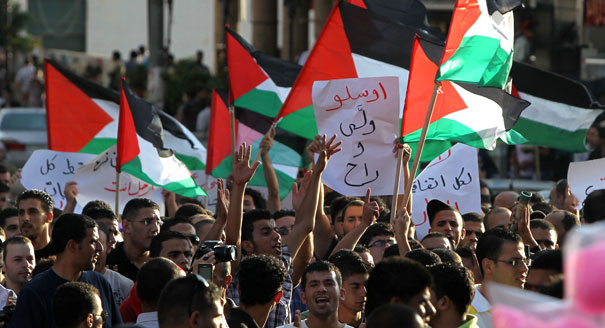
If Kerry’s proposal doesn’t include an agreement to eventually end Israeli control of Palestinian territories, then his economic plan simply becomes another iteration of a failed strategy.
Source: Al-Hayat
The Middle East has fully occupied U.S. Secretary of State John Kerry of late. Having visited Egypt and Saudi Arabia in the hope of mending U.S. relations with both countries, he then headed to Geneva to take direct part in the P5+1 talks with Iran over its nuclear program. Kerry also found time in between to meet Palestinian President Mahmoud Abbas and Israeli Prime Minister Benjamin Netanyahu, and to consult Jordan’s King Abdullah II, in an attempt to reinvigorate faltering Israeli-Palestinian peace negotiations.
The flurry of U.S. diplomatic activity and the prospect of a preliminary P5+1 deal with Iran has prompted optimistic observers to anticipate a diplomatic breakthrough in the Israeli-Palestinian conflict, possibly as early as the beginning of 2014. This would meet the nine-month schedule timetable set by Kerry in Spring 2013 to reach a final status agreement. The same observers believe this will build on the so-called “Clinton parameters” of December 2000 and the Arab Peace Initiative of 2002, and include a plan to develop the Palestinian economy.
Assertive diplomatic intervention by the U.S. might just secure Palestinian-Israeli agreement on a package encompassing political security, and economic components of this sort. Kerry brings personal energy and dedication to the task, but what will remain of his bold initiative if the Palestinian-Israeli peace talks stall completely and a final status agreement is not reached? Netanyahu’s belligerent responses to Kerry’s reminder that “the position of the United States of America on the settlements is that we consider them... to be illegitimate,” and to initial reports of a P5+1 deal with Iran, promise a bruising political battle ahead.If past experience is anything to go by, the U.S. administration will retreat from political confrontation with Netanyahu and his allies in the U.S. Congress and Senate and fall back, instead, on the economic component of Kerry’s plan. Speaking at the World Economic Forum in May 2013, he envisaged investments worth $4 billion that would expand the Palestinian economy by 50 percent in three years, focusing mainly on housing, tourism, and agriculture, reducing unemployment by two-thirds, and raising income levels for a majority of Palestinians.
The problem is that Kerry’s “transformative” economic plan looks all too like the failed “economic growth” strategy that the U.S. and the European Union championed in the occupied Palestinian territories from 1993 onwards. Instead of tackling the political obstacles to a peace agreement head-on, they led the international community in futile pursuit of economic growth that would “deliver tangible benefits to the Palestinian population to reinforce the momentum towards peace,” as the key World Bank framework document explained at the time.
But the U.S. and the European Union were patently unwilling to defend their own economic strategy. Repeated and prolonged Israeli border closures in 1994–1999 choked off Palestinian trade and led to a net drop in per capita income. The IDF’s Defensive Shield and Determined Path operations in Spring 2002 caused $361 million of damages to donor-funded civilian infrastructure and institutions in the West Bank, out of all proportion to the actual scale and intensity of combat, which the donor community subsequently paid to repair. And when the U.S. and the World Bank brokered the Agreement on Movement and Access in November 2005—which epitomized the donor strategy of developing the Palestinian economy within the matrix of Israeli security, territorial, and administrative control—the Israeli security establishment refused to implement it, resulting in its complete and speedy demise.
Despite this dismal track record, the U.S. and the European Union revived the economic growth strategy again in the wake of the Palestinian Authority’s split into two rival governments in the West Bank and the Gaza Strip in June 2007. Yet only two years later, the World Bank concluded that the Palestinian economy was “dramatically failing to fulfill its potential, even in periods of relative stability in the security situation,” and had “hollowed out, with the productive sectors declining and … a growing dependency on donor aid for the prevention of fiscal collapse.” Ironically, despite a sharp increase in donor assistance to the West Bank government of Prime Minister Salam Fayyad, the rival Hamas government in Gaza out-performed its rival in macro-economic indicators in 2010.
The past 20 years have seen international assistance to the Palestinians diverted from its original purposes of economic growth, private sector development, and institution building to humanitarian relief, emergency job generation, and budgetary assistance. The ultimate goals and underlying assumptions of the economic strategy have been almost entirely subverted: the result has not been sustainable development and credible institutions, let alone an end to Israeli occupation and Palestinian statehood in the context of a durable peace treaty with Israel, but rather chronic aid dependence. In its latest report issued on October 2, 2013, the World Bank estimated that Israel’s direct control of 61 percent of the West Bank alone—not counting East Jerusalem or indirect control of the rest of the West Bank and of Gaza—costs the Palestinian economy $3.4 billion a year, or 35 percent of Gross Domestic Product.
The U.S. and the European Union might have salvaged the economic growth strategy by insisting on setting up formal enforcement and dispute settlement mechanisms so as to ensure proper implementation of agreed economic arrangements and to deter violations by enabling the application of appropriate sanctions. But they quickly abandoned the one attempt they made to establish a monitoring mechanism—originally included as part of the U.S.-led international Quartet’s “Roadmap for Peace” of April 2003—in the face of Israeli objections. Time and again, the deeper the crisis in peacemaking, the more doggedly the U.S. and the European Union adhered to their preferred approach.
Kerry offers a glimmer of hope by proposing to integrate the economic component with an agreement that ends Israeli control, albeit incrementally. The outcome depends entirely on maintaining this integral connection. Without it, Kerry’s economic plan simply becomes the fourth tedious iteration of a failed strategy and contributes to an inherently degenerative status quo that it cannot maintain, let alone reverse.
This article was originally published in Arabic in Al-Hayat.

Senior Fellow, Malcolm H. Kerr Carnegie Middle East Center
Yezid Sayigh is a senior fellow at the Malcolm H. Kerr Carnegie Middle East Center in Beirut, where he leads the program on Civil-Military Relations in Arab States (CMRAS). His work focuses on the comparative political and economic roles of Arab armed forces, the impact of war on states and societies, the politics of postconflict reconstruction and security sector transformation in Arab transitions, and authoritarian resurgence.
Recent Work
Yezid Sayigh
Yezid Sayigh
Carnegie does not take institutional positions on public policy issues; the views represented herein are those of the author(s) and do not necessarily reflect the views of Carnegie, its staff, or its trustees.
As talks begin between Washington and Tehran, Beirut has an opening to advance a regional plan for the party’s disarmament.

Michael Young
What is behind Marco Rubio’s announcement that the body is now an international nongovernmental organization?

Zaha Hassan
In an interview, Elizabeth Thompson recalls how the country formulated a liberal constitution in 1920, before being denied by France and Britain.
Michael Young
Policy discussion is ignoring that the Palestinian national project is hollowed out and apartheid is a present danger.

Nathan J. Brown
As negotiations with Iran and Lebanon continue, chaos is at the heart of the Netanyahu government’s calculations.
Michael Young