

Research
- +10
Rosa Balfour, Frances Z. Brown, Yasmine Farouk, …
{
  "authors": [
    "Moisés Naím"
  ],
  "type": "legacyinthemedia",
  "centerAffiliationAll": "",
  "centers": [
    "Carnegie Endowment for International Peace"
  ],
  "collections": [
    "Arab Awakening"
  ],
  "englishNewsletterAll": "",
  "nonEnglishNewsletterAll": "",
  "primaryCenter": "Carnegie Endowment for International Peace",
  "programAffiliation": "",
  "programs": [],
  "projects": [],
  "regions": [
    "North America",
    "Middle East",
    "North Africa",
    "Russia",
    "Eastern Europe"
  ],
  "topics": [
    "Political Reform",
    "Democracy"
  ]
}
Source: Getty
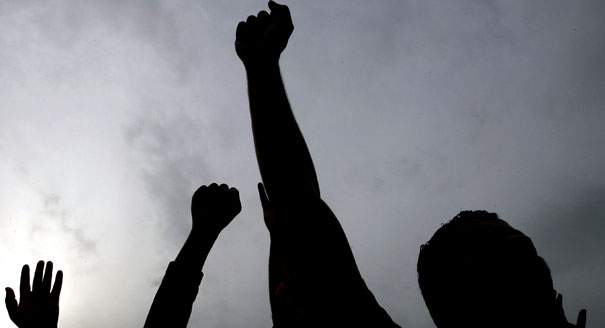
Behind street demonstrations there is rarely an organization capable of following up on protesters’ demands and undertaking the complex political work that produces real change in government.
Source: Atlantic
Street protests are in. From Bangkok to Caracas, and Madrid to Moscow, these days not a week goes by without news that a massive crowd has amassed in the streets of another of the world’s big cities. The reasons for the protests vary (bad and too-costly public transport or education, the plan to raze a park, police abuse, etc.). Often, the grievance quickly expands to include a repudiation of the government, or its head, or more general denunciations of corruption and economic inequality.
Aerial photos of the anti-government marches routinely show an intimidating sea of people furiously demanding change. And yet, it is surprising how little these crowds achieve. The fervent political energy on the ground is hugely disproportionate to the practical results of these demonstrations.Notable exceptions of course exist: In Egypt, Tunisia, and Ukraine, street protests actually contributed to the overthrow of the government. But most massive rallies fail to create significant changes in politics or public policies. Occupy Wall Street is a great example. Born in the summer of 2011 (not in Wall Street but in Kuala Lumpur’s Dataran Merdeka), the Occupy movement spread quickly and was soon roaring in the central squares of nearly 2,600 cities around the world.
The hodgepodge groups that participated had no formal affiliation with one another, no clear hierarchy, and no obvious leaders. But social networks helped to virally replicate the movement so that the basic patterns of camping, protesting, fundraising, communicating with the media, and interacting with the authorities were similar from place to place. The same message echoed everywhere: It is unacceptable that global wealth is concentrated in the hands of an elite 1 percent while the remaining 99 percent can barely scrape by.
Such a global, massive, and seemingly well-organized initiative should have had a greater impact. But it didn’t. Though the topic of economic inequality has gained momentum in the years since, in practice it is hard to find meaningful changes in public policy based on Occupy’s proposals. By and large the Occupy movement has now vanished from the headlines.
In fact, government responses usually amount to little more than rhetorical appeasement, and certainly no major political reforms. Brazilian President Dilma Rousseff, for example, publicly validated the frustrations of those who took to the streets of her country, and promised that changes would be made, but those ‘changes’ have yet to materialize. The reaction of Turkish Prime Minister Recep Tayyip Erdogan to the protests in his country was more aggressive. He accused the opposition and protesters of plotting a sophisticated conspiracy against him, and tried to block Twitter and YouTube. Earlier this month, Erdogan scored a huge victory in Turkey’s local elections. The same dynamic has played out during demonstrations against violence in Mexico City and corruption in New Delhi: massive marches, scant results.
Why? How can so many extremely motivated people achieve so little? One answer might be found in the results of an experiment conducted by Anders Colding-Jørgensen of the University of Copenhagen. In 2009, he created a Facebook group to protest the demolition of the historic Stork Fountain in a major square of the Danish capital. Ten thousand people joined in the first week; after two weeks, the group was 27,000 members-strong. That was the extent of the experiment. There was never a plan to demolish the fountain—Colding-Jørgensen simply wanted to show how easy it was to create a relatively large group using social media.
In today’s world, an appeal to protest via Twitter, Facebook, or text message is sure to attract a crowd, especially if it is to demonstrate against something—anything, really—that outrages us. The problem is what happens after the march. Sometimes it ends in violent confrontation with the police, and more often than not it simply fizzles out. Behind massive street demonstrations there is rarely a well-oiled and more-permanent organization capable of following up on protesters’ demands and undertaking the complex, face-to-face, and dull political work that produces real change in government. This is the important point made by Zeynep Tufekci, a fellow at the Center for Information Technology Policy at Princeton University, who writes that “Before the Internet, the tedious work of organizing that was required to circumvent censorship or to organize a protest also helped build infrastructure for decision making and strategies for sustaining momentum. Now movements can rush past that step, often to their own detriment.”
There is a powerful political engine running in the streets of many cities. It turns at high speed and produces a lot of political energy. But the engine is not connected to wheels, and so the “movement” doesn’t move. Achieving that motion requires organizations capable of old-fashioned and permanent political work that can leverage street demonstrations into political change and policy reforms. In most cases, that means political parties. But it doesn’t necessarily mean existing parties that demonstrators don’t trust to be change agents. Instead, as I have written elsewhere, we need new or deeply reformed parties that can energize both idealists who feel politically homeless and professionals who are fully devoted to the daily grind of building a political organization that knows how to convert political energy into public policies.
As many have noted, social media can both facilitate and undermine the formation of more effective political parties. We are familiar with the power of social media to identify, recruit, mobilize, and coordinate supporters as well as to fundraise. But we also know that clicktivism and slacktivism undermine real political work by creating the feel-good illusion that clicking “like’’ on a Facebook page or tweeting incendiary messages from the comfort of one’s computer or smartphone is equivalent to the activism that effects change.
What we’ve witnessed in recent years is the popularization of street marches without a plan for what happens next and how to keep protesters engaged and integrated in the political process. It’s just the latest manifestation of the dangerous illusion that it is possible to have democracy without political parties—and that street protests based more on social media than sustained political organizing is the way to change society.

Distinguished Fellow
Moisés Naím is a distinguished fellow at the Carnegie Endowment for International Peace, a best-selling author, and an internationally syndicated columnist.
Recent Work



Rosa Balfour, Frances Z. Brown, Yasmine Farouk, …
Moisés Naím
Carnegie does not take institutional positions on public policy issues; the views represented herein are those of the author(s) and do not necessarily reflect the views of Carnegie, its staff, or its trustees.

The accord represents a pivotal moment in the region to avert a security vacuum in the Gulf.


Azeema Cheema, Mohanad Hage Ali

In an interview, Jason Burke discusses his sweeping account of the “revolutionists” who so shaped the 1970s and early 1980s.

Michael Young

The armed forces champion a form of capitalism that is generating revenue, but its reliance on rent faces diminishing returns, leaving the country with massive sunk costs and deferred returns, deepening dependency on external borrowing.

Yezid Sayigh
There is a disturbing structural parallel between the old global energy economy and the new green transition.

Angie Omar
Understanding how farmers in the Oued Sahel-Soummam Valley grapple with climate change is essential for addressing the paradoxes through which adaptation, operating at both individual and institutional levels, deepens the region’s vulnerability and erodes the social fabric and agrarian identity that once defined life.

Ilyssa Yahmi