

Commentary
In an interview, Ian Lustick and Eli Clifton discuss their new book on why a prominent ally has so much influence in America.
Michael Young
{
  "authors": [
    "Eugene Rumer",
    "Andrew S. Weiss"
  ],
  "type": "legacyinthemedia",
  "centerAffiliationAll": "dc",
  "centers": [
    "Carnegie Endowment for International Peace"
  ],
  "collections": [],
  "englishNewsletterAll": "ctw",
  "nonEnglishNewsletterAll": "",
  "primaryCenter": "Carnegie Endowment for International Peace",
  "programAffiliation": "russia",
  "programs": [
    "Russia and Eurasia"
  ],
  "projects": [],
  "regions": [
    "Russia",
    "Eastern Europe",
    "Ukraine"
  ],
  "topics": [
    "Political Reform",
    "Security",
    "Foreign Policy"
  ]
}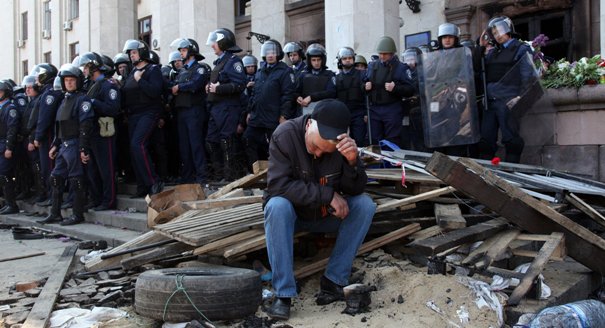
Source: Getty
Ukraine is unraveling, and the situation increasingly resembles a low-grade civil war. International mediation and new approaches are essential to pull Ukraine back from the abyss.
Source: POLITICO Magazine
Ukraine is unraveling before our eyes. The crisis increasingly resembles a low-grade civil war. Senseless violence, often captured on amateur video, is becoming a regular occurrence. A Swiss-led mediation effort launched last week was a hopeful sign, but both Washington and Kyiv have shown only muted enthusiasm. Instead, all parties to the conflict have dug in even deeper. The latest and most worrisome sign was last weekend’s separatist referendum in Donetsk and Luhansk, two cities in southeastern Ukraine, in which thousands of people waited for hours to cast their ballots to split off from the country and to join Russia—anything but to remain under Kyiv’s rule. No doubt illegitimate, the referendum was a clear sign that separatism had put down roots in the region and that any effort to put Ukraine back together is going to be a monumental task for many years to come.
Arguably, the biggest problem now is not Russia with its 40,000 troops massed on the border that may or may not be pulling back, depending on whether one believes Vladimir Putin or Western intelligence reports. The biggest obstacle to walking back from the abyss is chaos. It has become a fact of life in many parts of eastern and southern Ukraine that nobody knows who is in charge, and nobody seems to be in charge. Already, violence in southern and eastern Ukraine has taken well over 100 lives from all sides—pro-Russian, pro-Ukrainian, as well as those who were simply fed up with it all.The revolution in Kyiv and the resulting power vacuum have created opportunities for a multitude of non-state actors to assert themselves in a region notorious for organized crime, oligarchs and corrupt officials. This web of relationships is inherently difficult for outsiders to see, let alone understand. In the free-for-all that eastern and southern Ukraine have become everyone is maneuvering to hedge against uncertainty or take advantage of it. The oligarchs are rumored to be mobilizing against Yuliya Timoshenko, the former prime minister turned presidential contender who is reportedly the true powerbroker behind the interim government, which is packed with her associates. Rightfully, the oligarchs fear her ruthless, take-no-prisoners approach to governing. The separatists are seeking illusory legitimacy from their ill-conceived and illegitimate referendum. The deposed President Victor Yanukovych and his supporters are rumored to be bankrolling the separatists. The government in Kyiv is trying to re-assert its authority in the south and east even though it has admitted multiple times that it cannot do so. And all manner of opportunists, mercenaries, crazies and loose cannons looking for a cause are finding theirs in this tragedy.
The next major milestone on the Ukrainian calendar is the May 25 presidential election. How a nationwide poll can be conducted in this atmosphere is anyone’s guess. The run-up to the election is almost certain to be marred by continued violence; actual voting may be disrupted in crucial regions in eastern and southern Ukraine. On the day after, we take it for granted that the results will be contested, not least by Moscow, whose dim view of the legitimacy of the current interim government was part of the original impetus to hold the election. If anything, the election is likely to serve as a trigger for yet more clashes, not a clean break that pushes Ukraine back from the brink.
The conventional wisdom is that Russia is in control, directing, funding and arming the separatists. After the skillfully executed Russian operation to take over Crimea, it is only logical to conclude that Moscow sees the mess in the south and east as a means of exerting pressure on the government. Understandably, Kyiv and Western governments are worried that Moscow is still planning to invade, occupy and annex the vast region. Indeed, the facts support that theory—telephone intercepts of Russian officers directing local fighters, YouTube videos showing men in camouflage fatigues presenting themselves as Russian officers and Russian volunteers with alleged long records of appearing in trouble spots around the periphery of Russia.But the reality turns out to be more complex and difficult to fit into anyone’s neat theory. There is no doubt that Russia is involved in this unrest. But does it control it? Putin’s appeal to Russian separatists in Donetsk to postpone their referendum fell on deaf ears. His attempt to dial back the tensions may or may not have been genuine, but it is not clear that anyone is listening. The prospect of sending Russian troops into this vortex and annexing a region with some 19 million inhabitants—40 percent of Ukraine’s population—many of them opposed to joining Russia, is a guaranteed recipe for disaster. Putin may be many things, but he is no fool about these risks.
In the meantime, everyone’s position is hardening. Russian propaganda is painting the government in Kyiv as fascists—a charge that is difficult to overlook or walk away from. The Kyiv government, humiliated and hurt by the annexation of Crimea and Moscow’s arrogance, is vulnerable to charges of weakness and surrender from its own citizens. The United States and Europe, having imposed sanctions on Russia, seem eager to keep turning up the pressure as a matter of principle even without any evidence that the strategy is working. Cutting off Russian oil and gas is not an option, unless we are prepared for major disruptions in global energy markets and a substantial hit on economic growth. Imposing personal sanctions on Putin’s inner circle, most of whom have no direct Ukraine policy role and whose holdings have probably been long placed safely out of reach of U.S. sanctions, is mainly a symbolic move that is not likely to deter the Kremlin from further actions to destabilize Ukraine.
In this atmosphere, some form of international mediation is essential even if the odds are against it. What else is to be done?
Step one is to recognize that the situation in eastern and southern Ukraine is now far more complex than a mere Russian ploy.
Step two is to stop digging—at least for the United States and Europe to acknowledge that their sanctions are not going to solve Ukraine’s problems or hold Russia at bay. There will be plenty of time to punish Russia later.
Step three is a hard look at the possibility of postponing the May 25 election. It is difficult to see how it can be credibly conducted in the present circumstances.
Step four should be a no-holds-barred conversation involving all parties to the conflict about the way forward. What Ukraine really needs is a staggered process that postpones elections until after some combination of constitutional reform, parliamentary elections and national-level referendum on power-sharing between Kyiv and the regions. All sides have to be represented in that national conversation, and all of them will have to recognize that no side will come out on top, that compromise will be necessary to avoid the worst possible outcome: an outright civil war in Ukraine, in which all sides will be the losers.
Director and Senior Fellow, Russia and Eurasia Program
Rumer, a former national intelligence officer for Russia and Eurasia at the U.S. National Intelligence Council, is a senior fellow and the director of Carnegie’s Russia and Eurasia Program.

James Family Chair, Vice President for Studies
Andrew S. Weiss is the James Family Chair and vice president for studies at the Carnegie Endowment for International Peace, where he oversees research on Russia, Ukraine, and Eurasia. His graphic novel biography of Vladimir Putin, Accidental Czar: the Life and Lies of Vladimir Putin, was published by First Second/Macmillan in 2022.
Carnegie does not take institutional positions on public policy issues; the views represented herein are those of the author(s) and do not necessarily reflect the views of Carnegie, its staff, or its trustees.

In an interview, Ian Lustick and Eli Clifton discuss their new book on why a prominent ally has so much influence in America.

Michael Young

By failing to address Palestinian representation, the current process is bound to lead to just another temporary arrangement.

Nathan J. Brown

Just look at Iraq in 1991.

Marwan Muasher

A coalition of states is seeking to avert a U.S. attack, and Israel is in the forefront of their mind.
Michael Young

Baku may allow radical nationalists to publicly discuss “reunification” with Azeri Iranians, but the president and key officials prefer not to comment publicly on the protests in Iran.

Bashir Kitachaev