

Commentary
Maha Yahya
{
  "authors": [
    "Maha Yahya"
  ],
  "type": "legacyinthemedia",
  "centerAffiliationAll": "dc",
  "centers": [
    "Carnegie Endowment for International Peace",
    "Malcolm H. Kerr Carnegie Middle East Center"
  ],
  "collections": [],
  "englishNewsletterAll": "menaTransitions",
  "nonEnglishNewsletterAll": "",
  "primaryCenter": "Malcolm H. Kerr Carnegie Middle East Center",
  "programAffiliation": "MEP",
  "programs": [
    "Middle East"
  ],
  "projects": [],
  "regions": [
    "Maghreb",
    "Tunisia",
    "North Africa"
  ],
  "topics": [
    "Political Reform",
    "Security"
  ]
}
Source: Getty
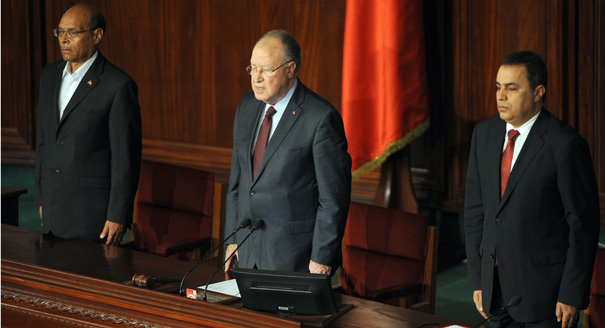
The specter of terrorism in Tunisia may force a postponement of planned parliamentary and presidential elections and derail the country's political transition – the Arab Spring’s only apparent success story.
Source: Mark News
This week, the National Constituent Assembly (NCA) in Tunisia will begin discussing an antiterrorism and money-laundering law. While a clear improvement over the law used in the Ben Ali era, this law opens the door for potential clampdowns on fundamental freedoms and a return to draconian rule.
Debates over this law are happening in the wake of increased terrorist attacks across the country, mainly against the military and security personnel. Recent announcements of the capture of terror cells in the immediate vicinity of the capital Tunis have raised the ante and contributed to public anxiety, creating a sense of urgency around ratifying the new law.
Potential terror activities in major cities, including car bombs and targeted assassinations, such as the murders of Chokri Belaïd (February 2013) and Mohamed Brahmi (July 2013), may force a postponement of planned parliamentary and presidential elections and derail Tunisia’s political transition – the Arab Spring’s only apparent success story.These apprehensions are amplified by developments in neighboring countries and across the Arab region. Libya’s unraveling and evident descent into civil strife, along with the security vacuum that followed Tunisia’s uprising, have increased concerns about a rise in jihadism and illicit arms trade across the country’s porous borders.
Abu Ayyad al-Tunisi, the leader of the recently banned Ansar al-Shariah, is believed to be residing in Tripoli. The concentration of attacks in the Chaambi mountains along Tunisia’s border with Algeria suggests that Algerian extremists may have also entered the fray.
From a regional perspective, there is deep concern about Tunisia’s foreign fighter networks and their potential links with terror cells in Syria and Iraq. Abu Ayyad al-Tunisi’s declared allegiance to the Islamic State in Iraq and Syria (ISIS) following the declaration of its Islamic caliphate raised additional alarm about its possible incursions onto Tunisian soil.
On July 17, in the wake of the biggest Mount Chaambi attack yet, which left 14 soldiers dead and another 20 injured, acting Tunisian Prime Minister Mehdi Jomaa highlighted these concerns when he described Tunisia’s war on terror as one with “regional extensions.”
Terrorism, however, is not the only thing that could derail Tunisia’s political transition. The larger legislative atmosphere and guarantees of fundamental rights and freedoms are also at risk.
While it is a considerable improvement over the 2003 law that former Tunisian President Zine el-Abidine Ben Ali’s regime used to effectively silence all political opposition, there are concerns that the proposed law may be used to undermine freedom of assembly, freedom of speech, and the right to political participation.
Activists and international organizations such as Human Rights Watch (HRW) are worried that the proposed law’s broad and vague definition of terrorism – which Ennahda party MP Kalthoum Badreddine described as a “deliberate choice” – may be used as a tool for political repression and the persecution of political dissent as terrorism.
According to the Human Rights Watch report on the matter, some provisions in the law could give “judges overly broad powers, and curtail lawyers’ ability to provide an effective defense. In addition, the draft does not offer sufficient judicial oversight over police authority to interfere with privacy in counterterrorism operations.” In time, these provisions could open the door for the politicization of legal proceedings under a state of exception.
Moreover, by listing activities that may lead to the disruption of public life, such as blocking traffic or minor acts of violence, the law may be used to criminalize legitimate political or economic dissent. In other words, civilian protests of even non-political issues may be criminalized under this law. This is particularly disconcerting in light of the severe socioeconomic challenges that Tunisia currently faces.
In the same spirit, the recent suspension of close to 150 organizations for alleged connections to terrorist activities undermines fundamental freedoms guaranteed by the constitution including freedom of association. Judicial proceedings guaranteed by the law in this process were not upheld.
Tunisia’s political leaders are showing a united front in the country’s “war on terror” equating it with the country’s transition to democracy. In recent speeches, both Jomaa and Tunisian President Moncef Marzouki have emphasized the need to revisit priorities in order to focus on the success of the democratic transition equating it with the fight against terrorism. They hinted that this may require revisiting the state budget to support military and security apparatus. Rachid al-Ghannouchi, head of the Ennahda party, has also voiced his condemnation of terrorist activities in successive speeches before and after the recent attacks.
This united front comes despite the continued politicization of national security as various political parties trade accusations over responsibility to score electoral points prior to the upcoming elections.
While addressing terrorist activities and control over borders is critical for the security, stability, and development of Tunisia, a sound democratic transition requires more than the proposed antiterrorism law. It needs political consensus around key issues, including concerted investments and development programs in Tunisia’s border areas, an agreement to depoliticize the management of the country’s security sector, and protection of judicial independence. Without the necessary oversight, the fight against terrorism could derail Tunisia’s democratic transition and open the door for the return of the security state in new clothes.

Director, Malcolm H. Kerr Carnegie Middle East Center
Maha Yahya is director of the Malcolm H. Kerr Carnegie Middle East Center, where her research focuses on citizenship, pluralism, and social justice in the aftermath of the Arab uprisings.
Recent Work
Maha Yahya
Maha Yahya
Carnegie does not take institutional positions on public policy issues; the views represented herein are those of the author(s) and do not necessarily reflect the views of Carnegie, its staff, or its trustees.

The armed forces champion a form of capitalism that is generating revenue, but its reliance on rent faces diminishing returns, leaving the country with massive sunk costs and deferred returns, deepening dependency on external borrowing.

Yezid Sayigh

Morocco and Algeria, each in its own way, are having to navigate the global economic fallout of the U.S.-Israeli military campaign against Iran.

Yasmine Zarhloule
This will be the region’s most representative tournament, amid broad changes in its footballing landscape.

Issam Kayssi
Understanding how farmers in the Oued Sahel-Soummam Valley grapple with climate change is essential for addressing the paradoxes through which adaptation, operating at both individual and institutional levels, deepens the region’s vulnerability and erodes the social fabric and agrarian identity that once defined life.

Ilyssa Yahmi
Unless the European Union-led energy transition provides economic development to Algeria, Morocco, and Tunisia, the process may be perceived as a new form of extraction.
Yasmine Zarhloule