

Article
C. Raja Mohan, Darshana M. Baruah
{
  "authors": [
    "C. Raja Mohan"
  ],
  "type": "legacyinthemedia",
  "centerAffiliationAll": "dc",
  "centers": [
    "Carnegie Endowment for International Peace",
    "Carnegie India"
  ],
  "collections": [],
  "englishNewsletterAll": "",
  "nonEnglishNewsletterAll": "",
  "primaryCenter": "Carnegie India",
  "programAffiliation": "SAP",
  "programs": [
    "South Asia"
  ],
  "projects": [],
  "regions": [
    "Asia",
    "South Asia",
    "India",
    "East Asia",
    "China"
  ],
  "topics": [
    "Foreign Policy"
  ]
}
Source: Getty
The rapid rise of Beijing relative to New Delhi has begun to have a powerful impact on India’s regional environment in the subcontinent and beyond.
Source: Indian Express
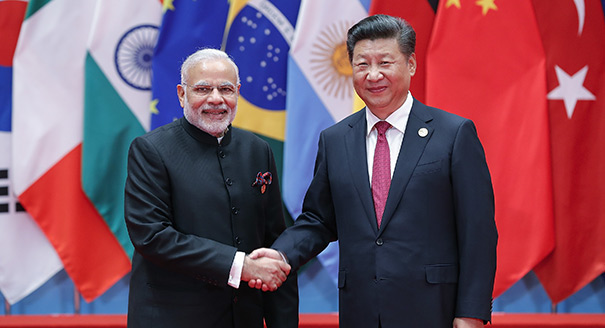
President Xi Jinping’s reluctance at the BRICS summit in Goa this week to yield either on India’s membership of the Nuclear Suppliers Group or its concerns about Pakistan’s support for cross-border terrorism reflects the huge power imbalance that now defines Beijing’s engagement with Delhi. On its part, India must move away from from the idea of parity with China to finding ways to cope with the consequences of the growing gap in material capabilities.
China’s GDP today is nearly five times larger than that of India ($11.4 trillion versus $2.2 trillion). China’s annual defence budget is more than three times that of India ($150 billion to $48 billion). Although India now has a higher annual rate of economic growth than China (7.6 per cent versus 6.9 per cent), it will be a long while before India can close the gap. Meanwhile, the rapid rise of Beijing relative to Delhi has begun to have a powerful impact on India’s regional environment in the Subcontinent and beyond.
One material manifestation was visible last week when Xi stopped over in Dhaka on his way to the BRICS summit at Goa. Xi signed multiple agreements with Bangladesh for investments worth more than $25 billion. That stands in contrast to the $2 billion that Prime Minister Narendra Modi offered Bangladesh during his last visit there. The intangible effects of China’s rise are manifold and express themselves in the size and quality of diplomatic presence, economic influence, political clout, and military engagement. Whether one likes it or not, China’s footprint in the Subcontinent grows at India’s expense.
Huge gap in material indices, however, does not necessarily mean India will have to throw up its hands. There are always options to deal with such imbalance. Consider, for example, Islamabad’s declining position vis a vis Delhi. India’s GDP is now nearly 10 times larger than that of Pakistan which now stands at around $280 billion. That has not stopped Islamabad from challenging India’s influence in the region and beyond.
Since the Partition, Pakistan always sought to balance the larger sibling by aligning with other powers. If the US and the West were preferred partners in the Cold War, China now dominates Pakistan’s calculus. China has even a longer tradition of power balancing. When it faced problems with a superior Soviet Russia on its northern frontiers, China drew close to the United States. Mao told the developing world in the 1970s that “Soviet social imperialism” was a bigger threat than the more familiar “Western imperialism”. If China used ideology to justify its power politics, India has often allowed ideological principles to trump the sensible pursuit of realpolitik. Despite its frequent problems with Beijing, Delhi proclaimed that its China policy will not abandon the special notions of Asian solidarity, Panchsheel and the long-term commitment to building a non-Western global order.
This often resulted in ceding the few strategic leverages that India had with China. When the US was trying to isolate China in the 1950s, India insisted that Beijing should be allowed to take its permanent seat in the United Nations Security Council. In the 1990s, Delhi barely bargained with Beijing, as China sought entry into the World Trade Organisation and had to get individual support from all members of the WTO.
As China began to build its own multilateral institutions over the last two decades including the Shanghai Cooperation Organisation, New Development Bank under the BRICS forum, and the Asian Infrastructure Investment Bank, Delhi jumped on the bandwagon with great alacrity.
Having dreamt an expansive multilateral vision with China, Delhi is now forced to stomach the facts that Beijing does not support India’s permanent membership of the UNSC, has actively prevented Delhi’s entry into the Nuclear Suppliers Group and blocks the consensus on Pakistan-based terrorist Masood Azhar. On top of it all, Beijing cheerily explains all this away by evoking the “multilateral principles of consensus and consultation”.
The problem is rooted in the fact that ideology has long dominated Delhi’s China policy. Beijing, in contrast, has never stopped seeing India through the prism of power politics. Consider for example China’s approach to Pakistan. While Delhi constantly worries that its friendly ties to America might upset Beijing, China has had no such problem with Pakistan’s enduring military partnership with the United States. Pakistan’s formal membership of CENTO and SEATO in the 1950s or its more recent status as a “major non-NATO ally” of America has not affected Beijing’s “all-weather partnership” with Islamabad. China has never hidden its resentment against India’s claims to South Asian primacy. Its relationship with Pakistan was part of a calculated effort to undermine what it sees as “India’s hegemony” over the Subcontinent.
With far more sweeping capabilities today, Beijing can and will vigorously contest the notion that South Asia and the Indian Ocean are part of Delhi’s natural sphere of influence. Delhi can respond effectively to Beijing’s challenge only by redoing the equation between power and principle. It could begin by learning from China on how to put the principle of power above the presumed power of principle.
This article was originally published in the Indian Express.
Former Nonresident Senior Fellow, Carnegie India
A leading analyst of India’s foreign policy, Mohan is also an expert on South Asian security, great-power relations in Asia, and arms control.
Recent Work

C. Raja Mohan, Darshana M. Baruah


Alexander Gabuev, Paul Haenle, C. Raja Mohan, …
Carnegie does not take institutional positions on public policy issues; the views represented herein are those of the author(s) and do not necessarily reflect the views of Carnegie, its staff, or its trustees.

A coalition of states is seeking to avert a U.S. attack, and Israel is in the forefront of their mind.

Michael Young

Baku may allow radical nationalists to publicly discuss “reunification” with Azeri Iranians, but the president and key officials prefer not to comment publicly on the protests in Iran.

Bashir Kitachaev

The country’s leadership is increasingly uneasy about multiple challenges from the Levant to the South Caucasus.

Armenak Tokmajyan
The countries of the region have engaged in sustained competition that has tested their capacities and limitations, while resisting domination by rivals. Can a more stable order emerge from this maelstrom, and what would it require?

Hamza Meddeb, Mohamed Ali Adraoui
As Washington reduces its presence in the country, the success of its withdrawal and continued containment of the Islamic State will hinge on adopting an approach of flexible oversight built around three priorities, as well as balancing Turkish and Israeli red lines.


Kheder Khaddour, Issam Kayssi