

Other
Michael D. Swaine
{
  "authors": [
    "Michael D. Swaine"
  ],
  "type": "other",
  "centerAffiliationAll": "dc",
  "centers": [
    "Carnegie Endowment for International Peace"
  ],
  "collections": [],
  "englishNewsletterAll": "asia",
  "nonEnglishNewsletterAll": "",
  "primaryCenter": "Carnegie Endowment for International Peace",
  "programAffiliation": "AP",
  "programs": [
    "Asia"
  ],
  "projects": [],
  "regions": [
    "East Asia",
    "China"
  ],
  "topics": [
    "Security",
    "Foreign Policy"
  ]
}
Source: Getty
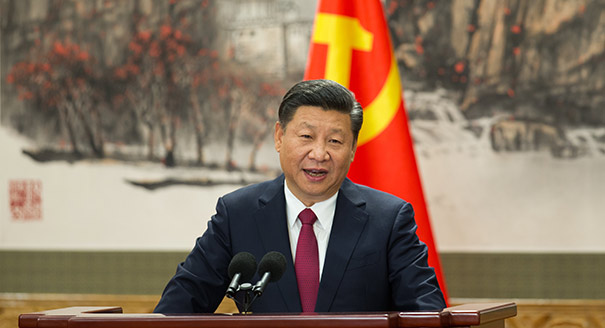
Foreign policy goals addressed at the 19th Party Congress confirm the end of China’s “hide and bide” period and demonstrate its growing interest in becoming a more influential player on the world stage.
Source: China Leadership Monitor
The 19th National Congress of the Communist Party of China was held October 18-24, 2017. Although party congresses normally do not address Chinese foreign policy in any detail, they nonetheless have invariably provided assessments of the external environment, descriptions of China’s development goals, and a summary of broad initiatives and priorities relating to foreign and defense policy since at least the early eighties.1 The 19th Party Congress was no exception. Indeed, it offered some very significant statements that not only reaffirmed great continuity in many elements of Chinese foreign policy under the reforms, but also struck some new and controversial themes.2 All of these elements were primarily contained in the Central Committee work report delivered by Chinese Communist Party (CCP) General-Secretary Xi Jinping on October 18.3
Given their obvious relevance to the future foreign policy orientation and behavior of the People’s Republic of China (PRC) over the next five years, and probably beyond, such 19th Party Congress statements have understandably generated a considerable amount of attention among leading Chinese officials, scholars, and policy analysts. While generally agreeing on and applauding the main foreign policy features of the Party Congress, these Chinese observers have also at times chosen to notably emphasize different elements and offer differing (and often sharper) implications of those features for overall PRC foreign policy, and for the United States.
This article first presents a brief overview of the foreign policy contents of the 19th Party Congress divided into three areas: 1) the overall features of the global and Asian diplomatic, economic, and security environment; 2) China’s basic national development goals and achievements of direct relevance to foreign policy; and 3) the country’s major foreign and defense policy principles, initiatives, and priorities. This is followed by a summary of Chinese observations and assessments regarding those contents and other issues relating to PRC foreign policy emanating from the Party Congress. As usual, the summary distinguishes between authoritative and non-authoritative Chinese views.4 The article ends with some concluding observations.
This article will be published by China Leadership Monitor.
1 Michael D. Swaine, “The 19th Party Congress and Chinese Foreign Policy,” Carnegie Endowment for International Peace, October 16, 2017, http://carnegieendowment.org/2017/10/16/19th-party-congress-and-chinese-foreign-policy-pub-73432.
2 Chris Buckley and Keith Bradsher, “Xi Jinping’s Marathon Speech: Five Takeaways,” New York Times, October 18, 2017, https://www.nytimes.com/2017/10/18/world/asia/china-xi-jinping-party-congress.html?_r=0; and Rush Doshi, “Xi Jinping just made it clear where China’s foreign policy is headed,” Washington Post, October 25, 2017, https://www.washingtonpost.com/news/monkey-cage/wp/2017/10/25/xi-jinping-just-made-it-clear-where-chinas-foreign-policy-is-headed/?utm_term=.1694f3b2be0f.
3 “Full text of Xi Jinping’s report at 19th CPC National Congress,” China Daily, November 4, 2017, http://www.chinadaily.com.cn/china/19thcpcnationalcongress/2017-11/04/content_34115212.htm.
4 Several types of PRC sources are considered authoritative in the sense of explicitly “speaking for the regime.” Authoritative statements include, in descending order of authority, PRC government and CCP statements, Ministry of Foreign Affairs (MFA) statements, MFA spokesperson statements, and MFA daily press briefings. Many types of low-level commentary and signed articles appearing in a wide variety of PRC and Hong Kong media convey notable yet decidedly non-authoritative views. Such articles appear in the PRC government news service (Xinhua), CCP and PLA newspapers, the Hong Kong–based (and People’s Daily–owned) Global Times (环球时报), and many minor PRC and Hong Kong newspapers and academic publications. See Michael D. Swaine, “Chinese Views and Commentary on Periphery Diplomacy,” China Leadership Monitor 44 (Summer 2014), 28.
Several types of usually homophonous, bylined articles appearing in People’s Daily are considered non-authoritative. A major example of this is articles using the byline “Zhong Sheng” (钟声). See Michael D. Swaine, “Chinese Views on the South China Sea Arbitration Case between the People’s Republic of China and the Philippines,” China Leadership Monitor 51 (Fall 2016), 2.

Former Senior Fellow, Asia Program
Swaine was a senior fellow at the Carnegie Endowment for International Peace and one of the most prominent American analysts in Chinese security studies.
Recent Work
Michael D. Swaine
Michael D. Swaine
Carnegie does not take institutional positions on public policy issues; the views represented herein are those of the author(s) and do not necessarily reflect the views of Carnegie, its staff, or its trustees.

In an interview, Ian Lustick and Eli Clifton discuss their new book on why a prominent ally has so much influence in America.

Michael Young

By failing to address Palestinian representation, the current process is bound to lead to just another temporary arrangement.

Nathan J. Brown

Just look at Iraq in 1991.

Marwan Muasher

A coalition of states is seeking to avert a U.S. attack, and Israel is in the forefront of their mind.
Michael Young

Baku may allow radical nationalists to publicly discuss “reunification” with Azeri Iranians, but the president and key officials prefer not to comment publicly on the protests in Iran.

Bashir Kitachaev