

Commentary
Just look at Iraq in 1991.
Marwan Muasher
{
  "authors": [
    "James L. Schoff",
    "Sugio Takahashi"
  ],
  "type": "other",
  "centerAffiliationAll": "dc",
  "centers": [
    "Carnegie Endowment for International Peace"
  ],
  "collections": [
    "The United States and Japan in Asia"
  ],
  "englishNewsletterAll": "asia",
  "nonEnglishNewsletterAll": "",
  "primaryCenter": "Carnegie Endowment for International Peace",
  "programAffiliation": "AP",
  "programs": [
    "Asia"
  ],
  "projects": [],
  "regions": [
    "East Asia",
    "Japan"
  ],
  "topics": [
    "Security",
    "Foreign Policy"
  ]
}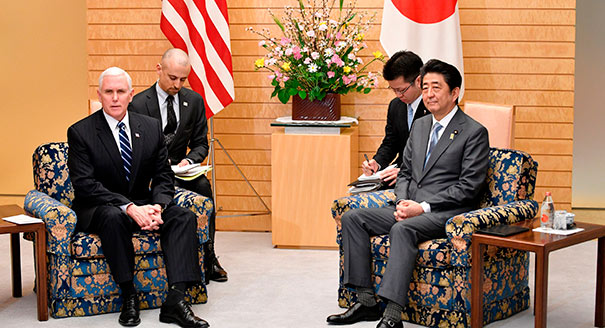
Source: Getty
Japan’s national security is protected first and foremost by the U.S.-Japan alliance and its deterrence power. Robust deterrence is a national imperative for both countries because it minimizes the prospect for conflict and maintains access and influence to preserve an open economic system
Source: Sasakawa Peace Foundation
Japan’s national security—together with vital U.S. security and economic interests in Asia—are protected first and foremost by the U.S.-Japan alliance and its deterrence power. Robust deterrence is a national imperative for both countries because it minimizes the prospect for conflict and maintains access and influence to preserve an open economic system. It also provides public goods in the Asia-Pacific region and around the world. This long-held allied strength is diminishing, however, challenged by North Korean and Chinese military advances. Renewing deterrence strength is in both countries’ national interests and should be a high priority.
Deterrence in the U.S.-Japan alliance context has long been described as “extended deterrence” (i.e., the United States “extends” its deterrence to Japan), rather than a truly shared activity. A deteriorating regional security environment, however, together with certain Japanese legal reforms and military investments suggest that a more integrated form of “alliance deterrence” is possible.1
In recent years, Japan’s involvement in alliance deterrence has expanded across multiple domains and potential phases of conflict. Japan has increased its ability to exercise a limited form of collective self-defense (based on 2015 security legislation), invested in substantial remote island and missile defenses, and expanded the Coast Guard’s essential role in so-called gray zone situations. If Japan decides to develop some kind of conventional counter-strike capability in the future, it will be another important factor in the alliance deterrence equation.
All of these developments—and possibly other measures—add potential deterrence power (and complexity) to alliance security cooperation. Their implementation should be considered carefully, in order to maximize effectiveness without stimulating a vicious cycle of countermoves by neighboring nations that could undermine the overall goal of enhancing security. This memo assesses emerging challenges to allied deterrence and recommends policies and actions to preserve both countries’ interests and regional stability.
North Korea’s nuclear and missile development and China’s military modernization and maritime assertiveness pose new challenges. Since the end of the Cold War, Japan and the United States shared a strategic approach to North Korea and China. Both countries sought a diplomatic solution to denuclearize North Korea while developing missile defenses and enhancing the credibility of extended deterrence. For China, the allies tried to “shape” China into a responsible major power while hedging against other possibilities. But results have been disappointing. North Korea will soon deploy an apparently reliable nuclear-armed intercontinental ballistic missile (ICBM) and China is arguably no longer “shapeable” through alliance persuasion, considering its behavior in the East and South China Seas and its ability to rival alliance military power in the region. Alliance hedging is now giving way to alliance management of a long-term strategic competition with China, even as all three countries maintain various common interests.2
The allies should develop an allied strategic approach toward North Korea and China. In order to help prevent a nuclear conflict with North Korea, Japan and the United States should prepare for one. Active containment and risk management is preferable to passive acquiescence to North Korea’s new capabilities, so the alliance will need a stronger deterrence posture to be effective. Cooperation with South Korea and close coordination with the U.S.-South Korea alliance is essential in this regard. For China, the “shape and hedge” strategy should be reconsidered. The notion of “shaping” should become more concrete by reducing China’s assertive options through supporting regional states’ ability and will to resist China’s creeping expansion and to impose costs on China. This new “shaping” effort can be interpreted as a kind of “selective containment,” because it intends to contain certain aspects of China’s assertive behavior. Selective containment will be influenced, of course, by the extent to which neighboring nations are willing to collaborate, and it should be accompanied by sincere efforts to improve relations with Beijing. This requires diplomatic and economic approaches as much as military ones, although this memo focuses primarily on the military deterrence aspects.
This paper was originally published by the Sasakawa Peace Foundation.
1 “Alliance deterrence” is used here to describe the full spectrum of American and Japanese military capabilities to discourage the instigation of armed conflict by others (conventional or nuclear), as well as the credibility of their readiness and willingness to do so on each other’s behalf.
2 Department of Defense, “Summary of the 2018 National Defense Strategy of the United States of America: Sharpening the American Military’s Competitive Edge,” January 2018, available at https://www.defense.gov/Portals/1/Documents/pubs/2018National-Defense-Strategy-Summary.pdf.

Former Senior Fellow, Asia Program
James L. Schoff was a senior fellow in the Carnegie Asia Program. His research focuses on U.S.-Japan relations and regional engagement, Japanese technology innovation, and regional trade and security dynamics.
Sugio Takahashi
Sasakawa Peace Foundation
Sugio Takahashi is chief of policy simulation division at the National Institute for Defense Studies.
Carnegie does not take institutional positions on public policy issues; the views represented herein are those of the author(s) and do not necessarily reflect the views of Carnegie, its staff, or its trustees.

Just look at Iraq in 1991.

Marwan Muasher

A coalition of states is seeking to avert a U.S. attack, and Israel is in the forefront of their mind.

Michael Young

Baku may allow radical nationalists to publicly discuss “reunification” with Azeri Iranians, but the president and key officials prefer not to comment publicly on the protests in Iran.

Bashir Kitachaev

The country’s leadership is increasingly uneasy about multiple challenges from the Levant to the South Caucasus.

Armenak Tokmajyan

The countries of the region have engaged in sustained competition that has tested their capacities and limitations, while resisting domination by rivals. Can a more stable order emerge from this maelstrom, and what would it require?


Hamza Meddeb, Mohamed Ali Adraoui